SKU: P_26-6_22
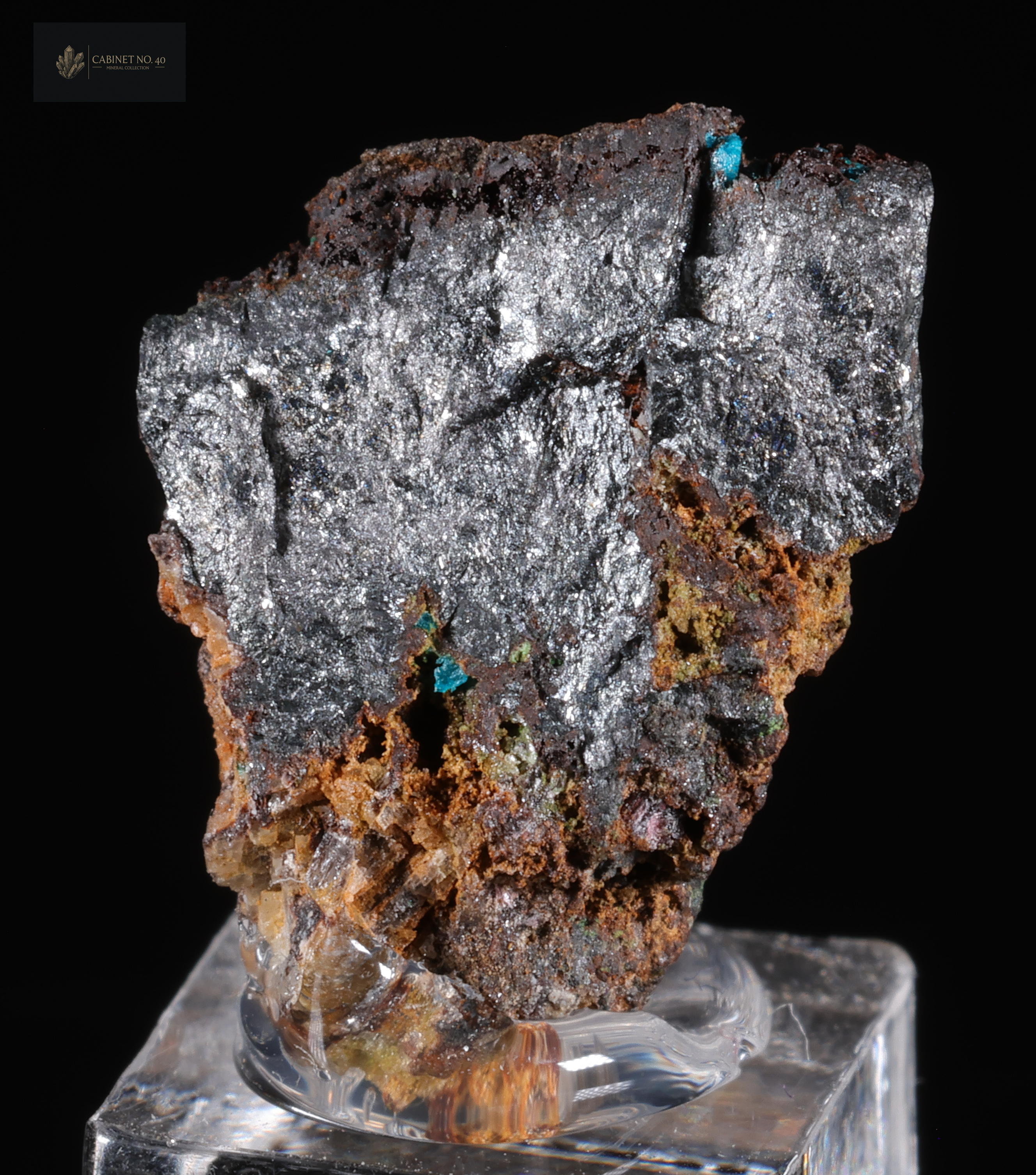
An exceptionally rare specimen of Krutaite - a rare copper selenide, originating from one of the most famous worldwide localities for this type of mineral. Krutaite forms dark gray, almost black aggregates with a distinct metallic luster, aesthetically embedded in the matrix. Main Features: rare copper selenide; dark gray, almost black krutaite aggregates with metallic luster; color contrast between krutaite and reddish-brown matrix; presence of tiny, turquoise inclusions on the specimen's surface. Condition: Good, the specimen is natural, with no visible mechanical damage.
Price: 11 EUR (49 PLN)
Availability: In stock
Location: El Dragon mine, Potosí, Bolivia
Size: 11 x 9 x 15 mm
Weight: 2.5 g
Chemical formula: CuSe₂
Mohs hardness: 3.5
Characteristics Krutaite is a rare copper selenide mineral that typically occurs as very fine, isometric grains or aggregates. Its color is usually gray to black, and fresh fractures may exhibit a metallic luster. Due to its rarity and small size, krutaite does not form spectacular macroscopic specimens. Physical Properties This mineral is characterized by a metallic luster. It is opaque. Its Mohs hardness is approximately 3.5. Krutaite is brittle, and its streak is black. Colors and Varieties Krutaite primarily occurs in gray to black colors. No varieties with different colors or special trade names are known. History and Name Krutaite was discovered in 1972 and named after the Czech mineralogist, Professor Tomáš Kruta (1906-1992), who was a renowned researcher of minerals from Moravia. This mineral was first described from a locality in the Czech Republic. Applications Krutaite has no industrial applications due to its rarity and small quantities. It is solely an object of scientific and collecting interest.
Identification Krutaite is difficult to identify macroscopically due to its fine-grained aggregates and resemblance to other sulfides. Microscopic examination and chemical analysis, especially the presence of selenium, are crucial. It occurs as isometric grains of gray to black color. Distinguishing from Similar Minerals Krutaite can be confused with other selenides or copper sulfides, such as umangite or klockmannite. Differentiation requires precise diffraction and chemical analyses to confirm the presence of selenium as the main anion and the characteristic crystal structure. Crystal Forms Krutaite typically forms isometric grains, often cubic or octahedral in shape, although they are rarely well-formed. It also occurs as fine-grained aggregates and coatings.
Genesis Krutaite is a hydrothermal mineral, formed in low-temperature, selenium-rich hydrothermal veins. It typically forms under reducing conditions, in the presence of copper and selenium, often in association with other selenides. Mineral Associations Krutaite often co-occurs with other selenides, such as umangite (Cu₃Se₂), klockmannite (CuSe), eskebornite (CuFeSe₂), as well as chalcocite (Cu₂S) and other copper sulfides. It can also be found in association with calcite and quartz. Localities The most important krutaite localities are those where it was first described, namely in the vicinity of Nová Ves in Moravia, Czech Republic. Other known localities include the Tsumeb area in Namibia and some selenium deposits in Canada and Russia.
Quality Criteria The quality of a krutaite specimen is primarily assessed based on its rarity, size, and purity of grains, as well as their visibility within the matrix. Fine, well-formed grains in a contrasting matrix are most valued. Authenticity and confirmed provenance of the specimen are also important. Market Prices Due to its rarity and microscopic size, krutaite rarely appears on the collector's market. Prices can vary widely and depend on the size, purity, and aesthetics of the specimen, as well as its origin. Specimens from historical localities may fetch higher prices. Popular Localities The most sought-after specimens come from the type locality, Nová Ves in Moravia, Czech Republic. Other localities, such as Tsumeb, also provide valuable specimens, although they are rarer.
See mineralogical reference for Krutaite in the Knowledge Base →