SKU: S_00153
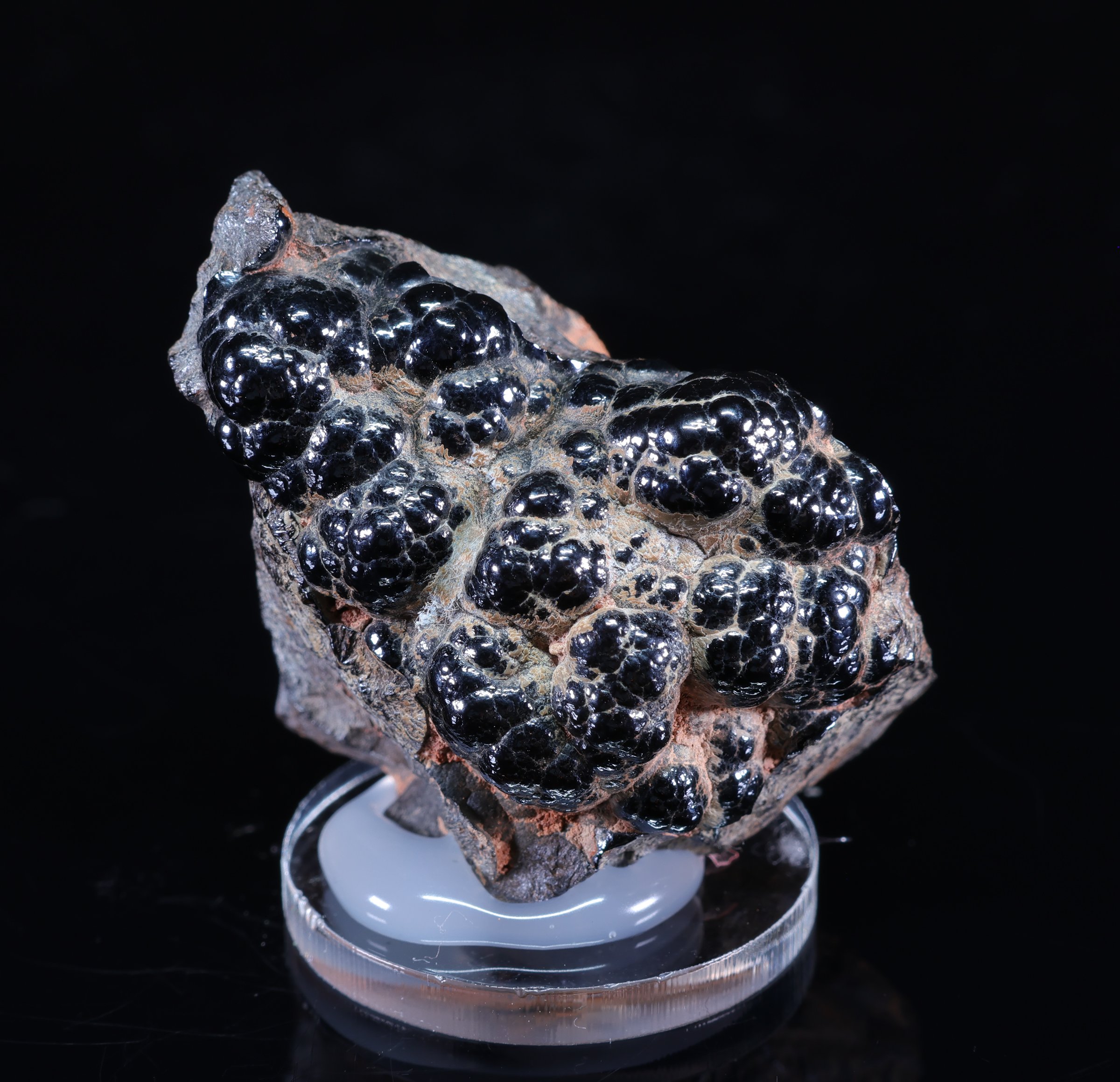
An aesthetic specimen of goethite from the Moroccan region of Taouz. The main part of the specimen consists of black, resinous, and highly lustrous crust with a characteristic kidney-shaped form. The shiny, rounded surface of the iron hydroxide contrasts very well with the raw host rock visible at the base and sides. Main Features: botryoidal form; high, almost mirror-like luster; resinous black; distinct contrast with the rusty matrix. Condition: Very good.
Price: 14 EUR (59 PLN)
Availability: In stock
Location: Tadaout, Taouz, Errachidia Province, Drâa-Tafilalet Region, Morocco
Size: 35 x 25 x 20 mm
Weight: 33 g
Chemical formula: FeO(OH)
Mohs hardness: 5-5.5
Characteristics Goethite is an iron hydroxide mineral, often forming reniform, stalactitic, radial, or fibrous aggregates. It also occurs as compact earthy masses. Its surface can be smooth and lustrous, resembling lacquer, or dull and porous. Goethite crystals are rare, usually acicular or columnar, often striated along their elongation. Physical Properties Goethite has a Mohs hardness of 5-5.5. It exhibits a luster ranging from adamantine to dull, and in the case of earthy varieties, it is earthy. It is an opaque mineral. The density of goethite is approximately 4.27 g/cm³. Colors and Varieties Goethite occurs in colors ranging from brownish-black, through yellowish-brown, to reddish-brown. Earthy varieties are usually yellow or ocherous. No specific commercial varieties are distinguished, but differences in habit and color are important for collectors. History and Name The mineral was named in 1806 in honor of Johann Wolfgang von Goethe, a prominent German poet, dramatist, and scientist who was interested in mineralogy. This name commemorates his contribution to the development of natural sciences. Uses Goethite is an important iron ore, especially in limonite-type deposits. It is also used as a pigment, particularly in the form of ocher, which is a natural dye with a yellow or brown hue.
Identification Goethite can be identified by its characteristic reddish-brown streak, luster (often adamantine or resinous on reniform surfaces), and relatively high density. It often occurs in botryoidal, reniform, or radial forms. Distinguishing from Similar Minerals Goethite is sometimes confused with hematite; however, hematite's streak is reddish-brown, while goethite's is yellowish-brown. From limonite, which is a mixture of iron hydroxide minerals, goethite is distinguished by its crystalline structure and constant chemical composition. Earthy varieties of goethite can be difficult to distinguish from other clay minerals, but the streak is a key diagnostic feature. Crystal Forms Goethite crystals are typically columnar or acicular, often striated parallel to the c-axis. It is more commonly found in radial, fibrous, reniform, stalactitic, botryoidal aggregates, or compact earthy masses.
Genesis Goethite is a secondary mineral, forming in the oxidation zones of iron ore deposits and as a result of the weathering of other iron-bearing minerals. It is a main component of limonite, which forms in swampy and lacustrine environments. It also forms through low-temperature hydrothermal processes. Mineral Associations Goethite often co-occurs with other iron minerals, such as hematite, limonite, siderite, pyrite, as well as with quartz, calcite, and clay minerals. Localities Significant goethite deposits are found worldwide. Important localities include: Germany (Siegen, Eiserfeld), England (Cumbria), France (Alsace), United States (Colorado, Michigan), Australia (Pilbara), and Brazil (Minas Gerais).
Quality Criteria Specimens with well-formed reniform, stalactitic, or radial habits, with distinct luster and intense color, are highly valued. Large, aesthetic aggregates of acicular crystals are also highly sought after. The purity of the mineral and the absence of mechanical damage increase the specimen's value. Popular Localities Particularly prized goethite specimens come from Siegen, Germany, where beautiful, lustrous reniform aggregates are found. Other popular locations include Cumbria, England, known for its radial forms, and some localities in the USA and Brazil, where large specimens occur.
See mineralogical reference for Goethite in the Knowledge Base →