SKU: B_32_0017
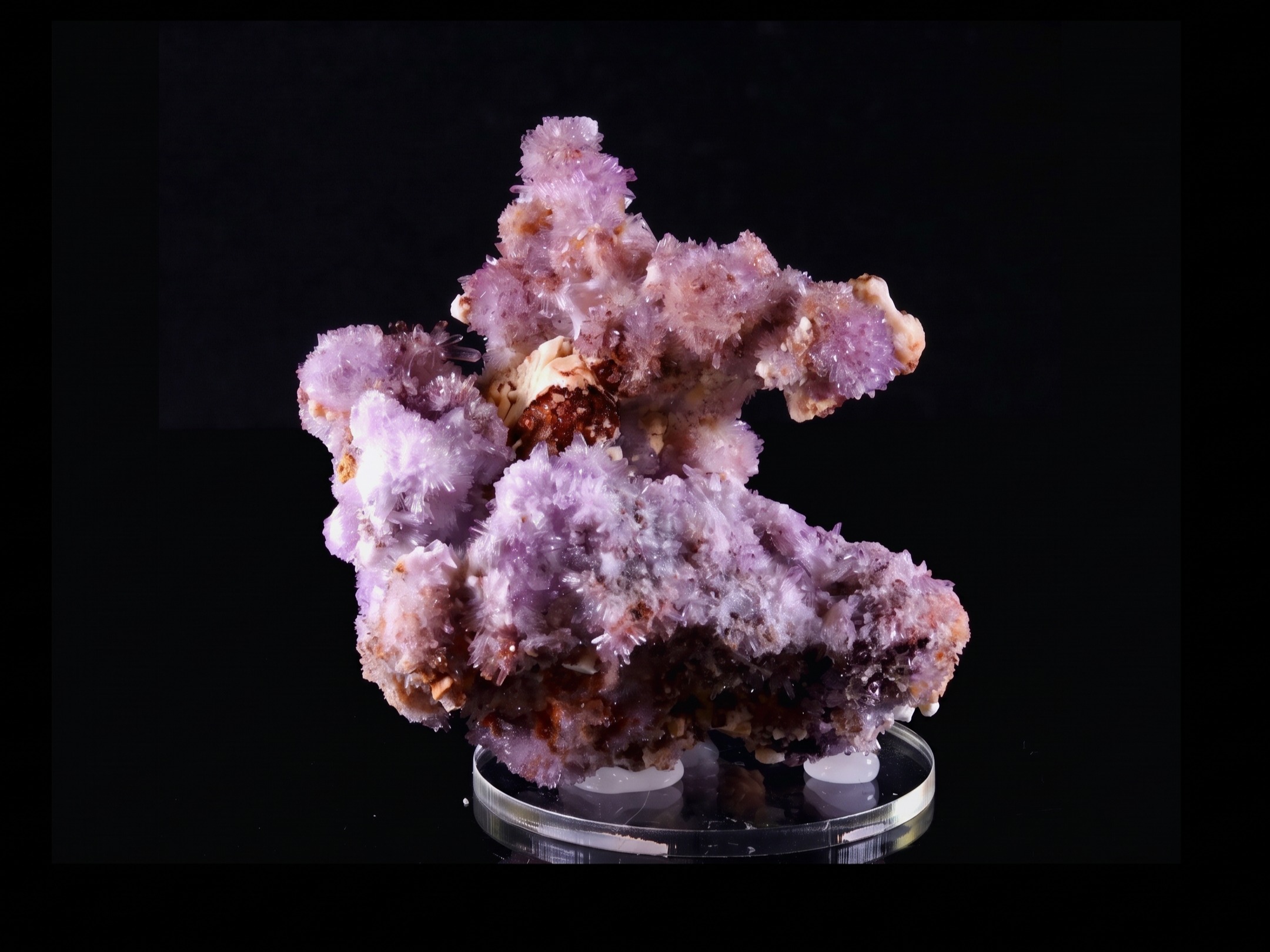
A unique cabinet specimen of creedite with a purple color. This mineral forms exceptionally striking clusters of needle-like crystals that densely cover a contrasting matrix. Main Features: saturated purple color; needle-like, radiating habit; large cabinet size; high aesthetic quality of the specimen. Condition: Very good - for such a brittle and delicate structure, the specimen is well preserved, with no visible significant mechanical damage within the crystals.
Price: 184 EUR (799 PLN)
Availability: In stock
Location: -, China
Size: 73 x 46 x 73 mm
Weight: 200 g
Chemical formula: Ca₃Al₂(SO₄)(F,OH)₁₀·2H₂O
Mohs hardness: 3.5-4
Characteristics Creedite is a calcium aluminum fluorosulfate mineral, typically forming radial aggregates of acicular or prismatic crystals. Specimens often appear as spherical or hemispherical aggregates. Its appearance can be highly varied, from colorless, transparent crystals to specimens with intense colors. Physical Properties Creedite has a Mohs hardness of 4, making it a relatively soft mineral. It exhibits a vitreous luster. It is transparent, allowing for observation of its internal structure. The specific gravity of creedite is 2.713, and its streak is white. This mineral has distinct cleavage along the {100} plane. Colors and Varieties Creedite occurs in many colors, including white, violet, purple, colorless, and orange. In transmitted light, it is colorless. The variety of colors makes it prized by collectors. History and Name Creedite was discovered in 1916. The mineral's name comes from its discovery location – Creed, Colorado, USA. Uses Creedite has no industrial applications. It is a mineral valued exclusively by collectors due to its rarity and aesthetics, especially specimens with intense colors and well-formed crystals.
Identification Creedite can be identified by its characteristic radial aggregates of acicular crystals and vitreous luster. Its Mohs hardness of 4 is also a diagnostic feature. The color, though variable, is often helpful in identification, especially violet or orange hues. Differentiation from Similar Minerals Creedite can be confused with other minerals that form radial aggregates, such as scolecite or natrolite. However, it differs from them in chemical composition and physical properties, such as hardness and density. Optical and chemical analysis allows for unambiguous identification. Crystal Forms Creedite most often occurs as radial aggregates of acicular or prismatic crystals. Crystals are usually small, forming spherical or hemispherical aggregates. Single, well-formed crystals are less common.
Genesis Creedite forms in the oxidation zones of fluorite deposits, often in association with other secondary minerals. It forms as a result of low-temperature hydrothermal processes, where solutions rich in fluorine and sulfates react with calcium and aluminum minerals. Mineral Associations Creedite often co-occurs with fluorite, barite, calcite, limonite, and other secondary minerals of the oxidation zone. Localities The most important creedite localities are in the USA (Creed in Colorado, mines in Arizona), Mexico (La Viesca mine in Coahuila), Russia (Dalnegorsk), and Kazakhstan.
Quality Criteria The most prized creedite specimens are characterized by intense color, especially violet or orange, and well-formed, radial aggregates of crystals. Large, aesthetic aggregates with distinct transparency are particularly sought after. The purity of the specimen and the absence of mechanical damage are also important. Popular Localities The most valued creedite specimens come from Creed in Colorado (USA), the La Viesca mine in Mexico, and Dalnegorsk in Russia. Specimens from these localities often stand out for their exceptional aesthetics and color intensity.
See mineralogical reference for Creedite in the Knowledge Base →