Colorless Topaz with Quartz from Skardu in Pakistan

SKU: S_00132

A classic specimen from the Skardu region, featuring a well-formed, glassy crystal of topaz. This mineral is characterized by a very light color that approaches white with a subtle champagne hue and sharp faces. The topaz is intergrown with a partially transparent crystal of quartz, and at the base, fragments of light matrix with distinct flakes of muscovite and feldspar are visible. Main Features: well-formed topaz crystal; high glassy luster; classic paragenesis with quartz and muscovite; representative location Condition: Good.
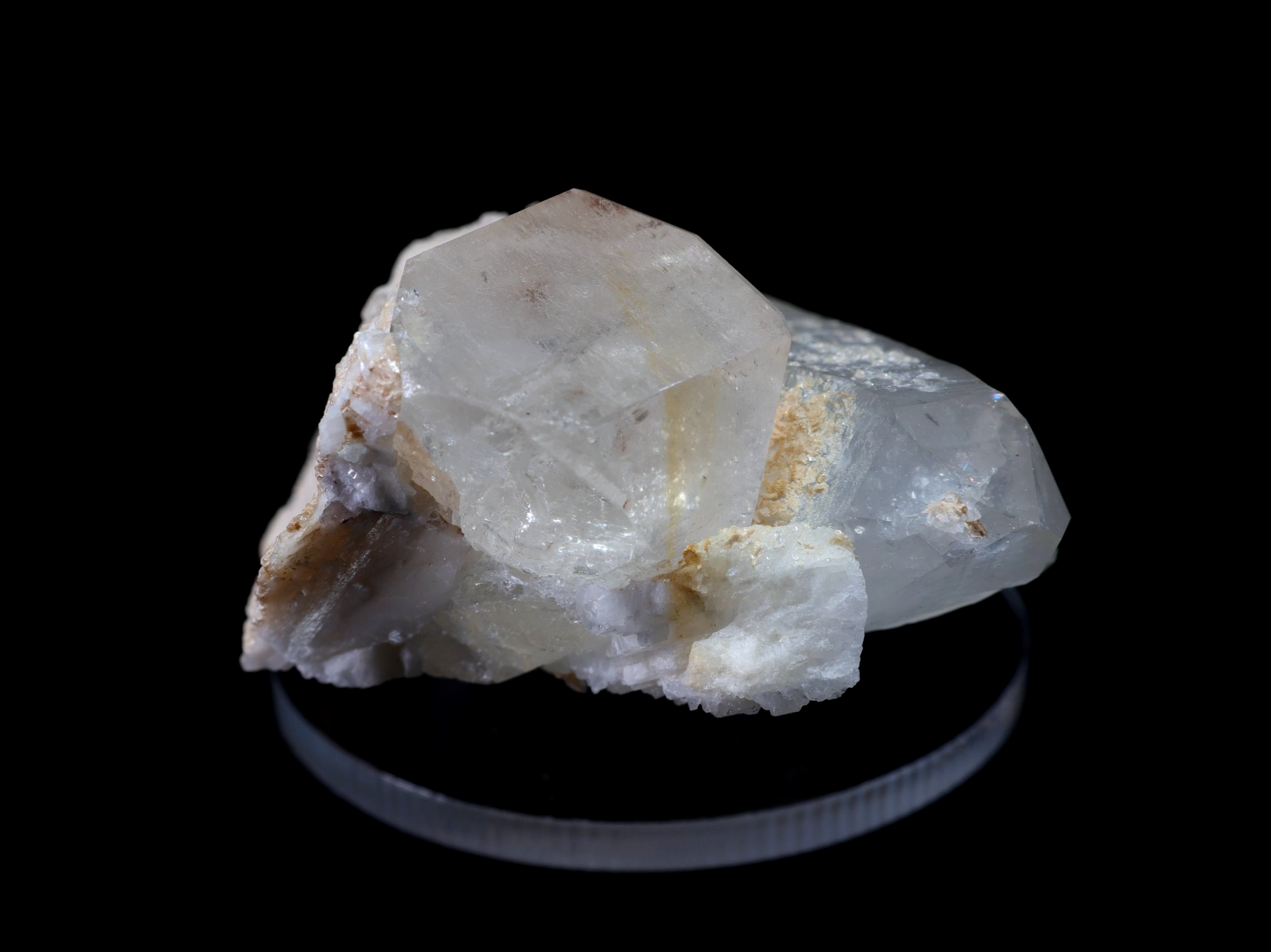
Colorless Topaz with Quartz from Skardu in Pakistan

Price: 34 EUR (149 PLN)

Availability: In stock

Location: Skardu, Gilgit-Baltistan, Pakistan

Size: 53 x 37 x 22 mm

Weight: 52 g

Chemical formula: Al₂SiO₄F₂

Mohs hardness: 8

Mineral group: Topaz Group

Characteristics Topaz is a silicate mineral with the chemical formula Al₂SiO₄F₂. It most commonly occurs as well-formed, prismatic crystals, often terminated pyramidally or bipyramidally. Crystal surfaces can be striated parallel to the elongation axis. Topaz is characterized by a vitreous luster and can be transparent to translucent. It often forms large, flawless crystals, making it a popular jewelry material. Physical Properties Topaz has a hardness of 8 on the Mohs scale, making it one of the harder minerals. It has perfect cleavage along the (001) plane, meaning it can easily cleave in one direction when struck. The density of topaz is approximately 3.4 g/cm³. The luster is vitreous, and the streak is white. It is transparent to translucent. Colors and Varieties Topaz occurs in a wide range of colors, including colorless, white, pale blue, light green, yellow, yellowish-brown, and also red. The color of topaz is often a result of the presence of trace element impurities or structural defects. Some color varieties of topaz have their commercial names, e.g., "Imperial Topaz" refers to topazes with a golden-yellow, orange, or pink color. History and Name The name "topaz" likely comes from the ancient Greek name of the island Topazios (now Zabargad) in the Red Sea, although the minerals found there were probably peridots. Mentions of topaz appear in the texts of ancient civilizations. It was described as a distinct mineral in 1737. Uses Topaz is a valuable gemstone, widely used in jewelry for making rings, necklaces, earrings, and other ornaments. Its hardness makes it resistant to scratches, and the variety of colors allows it to be matched with many styles. Large, clear topaz crystals are also sought after by collectors.

Diagnostic features

Identification Topaz can be identified by its hardness (8 on the Mohs scale), vitreous luster, and characteristic prismatic crystal habit, often with distinct striations on the side faces. Perfect cleavage in one direction is also an important diagnostic feature. Distinguishing from Similar Minerals Topaz is sometimes confused with quartz, beryl (aquamarine, heliodor), or citrine. It is distinguished from quartz by its greater hardness and perfect cleavage. From beryl, it can be distinguished by its higher density and different cleavage. Hardness testing and observation of cleavage are key to distinguishing topaz from similar minerals. Crystal Forms Topaz most commonly forms prismatic, columnar crystals with a rhombic cross-section, terminated by pyramids or bipyramids. Tabular crystals also frequently occur. Topaz aggregates are usually granular or massive.

Formation environment

Genesis Topaz forms mainly in acidic igneous rocks, such as pegmatites and rhyolites, where it crystallizes from hydrothermal solutions rich in fluorine. It also occurs in quartz veins and in cavities and geodes in metamorphic and igneous rocks. It can also be found in alluvial deposits as a secondary mineral resistant to weathering. Mineral Associations Topaz often co-occurs with quartz, feldspar, muscovite, fluorite, cassiterite, wolframite, and beryl. Localities Known topaz deposits are found in Brazil (Minas Gerais), Russia (Urals), Pakistan, Afghanistan, Sri Lanka, USA (Utah, New Hampshire), Mexico, Japan, Australia, and Namibia.

For the collector

Quality Criteria The most prized topaz specimens are those with intense, natural colors, high transparency, and clarity. Large, well-formed crystals with a distinct habit and without fractures are particularly sought after. Specimens on matrix, showcasing the natural growth environment, also increase collectible value. Popular Localities Brazil, especially the state of Minas Gerais, is known for producing high-quality topazes, including rare Imperial Topaz varieties. Pakistan and Afghanistan supply beautiful, often pink and purple topazes. The Russian Urals are a historical source of large crystals.

See mineralogical reference for Topaz in the Knowledge Base →

View product →