Collector's Rhodochrosite from Kalahari

SKU: S_00033

Aesthetic cabinet specimen of rhodochrosite from the legendary N'Chwaning II mine in South Africa, regarded as one of the most important sources of this mineral in the world. The specimen features a saturated pink color. Main Features: iconic location; saturated pink color; distinct contrast with the dark matrix. Condition: Very Good - rhodochrosite is well preserved in natural cavities; matrix solid and stable; specimen raw and natural.
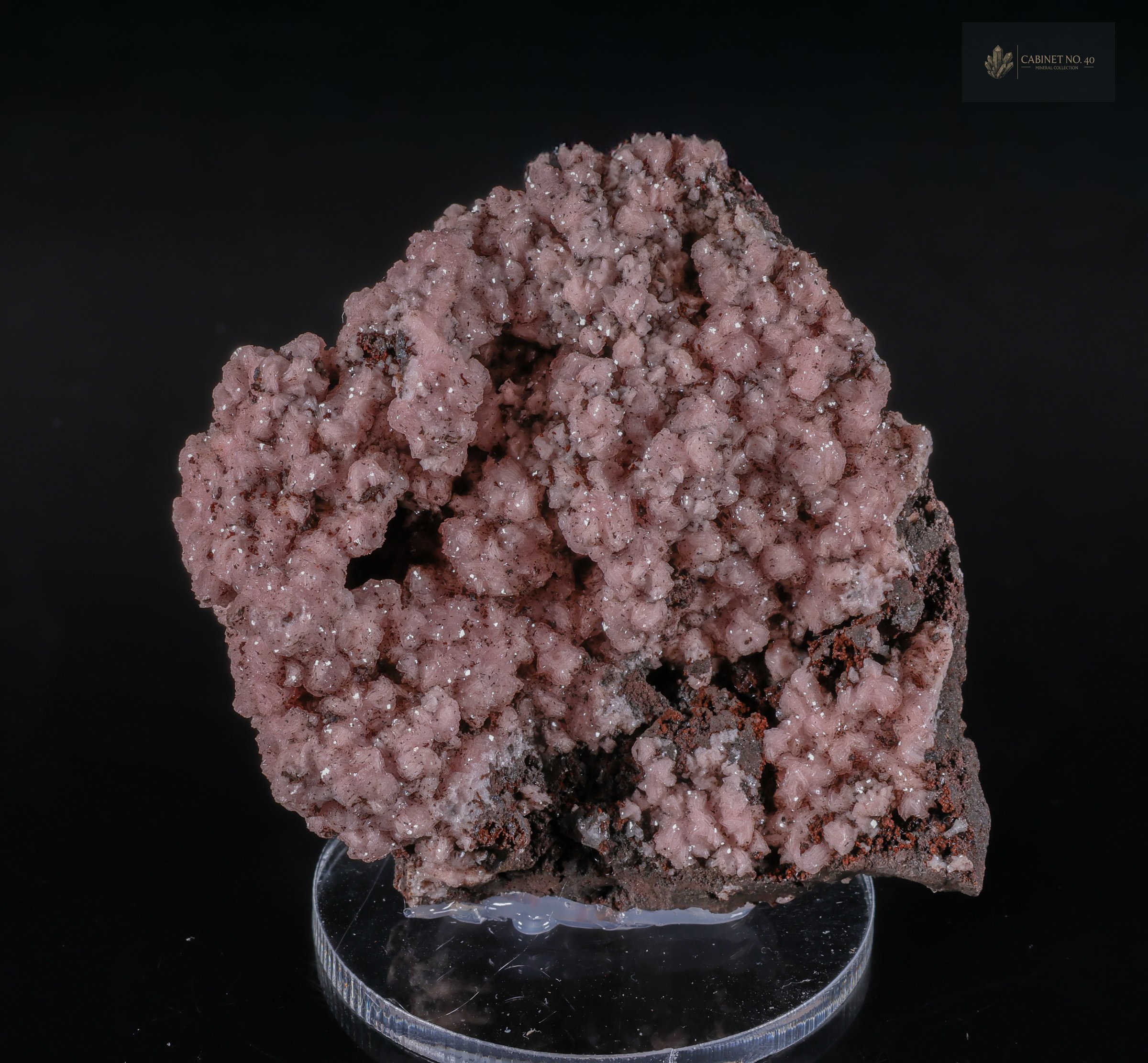
Collector's Rhodochrosite from Kalahari

Price: 135 EUR (589 PLN)

Availability: In stock

Location: NChwaning II Mine, Kuruman, Kalahari, Northern Cape Province, South Africa

Size: 58 x 50 x 25 mm

Weight: 42 g

Chemical formula: MnCO₃

Crystal system: Trigonal

Mohs hardness: 3.5–4.0

Characteristics Rhodochrosite is a manganese carbonate that crystallizes in the trigonal system. Typical rhodochrosite specimens range in color from light pink to intense red, often with white or light bands forming characteristic patterns. It can occur as rhombohedral crystals, but it is much more commonly found as stalactites, stalagmites, concretions, and massive and granular aggregates. Physical Properties Rhodochrosite has a Mohs hardness of 3.5-4, making it a relatively soft mineral. It has a vitreous luster. It is transparent to translucent. The specific gravity of rhodochrosite is approximately 3.7. This mineral exhibits perfect cleavage in three directions, forming rhombohedral fragments. Colors and Varieties The most desired specimens are those with an intense, raspberry-red color. Banded varieties are common, where pink layers alternate with white or gray, a result of the alternating precipitation of manganese carbonate and other minerals such as calcite or barite. Rhodochrosite's color can also take on yellowish-gray, brown, white, or gray hues. History and Name The name rhodochrosite comes from the Greek words "rhodon" (rose) and "chroma" (color), referring to its characteristic pink color. This mineral was described in 1813. It was known earlier, especially in South America, where Inca miners called it "Rosa del Inca" (Inca Rose). Uses Rhodochrosite is a valued ornamental and collector's stone. It is used for making jewelry, sculptures, and decorative objects. High-quality specimens with attractive coloration are sought after by collectors. It is also a source of manganese, although its industrial importance is less than that of other ores of this metal.

Diagnostic features

Identification Rhodochrosite can be identified by its characteristic pink to red color, vitreous luster, and relatively low hardness. It often occurs in banded aggregates, which is a diagnostic feature. It reacts with hydrochloric acid, releasing carbon dioxide, confirming its carbonate nature. Distinguishing from Similar Minerals Rhodochrosite can be confused with rhodonite, which is a manganese silicate. Rhodonite is harder (5.5-6.5 on the Mohs scale) and usually has a more matte luster. Another similar mineral is thulite, which is also harder and has different cleavage. Unlike calcite, rhodochrosite has a more distinct pink color and is heavier. Crystal Forms Rhodochrosite crystallizes in the trigonal system, forming rhombohedral crystals, often with rounded edges. However, it most commonly occurs as massive, granular, botryoidal, reniform, or stalactitic aggregates, often with characteristic concentric bands.

Formation environment

Genesis Rhodochrosite forms in low-temperature hydrothermal veins, often in association with manganese ores. It can also form in the oxidation zones of manganese deposits, where it is a secondary product. It also occurs in some metamorphic and sedimentary rocks, especially in manganese-rich deposits. Mineral Associations Rhodochrosite often co-occurs with other carbonate minerals such as calcite, dolomite, and siderite. It can also be found in association with quartz, fluorite, barite, pyrite, and various manganese minerals such as rhodonite, hausmannite, and braunite. Localities Known rhodochrosite deposits are found in Argentina (Capillitas, Catamarca), where beautiful stalactitic specimens occur. Other important localities include the USA (Sweet Home Mine in Colorado, where some of the best crystals were found), Peru (Uchucchacua), South Africa (Nchwaning Mine), China, Mexico, and Russia.

For the collector

Quality Criteria The most prized rhodochrosite specimens are characterized by an intense, raspberry or red color, good transparency, and distinct, aesthetic banding in the case of stalactitic forms. Large, well-formed crystals are rare and command high prices. The absence of cracks, inclusions, and mechanical damage also increases the value of the specimen. Popular Localities The most sought-after by collectors are crystals from the Sweet Home Mine in Colorado (USA), known for their exceptional color and form. Stalactitic specimens from Argentina (Capillitas) are also highly valued for their unique banded patterns. Deposits in South Africa provide large, well-formed crystals.

See mineralogical reference for Rhodochrosite in the Knowledge Base →

View product →