SKU: A-0201_3-MA
A high-quality specimen of erythrite from the most esteemed global location for this species. The mineral forms dense clusters of sharp, acicular crystals with a deep, saturated color. The crystals are embedded in an elongated cavity within the host matrix, providing them with natural protection and excellent exposure. Main Features: intense color; acicular crystal habit; high luster; classic location; rich cavity filling; ex coll. K.Urbanik. Condition: Very good - the crystals inside the cavity are intact and well-formed.
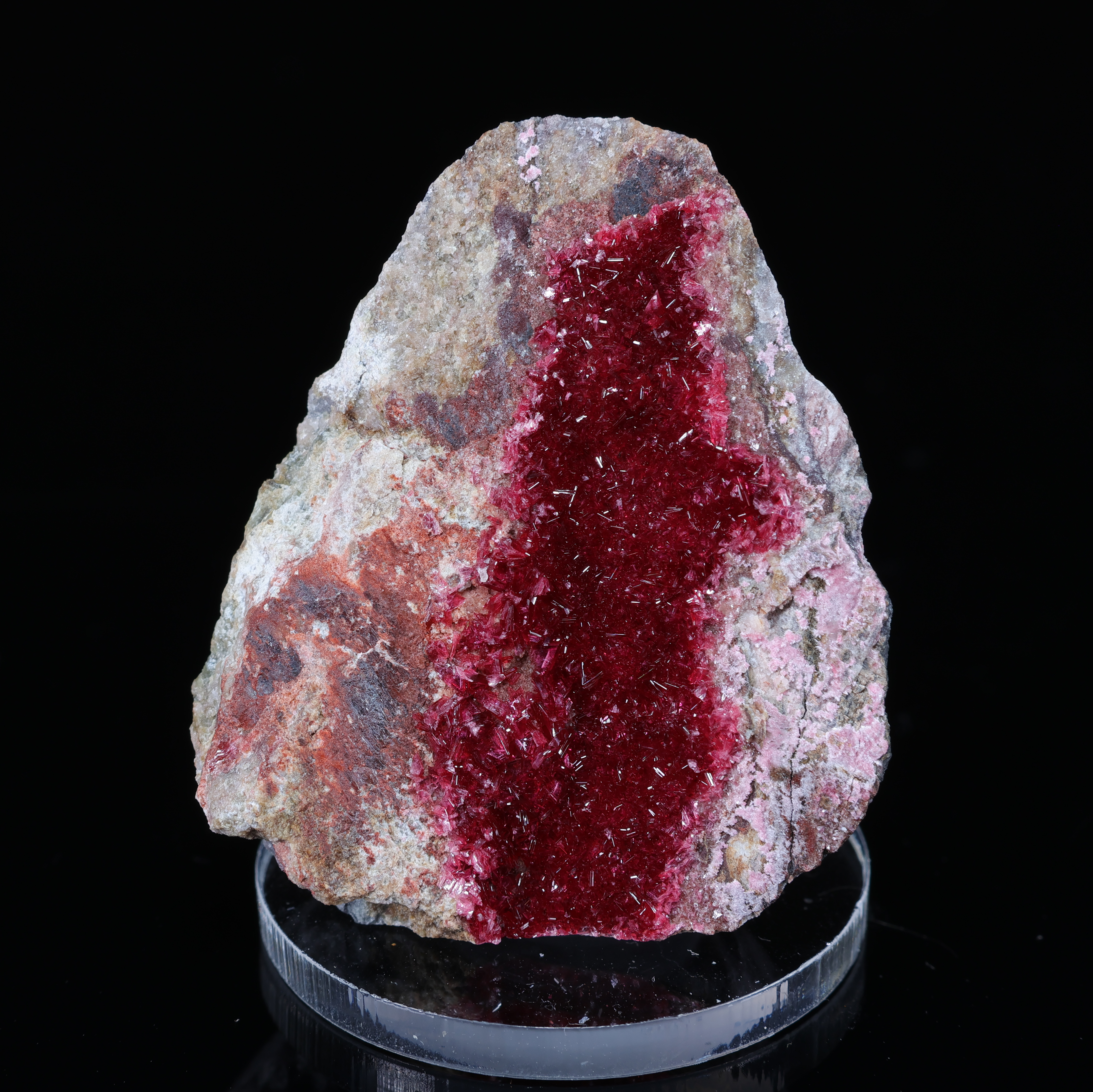
Price: 57 EUR (249 PLN)
Availability: In stock
Location: Bou Azer, Quarzazate Province, Morocco
Size: 40 x 32 x 23 mm
Weight: 25 g
Chemical formula: Co₃(AsO₄)₂·8H₂O
Crystal system: monoclinic
Mohs hardness: 1,5–2,5
Mineral group: Apatite Group Minerals
Rarity: Uncommon
Characteristics Erythrite is a hydrated cobalt arsenate that crystallizes in the monoclinic system. It typically occurs as radial, fibrous, or earthy aggregates, as well as coatings and crusts. Less commonly, it forms well-developed, acicular or prismatic crystals. Its color ranges from crimson to peach-red, pale pink, and even pink, which gives it a distinctive appearance. It is a soft and brittle mineral, easily crumbling. Physical Properties The hardness of erythrite on the Mohs scale is 1.5-2.5, which means it is a very soft mineral, easily scratched with a fingernail. It has perfect cleavage in one direction, which is visible in its structure. The specific gravity is approximately 3.06. The luster of erythrite is pearly on cleavage surfaces, and vitreous or dull on other surfaces in the case of earthy aggregates. The streak is pale pink to pink, lighter than the color of the mineral. Colors and Varieties The typical color of erythrite is shades of pink and red, from delicate pink to intense crimson. The intensity of the color depends on the cobalt content. No specific commercial varieties are distinguished, but differences in crystal habit and color intensity can affect its collector's appeal. History and Name The name erythrite comes from the Greek word "erythros," meaning "red," which refers to its characteristic color. The mineral was first described in 1832 by François Sulpice Beudant. Uses Erythrite has no significant industrial uses due to its rarity and softness. However, it is a valuable mineral for collectors, particularly sought after for its aesthetic color and crystal forms. It also serves as an indicator of the presence of cobalt deposits.
Identification Erythrite can be identified by its characteristic pink to red color, low hardness (can be scratched with a fingernail), and perfect cleavage. It often occurs as radial or earthy aggregates, as well as coatings on other minerals. The streak is pale pink, lighter than the color of the mineral. Distinguishing from Similar Minerals Erythrite can be confused with other pink minerals, such as rhodochrosite or rhodonite. However, its low hardness and characteristic streak distinguish it from these harder minerals. Rhodochrosite has a hardness of 3.5-4 and a white streak, while rhodonite has a hardness of 5.5-6.5 and a white streak. Erythrite is also more brittle. Crystal Forms Erythrite most often occurs as radial, fibrous, or earthy aggregates. Less commonly, it forms well-developed, acicular or prismatic crystals, which are often flattened and elongated along the b-axis. Aggregates can be radial, spherical, or reniform.
Genesis Erythrite is a secondary mineral that forms in the oxidation zones of cobalt and nickel deposits. It forms as a result of the weathering of primary arsenic-bearing cobalt minerals, such as cobaltite (CoAsS) or skutterudite (CoAs₃). Mineral Associations Erythrite often co-occurs with other secondary minerals, such as annabergite (nickel arsenate), cobaltite, skutterudite, as well as quartz, calcite, and other minerals of the oxidation zone. Localities Known occurrences of erythrite are found in Bou Azzer, Morocco, where beautiful, well-formed crystals occur. Other important localities include Schneeberg in Saxony (Germany), Jáchymov in the Czech Republic, Cobalt in Ontario (Canada), and some places in Australia and the United States.
Quality Criteria The most prized erythrite specimens are those with intense, crimson or pink color, well-formed crystals, and large sizes. Color purity, absence of mechanical damage, and aesthetic arrangement of crystals in aggregates also increase their collector's value. Popular Localities The most sought-after erythrite specimens come from Morocco, especially from the Bou Azzer region, where crystals of exceptional quality and color are found. Specimens from Germany and the Czech Republic are also highly regarded by collectors.
See mineralogical reference for Erythrite in the Knowledge Base →