SKU: K-0068_3-RU
A rare mineral from the titanium silicate group, characterized by an outstanding brown-golden metallic luster. The specimen exhibits impressive radial clusters of needle-like crystals, forming so-called 'suns' or stars on a light matrix. The crystals are well-formed, with a distinct structure typical for this location, showing a visible strong luster on the cleavage planes. Main Features: radial clusters; metallic, golden luster; rare titanium silicate; classic location; ex coll. K. Urbanik. Condition: Very good - the radial structures are complete and perfectly visible on the surface of the specimen.
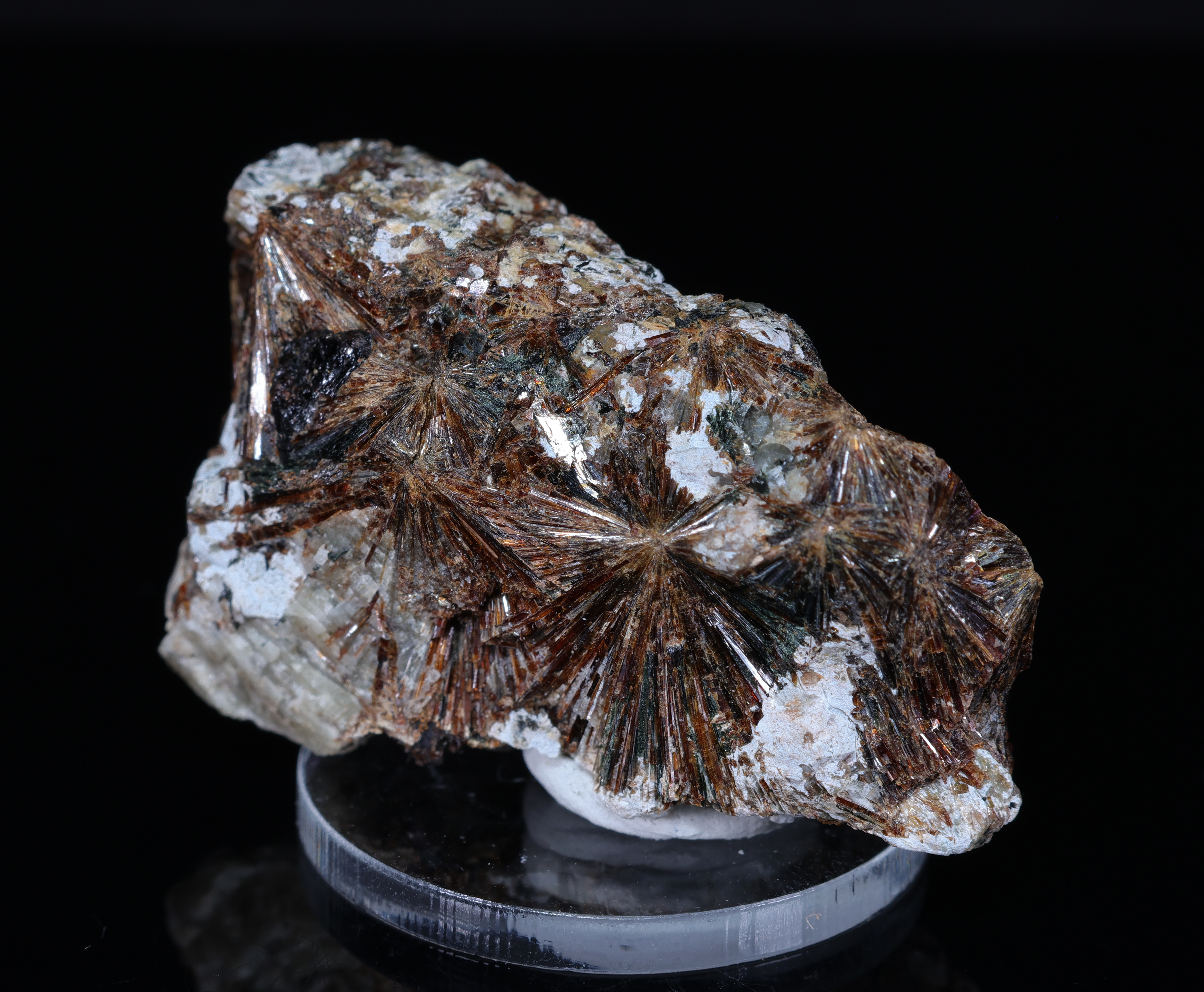
Price: 43 EUR (189 PLN)
Availability: In stock
Location: Mount Sengischorr, Lovozero Massif, Kola Peninsula, Russia
Size: 43 x 28 x 22 mm
Weight: 28.9 g
Chemical formula: (Na,K)₃(Mn,Ti)₂(Si₂O₇)(Si₂O₆)₂O₂(OH)₂F
Crystal system: Monoclinic
Mohs hardness: 4–4,5
Mineral group: Mica Group
Rarity: Uncommon
Characteristics Lamprophyllite is a silicate with a complex chemical composition, belonging to the group of titanium minerals. It most often occurs as platy, bladed, or acicular crystals, which frequently form radial or fibrous aggregates. Its color is usually brown, ranging from light yellowish-brown to dark brown, sometimes with a reddish tint. The surface of the crystals can sometimes be iridescent, which adds to their visual appeal. Physical Properties The hardness of lamprophyllite on the Mohs scale is 2-3, meaning it is a relatively soft mineral. It possesses distinct cleavage, which contributes to the formation of platy forms. The luster is pearly or silky on cleavage surfaces, and vitreous to greasy on fracture surfaces. The mineral is transparent to translucent, and its density is approximately 3.3-3.5 g/cm³. Colors and Varieties The typical color of lamprophyllite is brown, in various shades. No specific commercial or color varieties are widely recognized. History and Name Lamprophyllite was first described in 1894 by the Russian mineralogist W. Worobjew. The mineral's name comes from the Greek words "lampros" meaning "bright" and "phyllon" meaning "leaf," referring to its platy habit and luster. Uses Lamprophyllite has no industrial applications due to its rarity and lack of specific properties that could be exploited. It is solely a collector's mineral, valued for its rarity and the aesthetics of its crystals.
Identification Lamprophyllite can be identified by its characteristic platy or acicular habit, brown color, and pearly or silky luster on cleavage surfaces. Its softness (hardness 2-3 on the Mohs scale) is also a diagnostic feature. Distinguishing from Similar Minerals Lamprophyllite can be confused with other platy minerals such as biotite or phlogopite, but its brown color, pearly luster, and specific occurrence environment (alkaline rocks) help in differentiation. Chemical analysis is the ultimate confirmation of its identity. Crystal Forms Lamprophyllite most often forms platy, bladed, or acicular crystals. They frequently occur as radial or fibrous aggregates, forming characteristic "stars" or "suns" on the surface of the host rock.
Genesis Lamprophyllite is a mineral typical of alkaline rocks, especially nepheline syenites and associated pegmatites. It forms in the late stages of alkaline magma crystallization, under conditions rich in sodium, barium, strontium, and titanium. Mineral Associations It co-occurs with other alkaline minerals such as nepheline, aegirine, arfvedsonite, astrophyllite, eudialyte, as well as microcline and albite. Localities The most important lamprophyllite localities are on the Kola Peninsula in Russia, especially in the Khibiny and Lovozero massifs. Other known occurrences include Greenland (Ilimaussaq complex) and Canada (Mont Saint-Hilaire in Quebec).
Quality Criteria The most prized lamprophyllite specimens are those that exhibit well-formed, large, and aesthetically arranged crystals, preferably in radial aggregates. Intense, uniform brown color and a distinct pearly luster increase collectible value. Specimens on matrix are also highly valued. Popular Localities The most sought-after lamprophyllite specimens come from the Khibiny and Lovozero massifs on the Kola Peninsula in Russia, which are famous for well-formed and aesthetic crystals of this mineral.
See mineralogical reference for Lamprophyllite in the Knowledge Base →