Lamprophyllite
Chemical formula: (SrNa)Ti<sup>4+</sup><sub>2</sub>Na<sub>3</sub>Ti<sup>4+</sup>(Si<sub>2</sub>O<sub>7</sub>)<sub>2</sub>O<sub>2</sub>(OH)<sub>2</sub>
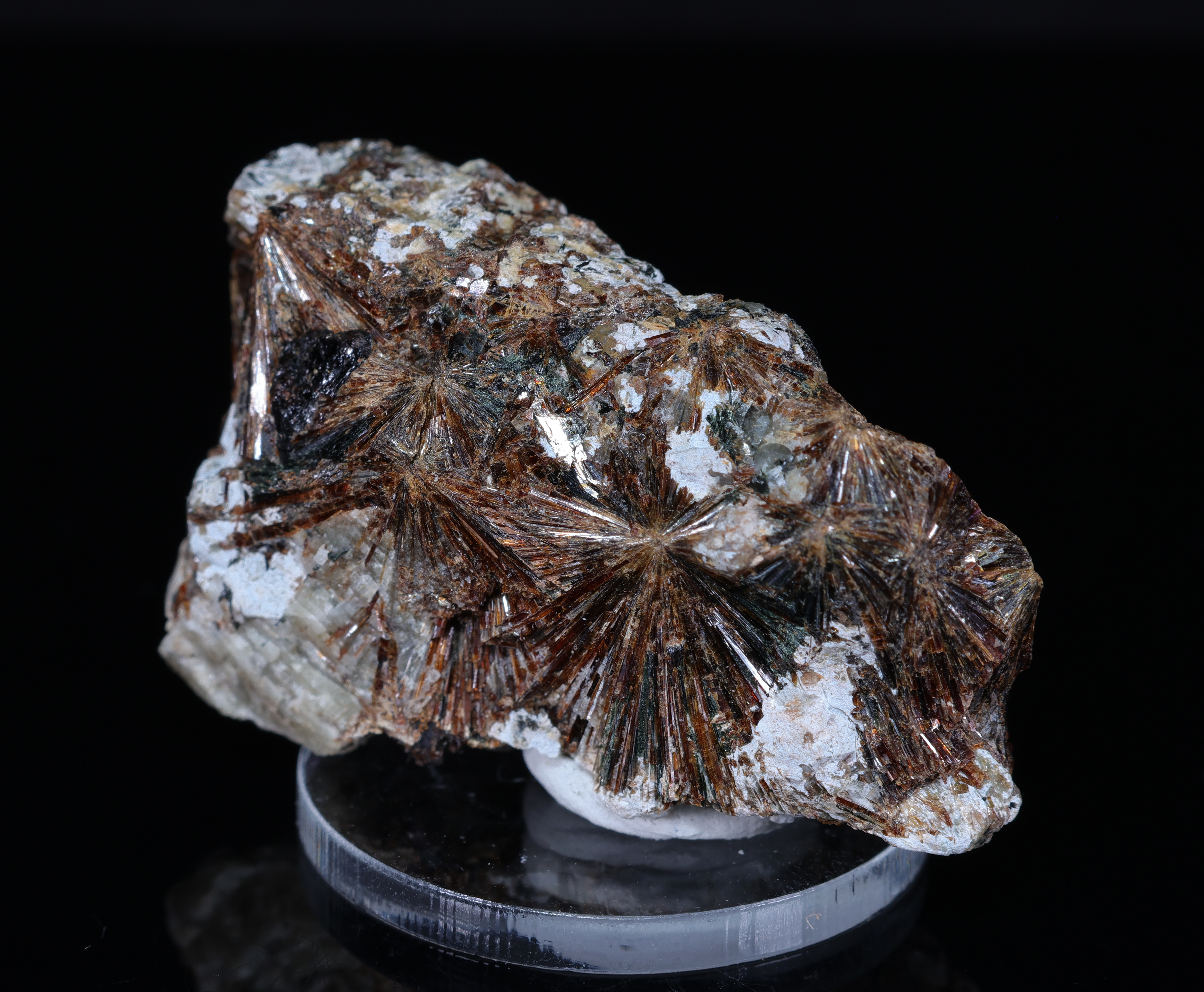
Lamprophyllite is a rare sodium, barium, strontium, and titanium silicate, typically forming platy or acicular crystals with a characteristic brown color.
Properties
- Mohs hardness
- 2-3
- Luster
- Pearly
- Streak
- Pale yellow to brownish yellow
- Density
- 3.3-3.5
- Cleavage
- Perfect on {100}
- Fracture
- Uneven
- Transparency
- Transparent to translucent
- Crystal system
- Monoclinic
Diagnostic features
## Identification Lamprophyllite can be identified by its characteristic platy or acicular habit, brown color, and pearly or silky luster on cleavage surfaces. Its softness (hardness 2-3 on the Mohs scale) is also a diagnostic feature. ## Distinguishing from Similar Minerals Lamprophyllite can be confused with other platy minerals such as biotite or phlogopite, but its brown color, pearly luster, and specific occurrence environment (alkaline rocks) help in differentiation. Chemical analysis is the ultimate confirmation of its identity. ## Crystal Forms Lamprophyllite most often forms platy, bladed, or acicular crystals. They frequently occur as radial or fibrous aggregates, forming characteristic "stars" or "suns" on the surface of the host rock.
Geological environment
## Genesis Lamprophyllite is a mineral typical of alkaline rocks, especially nepheline syenites and associated pegmatites. It forms in the late stages of alkaline magma crystallization, under conditions rich in sodium, barium, strontium, and titanium. ## Mineral Associations It co-occurs with other alkaline minerals such as nepheline, aegirine, arfvedsonite, astrophyllite, eudialyte, as well as microcline and albite. ## Localities The most important lamprophyllite localities are on the Kola Peninsula in Russia, especially in the Khibiny and Lovozero massifs. Other known occurrences include Greenland (Ilimaussaq complex) and Canada (Mont Saint-Hilaire in Quebec).
Rarity
Uncommon
For collectors
## Quality Criteria The most prized lamprophyllite specimens are those that exhibit well-formed, large, and aesthetically arranged crystals, preferably in radial aggregates. Intense, uniform brown color and a distinct pearly luster increase collectible value. Specimens on matrix are also highly valued. ## Popular Localities The most sought-after lamprophyllite specimens come from the Khibiny and Lovozero massifs on the Kola Peninsula in Russia, which are famous for well-formed and aesthetic crystals of this mineral.
Care and storage
## Cleaning Lamprophyllite is a relatively soft mineral, so it requires gentle cleaning. It is best to use a soft brush or paintbrush to remove dust. For heavier soiling, lukewarm water with a small amount of mild soap can be used, followed by thoroughly rinsing the specimen with distilled water and drying it with a soft cloth. ## What to Avoid Avoid using strong chemicals, acids, and solvents, which can damage the mineral's surface. Due to its softness, it should be protected from scratches and impacts. Prolonged exposure to direct sunlight can potentially affect its color, so it is recommended to store it away from intense light. ## Storage Lamprophyllite specimens are best stored in enclosed display cases or boxes lined with soft material to protect them from dust and mechanical damage. It is important to avoid sudden changes in temperature and humidity, which can negatively affect the mineral's stability.