SKU: S_00062
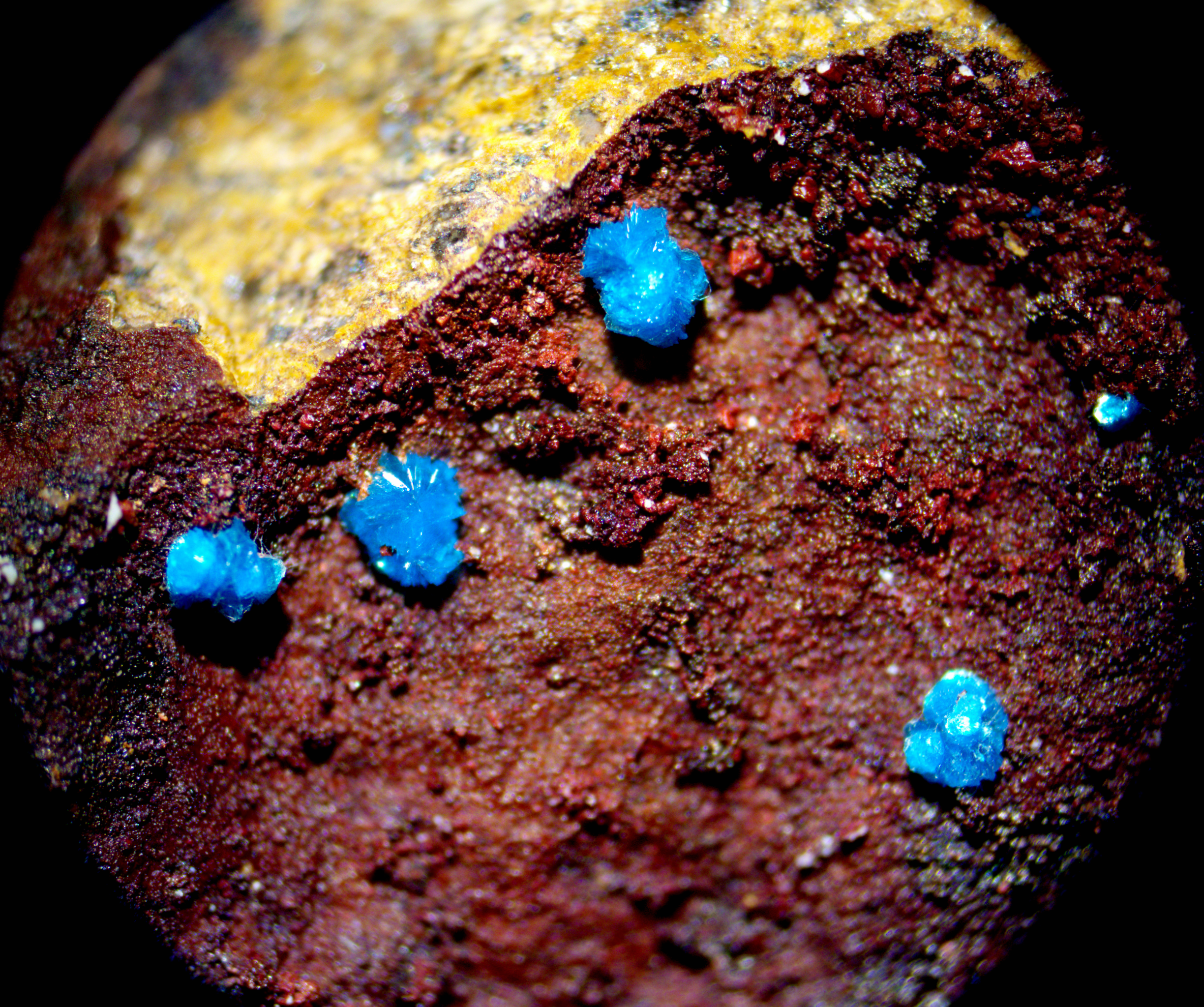
An extremely attractive miniature of a rare copper phosphate, originating from a classic Chilean locality. The specimen features a bright blue color. Sampleite forms distinct, shiny rosettes and crystalline clusters. Main Features: rare phosphate; intense blue color; crystalline rosettes; classic locality; outstanding color contrast. Condition: Very good - the crystalline rosettes of sampleite are completely preserved, with no visible mechanical damage.
Price: 34 EUR (149 PLN)
Availability: In stock
Location: La Farola Mine, Chile
Size: 10 x 20 x 20 mm
Weight: 200 g
Chemical formula: NaCaCu₅(PO₄)₄Cl·5H₂O
Crystal system: Tetragonalny
Mohs hardness: 5
Characteristics Sampleite is a hydrated copper, sodium, and calcium phosphate with chlorine. It typically occurs as radial, fibrous, or lamellar aggregates of tiny crystals, forming intensely blue or blue-green masses. The crystals are often very small, making individual observation without magnification difficult. Physical Properties Sampleite has a Mohs hardness of 4. This mineral is transparent, and its streak is light blue. The specific gravity is 3.2. It exhibits perfect cleavage along {010} and good cleavage along {100} and {001}. Colors and Varieties Sampleite ranges in color from light blue to blue-green. In transmitted light, it is blue. No specific commercial varieties of this mineral are known. History and Name Sampleite was described in 1942. The mineral is named after Charles H. Sample, an American geologist who discovered it in a mine in Arizona. Uses Sampleite has no industrial applications. It is a mineral of interest exclusively to collectors due to its rarity and aesthetic appearance.
Identification Sampleite can be identified by its characteristic, intensely blue or blue-green color and its radial or fibrous crystal habit. Its occurrence in the oxidation zones of copper deposits is also an important diagnostic indicator. Distinguishing from Similar Minerals Due to its color, sampleite can be confused with other blue copper minerals such as azurite, chrysocolla, or turquoise. It differs from azurite by its lower hardness and lack of reaction with hydrochloric acid (azurite effervesces). Chrysocolla is usually more massive and has lower hardness. Turquoise typically has a more dull luster and a different genesis. Crystal Forms Sampleite forms small, acicular or platy crystals that often arrange into radial or spherical aggregates. Well-formed, single crystals visible to the naked eye are rare.
Genesis Sampleite is a secondary mineral, forming in the oxidation zones of copper deposits. It forms as a result of reactions between copper-rich solutions and phosphate and chloride minerals in a sodium and calcium-rich environment. Mineral Associations Sampleite often co-occurs with other secondary copper minerals, such as chrysocolla, azurite, malachite, as well as with phosphate and chloride minerals. Localities The most important sampleite localities are in the United States, especially in Arizona (e.g., Mammoth-St. Anthony mine in Tiger, Pinal County). Other occurrences include Chile, Australia, and Namibia.
Quality Criteria The most prized sampleite specimens are those with intense, uniform color, well-formed radial crystal aggregates, and without visible damage. The size and aesthetic appeal of the crystal aggregate also influence its collector's value. Popular Localities Specimens from the Mammoth-St. Anthony mine in Arizona are particularly sought after by collectors due to their quality and intense color.
See mineralogical reference for Sampleite in the Knowledge Base →