SKU: 0234_4-GR
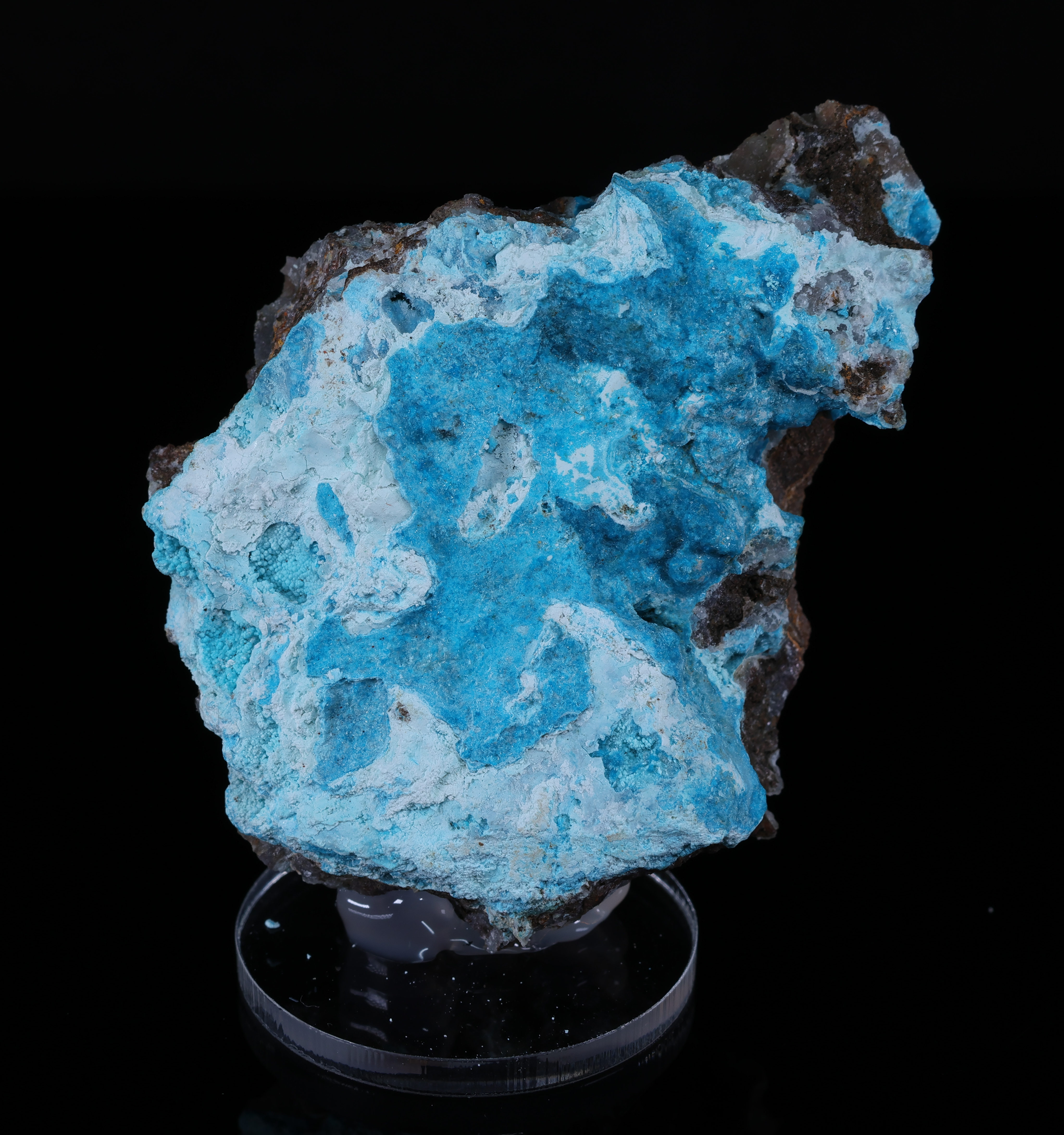
An exceptionally aesthetic specimen of the rare mineral serpierite. The specimen is characterized by an intense blue color, forming dense crusts and fine crystalline aggregates on the surface of the matrix. Main Features: intense blue color; rare copper and zinc sulfate; classic location; rich crusts; ex coll. K.Urbanik. Condition: Very good - the crystal surface is intact, and the blue aggregates are densely and stably distributed on the matrix.
Price: 64 EUR (279 PLN)
Availability: Sold out
Location: Hilarion mine, Greece
Size: 50 x 20 x 52 mm
Weight: 62 g
Chemical formula: Ca(Cu,Zn)₄(SO₄)₂(OH)₆·3H₂O
Crystal system: Monoclinic
Mohs hardness: 2–3
Mineral group: Serpierite Group
Rarity: Rare
Characteristics Serpierite is a mineral with an intense blue coloration, often described as linarite blue. It typically forms small, acicular or platy crystals, which can arrange into radial or spherical aggregates. It is a secondary mineral, formed in the oxidation zones of copper and zinc ore deposits. Physical Properties This mineral is characterized by a Mohs hardness of 2, meaning it is very soft and easily scratched. It possesses perfect cleavage along one plane, which gives it a pearly luster on cleavage surfaces, while on other surfaces the luster is vitreous. The density of serpierite is approximately 3.07 g/cm³, and its streak is white or light blue. It is transparent. Colors and Varieties Serpierite occurs in shades from deep sky blue to medium sky blue. In transmitted light, it can appear greenish-blue. No specific commercial or color varieties of serpierite are known, beyond natural variations in blue intensity. History and Name Serpierite was discovered in 1881. The mineral's name comes from the Greek word "serpieris," meaning "snake," likely referring to its habit or mode of occurrence, although the exact etymology is not unequivocally confirmed in mineralogical literature. Uses Serpierite has no industrial applications due to its rarity and softness. It is a mineral valued exclusively by collectors, due to its attractive color and rarity.
Identification Serpierite can be identified by its characteristic, intense blue color, often resembling linarite. It usually occurs as small, acicular or platy crystals, forming aggregates. Its softness (Mohs hardness of 2) is also a diagnostic feature. Perfect cleavage is visible as a pearly luster on fracture surfaces. Distinguishing from Similar Minerals Serpierite can be confused with other blue secondary minerals, such as linarite, azurite, or chalcanthite. It differs from linarite by its lower hardness and the absence of lead in its chemical composition. Azurite usually has a darker, more navy blue hue and higher hardness. Chalcanthite is water-soluble and has a more intense, dark blue color. The streak of serpierite is white or light blue, which also helps in differentiation. Crystal Forms Serpierite forms monoclinic crystals, typically acicular or platy in habit. They often occur as radial or spherical aggregates, forming coatings or incrustations on other minerals.
Genesis Serpierite is a secondary mineral, formed in the oxidation zones of copper and zinc ore deposits. It forms as a result of reactions of hydrothermal solutions with primary copper and zinc minerals in the presence of sulfates. Mineral Associations Serpierite often co-occurs with other secondary minerals of the oxidation zone, such as linarite, azurite, malachite, chalcanthite, brochantite, gypsum, hemimorphite, and iron minerals. Localities Known occurrences of serpierite include mines in Laurion, Greece, where it was discovered, as well as in Great Britain (e.g., Cornwall), Germany, France, Italy, the United States (e.g., Arizona, Utah), and Australia.
Quality Criteria The most prized serpierite specimens are characterized by an intense, uniform blue color, well-formed crystals, and a lack of mechanical damage. Large, aesthetic crystal aggregates with distinct luster are particularly sought after. The clarity and transparency of the crystals also affect the specimen's value. Popular Localities The most valued serpierite specimens come from Laurion, Greece, where the mineral was discovered. Other important localities include mines in Cornwall, Great Britain, and in some regions of the United States, especially Arizona.
See mineralogical reference for Serpierite in the Knowledge Base →