SKU: S-0146_2-MX
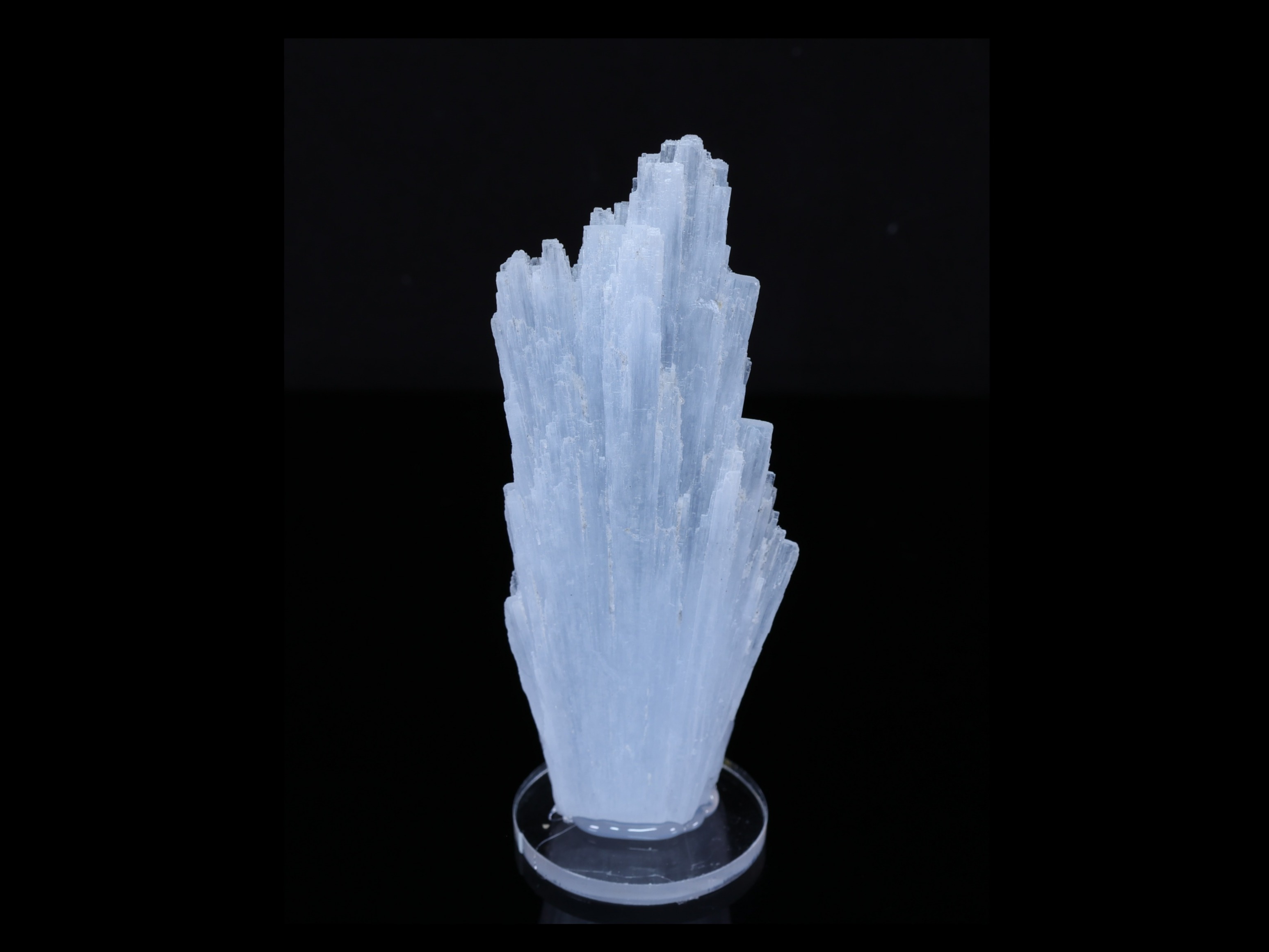
A slender, vertical specimen of blue anhydrite from the legendary location of Naica in Mexico. It forms characteristic, elongated crystals with a prismatic habit and distinct longitudinal striations. Main Features: blue color; prismatic habit; slender form; classic location; ex coll. K. Urbanik. Condition: Very good - the crystals are well preserved, with sharp edges and no visible major mechanical damage.
Price: 32 EUR (139 PLN)
Availability: In stock
Location: Chihuahua, Naica, Mexico
Size: 85 x 30 x 20 mm
Weight: 50 g
Chemical formula: CaSO₄
Crystal system: rhombic
Mohs hardness: 3–3,5
Mineral group: Gypsum Group
Rarity: Common
Characteristics Anhydrite is a sulfate mineral, an anhydrous calcium sulfate. It usually occurs as massive, granular, or fibrous aggregates; well-formed crystals are rarer. Anhydrite crystals are typically tabular or prismatic, with an orthorhombic habit. The color of anhydrite is variable, ranging from colorless, white, gray, to bluish, violet, pink, and even reddish and brown. It often exhibits a vitreous or greasy luster. Physical Properties Anhydrite is characterized by a hardness of 3-3.5 on the Mohs scale. It possesses perfect cleavage in one direction, nearly perfect in a second, and good to imperfect in a third, which is a diagnostic feature. The density of anhydrite is approximately 2.98 g/cm³. This mineral is transparent to translucent. Colors and Varieties Anhydrite occurs in a wide range of colors, including colorless, white, gray, bluish, violet, pink, and reddish-brown. Some blue varieties are sometimes called angelite, although this is not a formal mineralogical name. History and Name The name "anhydrite" comes from the Greek words "an" (without) and "hydor" (water), referring to its anhydrous nature, in contrast to hydrated gypsum. This mineral was described in 1804. Uses Anhydrite is used in the construction industry as an additive to cement and for the production of sulfuric acid. It is also used as a filler in the paper and plastics industries. Specimens with attractive color and form are valued by collectors.
Identification Anhydrite can be identified by its hardness (3-3.5 on the Mohs scale), which is higher than that of gypsum. Its characteristic cleavage in three directions, forming nearly perpendicular planes, is also diagnostic. A massive, granular structure is often observed. A vitreous to greasy luster also aids in identification. Distinguishing from Similar Minerals Anhydrite is sometimes confused with gypsum; however, gypsum is much softer (hardness 2 on the Mohs scale) and has different cleavage. Barite can also be similar but is significantly heavier (density approximately 4.5 g/cm³) and has different cleavage. Calcite is also softer (hardness 3) and reacts with hydrochloric acid, which anhydrite does not. Crystal Forms Anhydrite most commonly occurs as massive, granular, or fibrous aggregates. Well-formed crystals are rarer and are typically tabular or prismatic, with an orthorhombic habit.
Genesis Anhydrite typically forms in evaporitic environments, i.e., as a result of the evaporation of saline marine or lake waters. It occurs in salt deposits, often in association with halite, gypsum, and carnallite. It can also form through the dehydration of gypsum under elevated temperature and pressure during diagenetic and metamorphic processes. Mineral Associations Anhydrite often co-occurs with other evaporite minerals, such as halite (rock salt), gypsum, sylvite, carnallite, as well as calcite and dolomite. Localities Significant anhydrite deposits are found worldwide. Important localities include Germany (e.g., salt mines in Stassfurt), the United States (e.g., New Mexico, Texas), Canada (e.g., Nova Scotia), France, Italy, Poland (e.g., salt mines in Wieliczka and Bochnia), and Russia.
Quality Criteria The most prized anhydrite specimens are those that exhibit well-formed crystals, especially those with rare colors such as blue, violet, or pink. Transparency and the absence of inclusions also increase collectible value. Large, aesthetic granular or fibrous aggregates, particularly those with interesting mineral associations, are also sought after. Popular Localities Valued anhydrite specimens come from various places around the world. Italian deposits often yield beautiful blue crystals (so-called angelite). In Poland, interesting anhydrite aggregates can be found in the salt mines of Wieliczka and Bochnia. Other important localities include Mexico, the United States, and Germany.
See mineralogical reference for Anhydrite in the Knowledge Base →