SKU: P_26-7_21
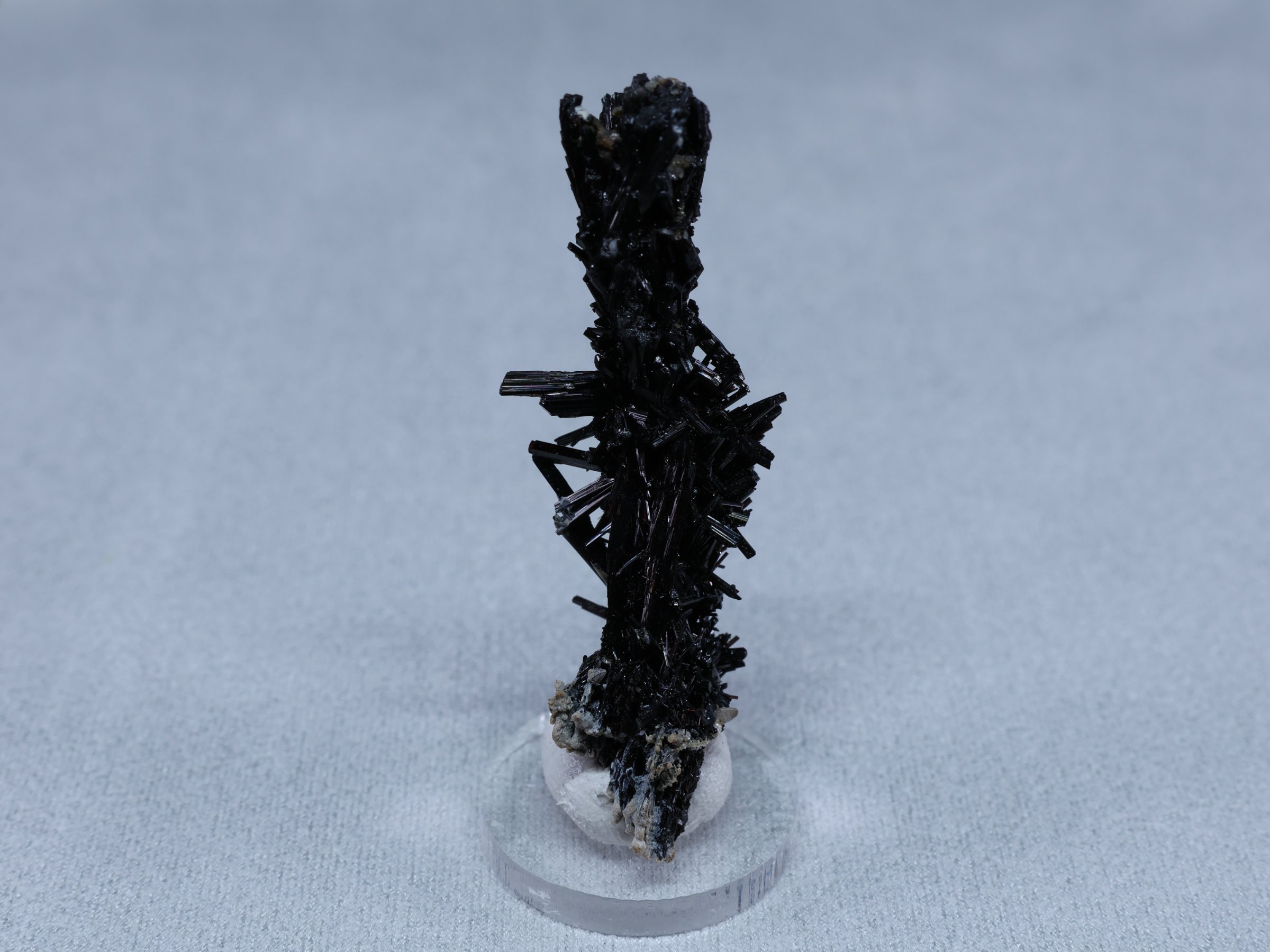
A slender specimen of Epidote presents itself as a vertical column of deeply black, needle-like crystals with a distinct glassy luster. Small columns grow around the main axis, creating a lace-like form with protruding crystals on the sides. At the very base of the specimen, slight remnants of a lighter matrix have been preserved. Main features: black color; needle-like form of crystals with distinct luster; small fragments of matrix at the base. Condition: Fair.
Price: 7 EUR (29 PLN)
Availability: Sold out
Location: Mount Malosa, Zomba, Southern Region, Malawi
Size: 17 x 16 x 45 mm
Weight: 3.4 g
Chemical formula: NaFe³⁺Si₂O₆
Mohs hardness: 6
Characteristics Aegirine is a mineral from the pyroxene group, a sodium iron silicate. Typical aegirine specimens occur as elongated, prismatic crystals, often with rhombic or hexagonal cross-sections. These crystals can be thin and acicular, forming radial or fibrous aggregates. The color of aegirine is usually dark green to greenish-black, although reddish-brown or black specimens are also found. Crystal surfaces may exhibit a characteristic vitreous or resinous luster. Physical Properties The Mohs hardness of aegirine is 6. This mineral exhibits good cleavage along the {110} planes. The density of aegirine is approximately 3.5 g/cm³. The luster is usually vitreous, sometimes resinous. Aegirine can be transparent to opaque. Colors and Varieties Aegirine most commonly occurs in shades of dark green, transitioning to greenish-black. Reddish-brown and black colors are also possible. No specific commercial varieties of aegirine are distinguished, however, its color and crystal form may vary depending on the locality. History and Name Aegirine was described in 1821. Its name comes from Ægir, the Norse god of the sea, referring to the discovery site of the first specimens in Norway, near the coast. Applications Aegirine has no significant industrial applications. It is primarily valued by mineral collectors due to its aesthetic crystals and the rarity of well-formed specimens.
Identification Aegirine can be identified by its characteristic dark green to black color, elongated, prismatic crystals, and vitreous or resinous luster. A Mohs hardness of 6 is also a diagnostic feature. The streak of aegirine is pale yellowish-gray. Distinguishing from Similar Minerals Aegirine can be confused with other dark minerals such as hornblende or arfvedsonite. It is distinguished from hornblende by its typically more distinct cleavage at angles of approximately 87 and 93 degrees (in pyroxenes) compared to approximately 56 and 124 degrees (in amphiboles), as well as the absence of the fibrous habit typical of amphiboles. It differs from arfvedsonite in chemical composition and often a greener hue. Crystal Forms Aegirine most commonly forms elongated, columnar, or acicular crystals, often with rhombic or hexagonal cross-sections. These crystals can occur individually, form radial aggregates, or dense, fibrous masses.
Genesis Aegirine primarily forms in alkaline igneous rocks, such as nepheline syenites, phonolites, and trachytes, as well as in pegmatites and hydrothermal veins associated with these rocks. It can also occur in some metamorphic rocks that have undergone sodic metasomatism. Mineral Associations Aegirine often co-occurs with other alkaline minerals, such as nepheline, sodalite, arfvedsonite, microcline, albite, zircon, titanite, and astrophyllite. Localities Known localities for aegirine include Norway (Langesundsfjord), Russia (Kola Peninsula, Khibiny), Canada (Mont Saint-Hilaire in Quebec), USA (Arkansas), Greenland, Malawi, and South Africa.
Quality Criteria The most prized aegirine specimens are those with well-formed, large, undamaged crystals of intense, dark green color and distinct luster. Radial aggregates or druses with aesthetically arranged crystals are also highly valued. Transparency and lack of inclusions increase the specimen's value. Popular Localities The most sought-after aegirine specimens come from Norway, especially from the Langesundsfjord area, where some of the first and best-formed crystals were found. Other valued localities include the Kola Peninsula in Russia and Mont Saint-Hilaire in Canada.
See mineralogical reference for Aegirine in the Knowledge Base →