Black Magnetite from Cerro Huañaquina in Bolivia

SKU: P_26-6_25

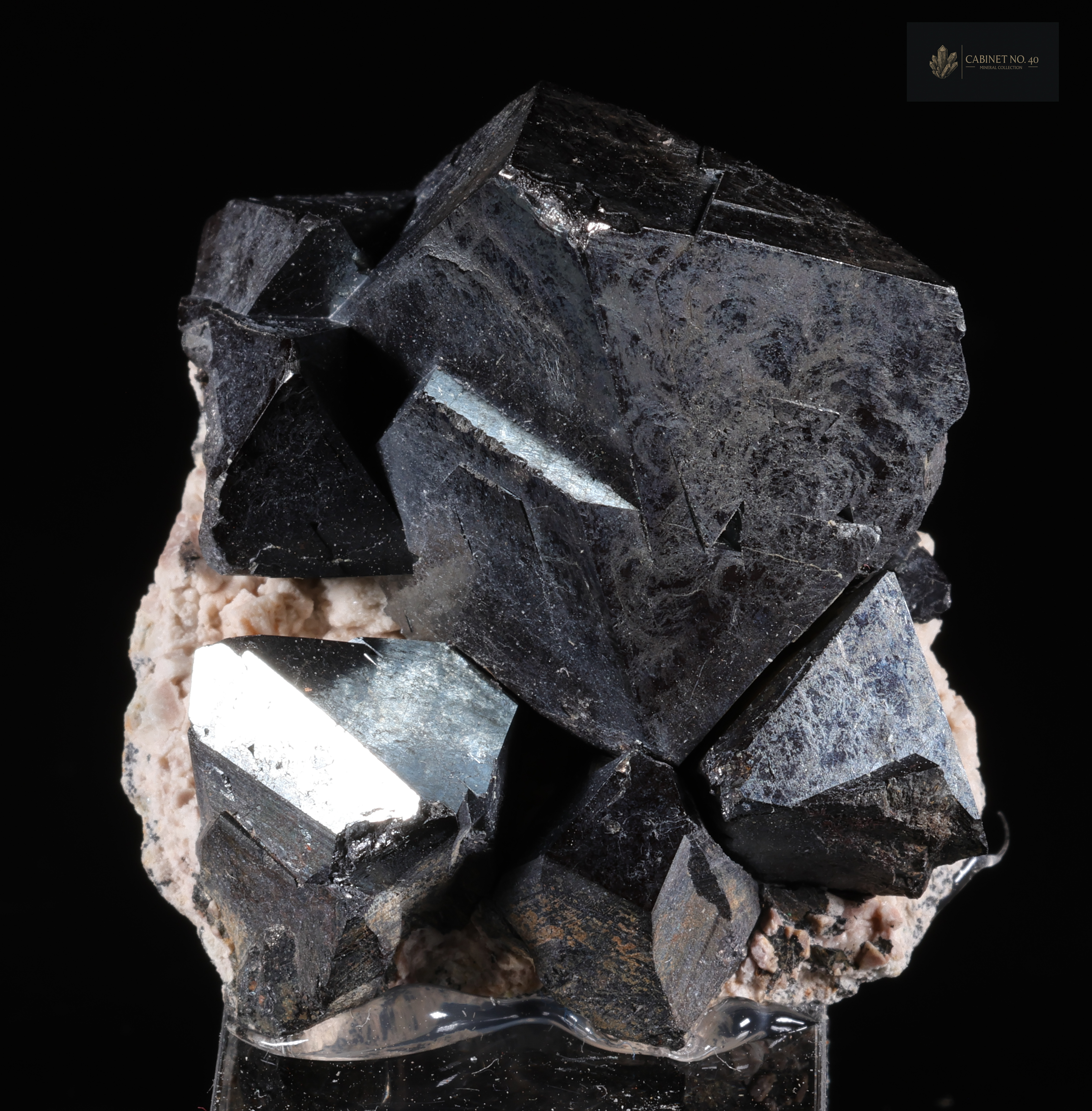
The presented specimen is a cluster of magnetite crystals, set on a light beige matrix. The magnetite crystals, with a dark, almost black color, exhibit a strong metallic luster that distinctly reflects light, creating bright highlights on their surfaces. Numerous fine growth marks are visible on the walls of the crystals, giving them a characteristic texture. Main features: clear contrast between the dark magnetite crystals and the light matrix; strong metallic luster of the magnetite; visible growth marks on the surfaces of the crystals. Condition: Good.
Black Magnetite from Cerro Huañaquina in Bolivia

Price: 32 EUR (139 PLN)

Availability: In stock

Location: Cerro Huañaquina, Yocalla Municipality, Tomás Frías Province, Potosí, Bolivia

Size: 29 x 19 x 30 mm

Weight: 27 g

Chemical formula: Fe₃O₄

Crystal system: Cubic

Mohs hardness: 6.0

Characteristics Magnetite is an oxide mineral belonging to the spinel group, with the chemical formula Fe²⁺Fe³⁺₂O₄. Typical magnetite specimens occur as granular aggregates, massive forms, or well-formed octahedral crystals. Its surface often exhibits a metallic luster, and the color is usually grayish-black or iron-black. It is a strongly magnetic mineral, which is its most characteristic feature. Physical Properties The hardness of magnetite on the Mohs scale is 5.5-6.5. This mineral is characterized by a metallic luster. It is opaque. The specific gravity of magnetite is 5.175 g/cm³. Magnetite does not exhibit cleavage. Colors and Varieties Magnetite primarily occurs in grayish-black or iron-black colors. There are no significant color or commercial varieties. History and Name The name magnetite comes from the Greek word "magnḗtēs líthos," meaning "stone from Magnesia" (a region in Thessaly where magnetic stones were discovered). The mineral was described in 1845. Applications Magnetite is an important iron ore and is used in the metallurgical industry. Due to its magnetic properties, it is also used in the production of magnetic materials, as well as in medicine and technology, for example, in data storage media.

Diagnostic features

Identification Magnetite is easily recognizable due to its strong magnetic properties – it attracts iron filings and reacts to a magnet. Additionally, its metallic luster and black streak are diagnostic features. It occurs in granular aggregates or as well-formed crystals. Distinguishing from similar minerals Magnetite can be confused with hematite or ilmenite, which are also black, metallic minerals. However, magnetite is distinguished by strong magnetism, while hematite is usually non-magnetic or weakly magnetic, and ilmenite is only weakly magnetic and has a brownish-red streak. Crystal forms Magnetite most commonly forms octahedral crystals, less often dodecahedral. It can also occur as granular aggregates or massive forms.

Formation environment

Genesis Magnetite forms in a wide range of geological environments. It occurs in igneous rocks, both volcanic and intrusive, as an accessory component or in larger accumulations. It is also a common mineral in metamorphic rocks, such as skarns and schists, and in hydrothermal deposits. It can also form as a result of sedimentary processes, in the form of magnetite sands. Mineral associations Magnetite often co-occurs with other ore minerals, such as hematite, pyrite, chalcopyrite, as well as with rock-forming minerals like quartz, feldspars, pyroxenes, and amphiboles. Localities Known magnetite deposits are found worldwide. Important localities include Kiruna in Sweden, the Ural region in Russia, the United States (e.g., Adirondack Mountains), Brazil, India, China, and Australia.

For the collector

Quality criteria The most prized magnetite specimens are those with well-formed, large, and lustrous crystals with a distinct octahedral habit. Crystal clarity, absence of mechanical damage, and contrast with the matrix also influence collector value. Popular localities High-quality collector specimens come from places such as Kiruna in Sweden, where large, well-formed crystals occur. Other valued localities include Russia, Brazil, and certain regions of the United States.

See mineralogical reference for Magnetite in the Knowledge Base →

View product →