Why Mineral Provenance is Important
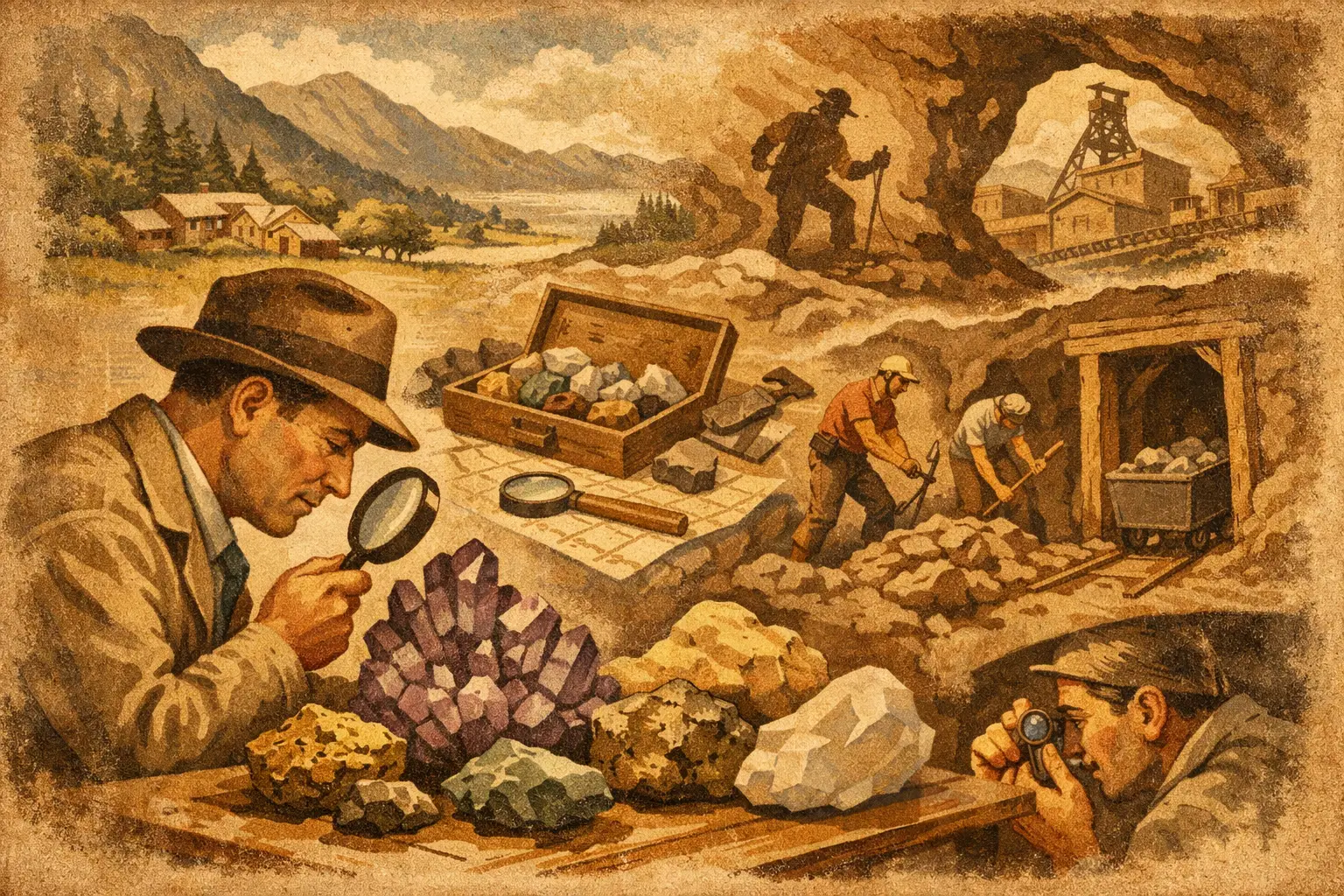
Why is mineral provenance important? Because it determines authenticity, value, identification, and the quality of collection documentation.
The label shows the mineral name, dimensions, and location. This is a good start, but for a collector, the real question quickly arises: why is mineral provenance important and what does it really change in the assessment of a specimen? The answer is only seemingly simple. The origin of a specimen is not an addition to the description, but a part of its collecting, scientific, and market identity.
In practice, provenance includes more than just the country or mine itself. It's a continuous stream of information about the place of discovery or extraction, the date of acquisition, previous owners, old labels, archival markings, and all documentation that allows reconstructing the history of the specimen. The more complete this stream, the easier it is to speak of the object not as an anonymous mineral, but as a specific specimen with a documented past.
Why mineral provenance is important for a collector
For an advanced collector, provenance serves three functions simultaneously. Firstly, it confirms credibility. Secondly, it increases the specimen's utility in the collection. Thirdly, it affects its value, though not always in a straightforward way.
Without provenance, many specimens remain visually attractive but difficult to correctly place in a collection. A well-formed fluorite crystal from an unspecified location may make a great impression, but the same fluorite with confirmed provenance from a classic locality becomes a much more specific object - comparable, catalogable, and interpretable.
From the perspective of collection organization, provenance allows for arranging the collection not only by species or chemical class, but also by regions, deposit types, historical mines, or former collections. This transforms the collection from a set of individual items into a system of knowledge.
Provenance and specimen authenticity
In the world of minerals, authenticity does not only concern whether the specimen is natural. It also concerns whether the description attributed to the specimen corresponds to reality. Provenance is one of the strongest verification tools.
If a specimen has retained an old label, an inventory number, consistency with characteristic morphology for a given locality, and a coherent circulation history, the risk of misidentification decreases. It doesn't disappear entirely, because labels can be misleading, and old locality names can be imprecise, but the evidentiary material becomes significantly stronger.
This is particularly important for specimens from localities that are no longer active, historical, or difficult to re-acquire. There, provenance is often the only way to distinguish a truly classic specimen from material that is only visually similar.
It is also worth remembering that a lack of provenance does not necessarily mean a problem. It rather means a limitation. Such a specimen can be appreciated aesthetically or systematically, but the level of uncertainty must be honestly noted. For a responsible collector, this is a fundamental difference.
The impact of provenance on market value
In the collector's market, provenance often acts as a layer of additional quality. Two specimens of the same species, similar size, and similar aesthetics can fetch different prices if one has full documentation and the other does not.
Most often, value increases when provenance includes:
precise locality, preferably at the level of the mine, vein, or specific exploitation area,
documented ownership history,
old collector's or museum labels,
confirmation of association with a renowned collection,
consistency of data with the visual characteristics of the specimen.
However, this does not work automatically. A poor specimen with excellent provenance will not always be more desirable than an excellent specimen with documentation limited to the basics. The market usually rewards a combination of both elements - aesthetic quality and data quality. This is why provenance should be treated not as a substitute for specimen quality, but as its essential complement.
Why mineral provenance is important for identification
Collectors often think about identification through the prism of color, habit, luster, or associations with classic specimens. This is necessary, but not always sufficient. Provenance narrows the field of interpretation.
If it is known that a specimen comes from a specific hydrothermal region, the list of probable species and mineral associations becomes much shorter. If the locality is famous for specific crystal habits, typical intergrowths, or characteristic color, provenance begins to act as an additional diagnostic layer.
This is particularly important for visually similar minerals or complex specimens. In such cases, origin does not resolve everything, but it can guide identification in the right direction. For a systematically cataloged collection, this is a very practical advantage.
Provenance as part of collection documentation
A well-maintained collection does not end in a display case. It needs a consistent description, photographs, numbering, and history. Provenance is one of the key metadata fields, without which the catalog card remains incomplete.
In documentation, it is worth separating several levels of information:
locality - current, as precise as possible geological locality,
source history - where and when the specimen entered the collection,
old labels - content of old labels, even if they require interpretation,
verification notes - remarks on the degree of data certainty,
references to imaging - photos of labels, macrophotographs, 360 documentation.
This approach has two advantages. Firstly, it allows preserving the source material, instead of reducing it to one simplified label. Secondly, it facilitates future data correction when new information or better locality identification emerges.
For collectors building digital collections, provenance becomes even more important. In an environment where a specimen exists both physically and as a record in a database, the value of information depends on the precision of descriptive fields and whether the object's path can be traced. This is one of the reasons why collecting platforms such as Cabinet No. 40 so strongly emphasize documentation and data structure.
What constitutes good provenance
Not all information about origin has the same weight. The phrase "Morocco" is better than nothing, but for many specimens, it remains too broad. On the other hand, an old label with the name of a no-longer-existing mine can be of great importance, even if it requires updating geographical nomenclature.
Good provenance is usually considered to be that which is:
as geographically precise as possible,
situated in time,
linked to material evidence, such as a label or purchase record,
consistent with the characteristics of the specimen itself,
recorded in a way that allows for later verification.
It is also worth preserving seemingly secondary information, such as old numbering, the name of the previous owner, or a description of the material batch. Today they may seem insignificant, but after a few years, they often become the missing piece of a larger puzzle.
The most common problems with provenance
In collecting practice, provenance is rarely ideal. Typical difficulties include old, abbreviated labels, outdated place names, confusing the place of purchase with the geological locality, and a lack of continuity between successive owners.
There are also more complex situations. Material from one region is sometimes attributed on the market to a more famous commercial locality. Sometimes a label has been transferred between specimens, and sometimes the description is only partially correct. The collector should not then "force" the story to close. It is much better to leave the degree of certainty open than to enter attractive but unconfirmed information into the catalog.
Good practice is to use designations such as "attributed to," "old label states," or "locality requires confirmation" in private catalog notes. This is the language of precision, not weakness.
How to evaluate provenance before purchase
Before adding a specimen to a collection, it is worth asking a few simple questions. Is the locality precisely stated? Are there old labels or other documents? Does the description match the morphology and mineral association? Does the ownership history sound credible and can it be recorded in the catalog?
It is not always necessary to have a complete set of data. Many very good specimens circulate with partial provenance. The key is rather to know what is missing. A conscious purchase is based not on the illusion of complete certainty, but on a correct assessment of the quality of information.
For collectors developing a collection long-term, provenance should be treated as an integral feature of the specimen, similar to its condition or crystal quality. A well-documented specimen works better in a collection - it is easier to describe, compare, display publicly, and pass on without losing context.
The most interesting collections do not consist solely of spectacular objects. They consist of specimens whose history can be read, recorded, and preserved. It is there that provenance ceases to be an addition and becomes part of collecting itself.