What determines the value of a mineral specimen?
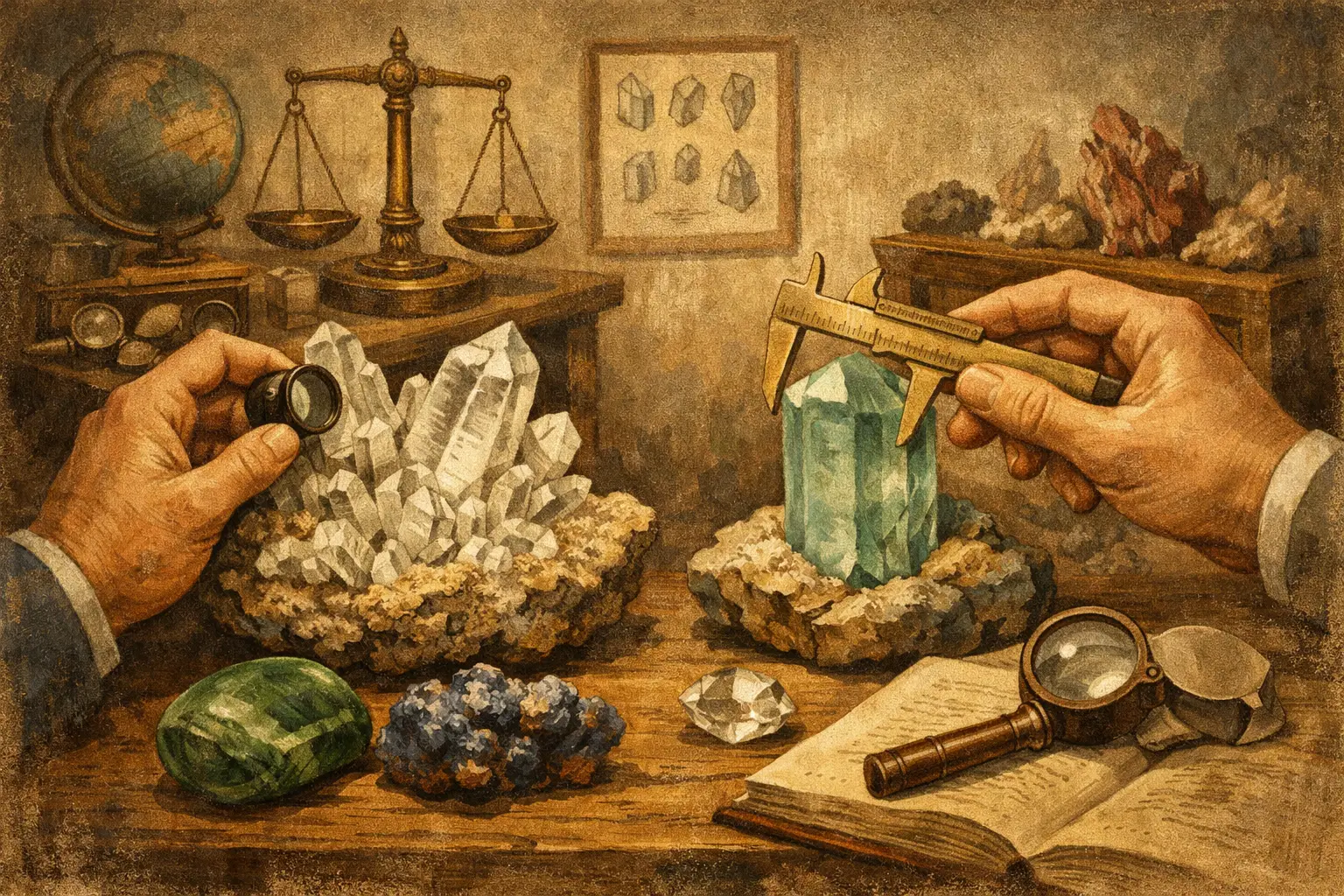
What determines the value of a specimen? Not only rarity matters, but also aesthetics, condition, provenance, documentation, and preparation quality.
In a photo, two specimens might look similar. In a collection, at a show, or during cataloging, however, the difference in their value can be very significant. This is precisely why the question of what determines a specimen's value doesn't have one simple answer. In collectible mineralogy, a combination of features matters: from the rarity of the species, through the quality of crystallization, to provenance and documentation.
What determines the value of a specimen in collecting practice
The value of a specimen does not solely derive from the mineral's name. The same species can occur as average, educational material or as a collector-grade object. The price and significance in a collection are determined by a combination of several parameters, not a single asset.
Most often, the following are analyzed:
rarity of the species and rarity of a specific form of occurrence,
aesthetics and display quality,
state of preservation,
size in relation to quality,
location and significance of the locality,
documentation and certainty of identification,
preparation and presentation method.
Only by combining these elements can one assess whether we are dealing with a commercially attractive specimen, a scientifically important one, or simply a pleasant addition to a collection.
Rarity is just a starting point
Rarity matters, but by itself, it does not guarantee high value. A mineral recorded from few localities may be poorly formed, fragile, visually indistinct, or lack confirmed provenance. In such a case, its attractiveness to a collector may be less than that of a well-preserved, classic specimen of a more common species.
In practice, it is worth distinguishing several types of rarity:
rarity of the mineral species itself,
rarity of a given color variety or habit,
rarity of a specific paragenetic mineral assemblage,
rarity of material from a historic or now inaccessible locality.
This is an important distinction. Fluorite is not a rare mineral, but fluorite of exceptional color, from a classic locality, and of above-average quality can have very high value. On the other hand, a systematically rare mineral, but without display qualities, is often valued mainly by specialized collectors.
Species rarity vs. specimen rarity
Not every specimen of a rare mineral is an outstanding specimen. Advanced collectors look not only at the label but also at whether a given example well represents the species. Are the crystals distinct? Is the habit typical or exceptional? Does the specimen have comparative value against other known examples from that locality? This is where real quality selection begins.
Aesthetics and display quality
In mineral collecting, aesthetics is not an accessory. Very often, it is one of the main components of value. A specimen may be scientifically correct, but if it is visually chaotic, poorly legible, or has an unfavorable composition, its attractiveness decreases.
Aesthetics are primarily influenced by:
color contrast between the mineral and the matrix rock,
luster and transparency,
symmetry or dynamic arrangement of crystals,
clarity of crystal forms,
balance between the matrix and the specimen part,
overall "presentability" of the object from the best viewing angle.
A well-formed specimen is clear at first glance. What is most important about it is visible. This is particularly important for photographic documentation, display in a cabinet, and building a collection with a consistent visual standard.
Why two similar specimens have different prices
Differences often arise from subtleties. One crystal may have better luster, cleaner faces, fewer damages, and a better-set composition on the matrix. For a beginner, these are trifles. For a collector who compares dozens of examples of the same species, these are fundamental elements.
Condition and integrity
The state of preservation is one of the most underestimated factors. Mechanical damage, reconstructions, repairs, retouching, or traces of aggressive cleaning affect the value more strongly than its appearance in the first photo would suggest.
When assessing the condition, it is worth paying attention to:
chipped crystal terminations,
cracks and internal fractures,
areas that have been re-glued,
marks from detachment from a larger mass,
unnatural luster after cleaning or impregnation,
lack of structural stability of the specimen.
Not every defect disqualifies a specimen. Many materials are naturally delicate, and minor damage is acceptable. The key is whether the damage disrupts the main visual or cognitive value. For very rare minerals, tolerance is often greater. For commonly available species, the evaluation standard is usually stricter.
Size matters, but only in relation to quality
A large specimen does not necessarily have to be more valuable than a small one. Value increases when size is accompanied by good form, aesthetics, and preservation. A large mass with poor crystal display may be less desirable than a small but perfectly formed miniature.
In collecting, a specimen is often evaluated within its size class. Different criteria are applied to a thumbnail than to a cabinet specimen. For an advanced collection, the question is: does the specimen in a given format exhibit above-average quality? If so, its value can be very high regardless of its dimensions.
Provenance and significance of the locality
Provenance is one of the pillars of collectible value. A specimen from a classic, historic, or closed locality can be significantly more valuable than similar material from a currently exploited location. This applies especially to reference localities that have built the reputation of a given species or provided material of exceptional quality.
Not only the country or region matters, but also the most precise possible location:
mine,
level or exploitation zone,
vein or mineral lens,
date of acquisition, if known,
previous collection or history of the specimen's circulation.
The better documented the provenance, the greater the credibility. In the case of older specimens, a good label can increase the value as clearly as the visual quality itself. Without it, the object loses some of its archival and comparative significance.
Documentation: identification, label, history
In the collecting market, a well-documented specimen is usually worth more than similar material without data. This is not just about convenience. Documentation organizes the scientific, commercial, and collecting context.
Specimens accompanied by the following have the greatest value:
correct mineralogical identification,
full locality label,
information about the former owner or collection,
notes on preparation or acquisition,
good reference photographs.
For a systematic collector, this is not an administrative detail, but part of the object itself. A mineral without data becomes more difficult to integrate into a coherent collection, more difficult to compare, and more difficult to resell in the future. Therefore, digital cataloging, archiving photos, and preserving original labels have real value today.
Preparation and presentation of the specimen
Good preparation can bring out the class of a specimen, but it must not falsify its nature. Removing excess matrix, cleaning surfaces, or stabilizing a fragile structure are justified if they improve legibility without compromising authenticity.
The line is simple: preparation should reveal, not create. If intervention changes the character of the object or masks its flaws, the collectible value usually decreases, even if the visual effect seems attractive.
Equally important is the presentation. A neutral background, proper lighting, macro photography, and shots showing the actual geometry of the specimen help assess its class. In collecting practice, the quality of visual documentation does not create value by itself, but it very well reveals its level.
What determines the value of a specimen when buying online
Remote purchasing requires a more disciplined evaluation. Since the object cannot be examined by hand, the specimen must be "read" through data and images. This is where offers prepared to a collector's standard have an advantage.
Before purchasing, it is worth checking:
whether the specimen is shown from several sides,
whether the photos accurately represent the scale and actual color,
whether the description includes the full locality and species name,
whether any damage is indicated,
whether the presentation format allows for assessing relief, luster, and transparency.
For a collector, not only the purchase itself matters, but also the specimen's subsequent place in the collection. If an object has good documentation from the outset, it is easier to catalog, describe, and compare with other examples. This is precisely why the presentation standard is so important, even beyond the transaction itself.
Market value vs. collectible value
These two concepts are not always synonymous. Market value depends on supply, demand, trends for certain localities, and seller activity. Collectible value is more stable and results from quality, the significance of the locality, and the specimen's place in a specific type of collection.
Sometimes fashionable material sells for a high price, although in the long run it may not prove particularly important. Other times, a visually more modest specimen with excellent provenance will have greater weight for a specialized collection than a spectacular but poorly described example. A well-managed collection is built when purchasing decisions are based not only on price but on the quality of the data and the specimen's place within the entire collection system.
The best specimens are not defended by a single argument. They combine form, condition, provenance, and documentation into a coherent whole. If you begin to evaluate objects in this way, you will not only build a better collection but also much more reliable criteria for selecting future acquisitions.