Tsumeb Mine: The Unrivaled Polymetallic Pipe of Namibia
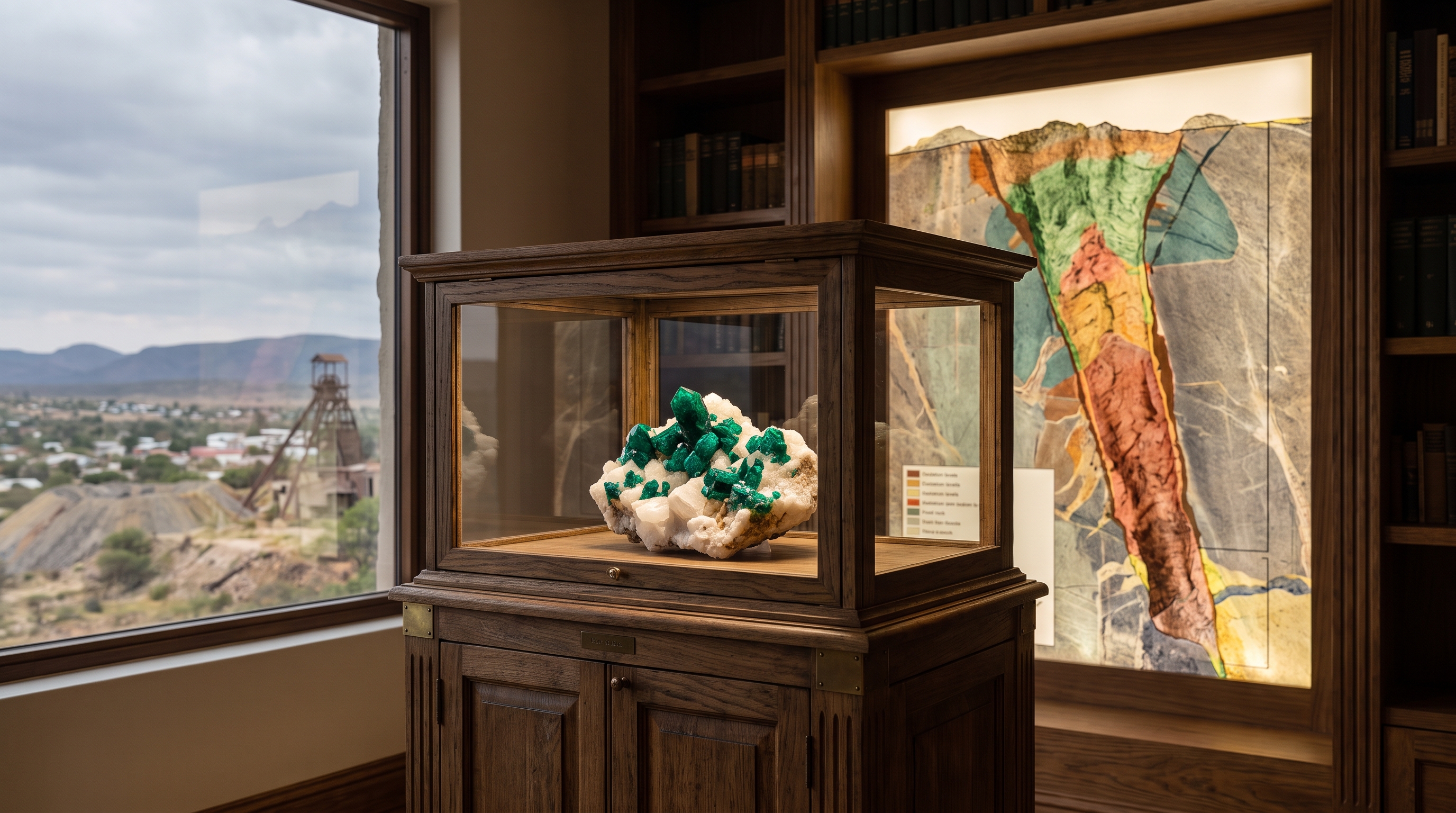
Explore the geology, classic habits, and type locality minerals of the Tsumeb Mine, the world's most prolific and celebrated polymetallic deposit.
Tsumeb Mine: The Unrivaled Polymetallic Pipe of Namibia
For over a century, this single hydrothermal pipe in the Otavi Mountain Land has defined the pinnacle of secondary mineral crystallization.
Geology and setting
The Tsumeb deposit is a world-class hydrothermal polymetallic pipe located in the Otavi Mountain Land of northern Namibia. The host rocks are Neoproterozoic dolomites and limestones of the Otavi Group. The orebody itself is a steeply dipping, pipe-like karst breccia structure that extends from the surface to a depth of at least 1,700 meters. This pipe was filled with a feldspathic sandstone known locally as pseudo-aplite, which acted as a conduit for metal-rich hydrothermal fluids. The primary mineralization consisted of massive sulfides, predominantly galena, sphalerite, tennantite, and enargite, heavily enriched in copper, lead, zinc, arsenic, silver, germanium, cadmium, and gallium. What truly separates Tsumeb from other base metal deposits is its extraordinary oxidation profile. Instead of a single, shallow weathered zone, Tsumeb features three distinct oxidation zones. The first oxidation zone extends from the surface down to roughly 300 meters. The second oxidation zone, triggered by a deep, circulating meteoric aquifer intersecting the pipe, occurs between 800 and 1,000 meters (roughly levels 26 to 35). A third oxidation zone was encountered below 1,400 meters (levels 42 to 48). This repeated, deep oxidation of complex primary sulfides in a carbonate-rich environment created the perfect geochemical laboratory. The dissolution of arsenic-bearing sulfides like tennantite provided abundant arsenate ions, which reacted with mobilized copper, lead, zinc, and rare elements to precipitate an astonishing array of secondary minerals. Mining was conducted via underground methods, primarily sub-level caving and cut-and-fill, beginning in 1905 and concluding in 1996 when the mine closed due to depleted reserves, labor strikes, and flooding.
Why collectors care
Tsumeb is arguably the greatest mineral locality on Earth. It is the type locality for over 70 valid mineral species and has produced more than 300 distinct minerals in total. For advanced collectors, "Tsumeb" is synonymous with the absolute highest standard of perfection for secondary base metal minerals. The sheer size, color saturation, and structural complexity of its crystals are unmatched globally. A classic Tsumeb specimen is defined by its paragenetic complexity and striking visual contrast. Collectors seek out the vivid interplay of primary and secondary minerals - such as brilliant emerald-green dioptase perched on snow-white rhombohedral calcite, or massive, midnight-blue azurite crystals coated in a fine druse of apple-green duftite. The locality is also uniquely revered for its rare element suites, particularly its germanium, gallium, and cadmium minerals. Because the mine is permanently closed and flooded, the supply of Tsumeb specimens is entirely limited to legacy collections, driving intense historical and financial interest in the mineral market.
Type locality minerals
Arsendescloizite
Defined at Tsumeb, arsendescloizite is the arsenic analogue of the much more common vanadate, descloizite. It typically forms pale yellow to yellowish-green tabular crystals, often arranged in radiating rosettes or wedge-shaped aggregates. It is frequently found in the deep oxidation zones associated with tennantite, quartz, and other arsenates.
Arsentsumebite
This rare lead copper arsenate sulfate is the arsenic analogue of tsumebite. At Tsumeb, it typically occurs as pale green to emerald-green crusts and microscopic crystals coating oxidized ores. It is often found in association with azurite, cerussite, and smithsonite, and requires careful analytical distinction from the visually identical tsumebite.
Bartelkeite
Named after the renowned German collector and Tsumeb specialist Wolfgang Bartelke, this exceedingly rare lead iron germanium mineral was discovered in the deep-level germanium ores. It forms tiny, colorless to pale green acicular crystals. Its presence highlights the unique germanium enrichment of the Tsumeb pipe.
Duftite
Duftite is an essential component of the classic "Tsumeb look". This lead copper arsenate forms apple-green to olive-green crusts, botryoidal aggregates, and microcrystalline druses. It is most famous for selectively coating or completely replacing crystals of azurite, cerussite, and calcite, providing the vivid green contrast that makes Tsumeb matrix pieces so desirable.
Fahleite
Named in honor of the German mineral dealer Rolf Fahle, this complex zinc calcium iron arsenate occurs as pale green, grey-green, or straw-yellow fibrous tufts and radiating aggregates. It is a late-stage secondary mineral, typically found nestled in cavities of massive tennantite ore.
Germanite
Germanite is a primary copper iron germanium sulfide and was one of the most economically important minerals at Tsumeb during the mid-20th century. It occurs as massive, fine-grained metallic ore with a distinctive reddish-grey to purplish tarnish. While not typically forming display crystals, it is the crucial primary source for the suite of secondary germanium minerals that make the locality famous.
Helmutwinklerite
This rare zinc lead copper arsenate was discovered in the deep oxidation zones of the mine. It forms pale blue to colorless microscopic crystals and thin crusts. It is highly sought after by rare-species collectors focusing on Tsumeb's complex arsenate paragenesis.
Jamesite
Jamesite is a complex lead zinc iron arsenate that forms distinct reddish-brown to dark brown acicular crystals. It was primarily found in the second oxidation zone, often associated with tsumcorite and other late-stage oxidized minerals in small vugs within the breccia.
Koritnigite
This hydrous zinc arsenate forms colorless to pale pinkish tabular crystals. It is often found in close association with adamite, tennantite, and willemite. The pinkish tint, when present, is usually attributed to trace cobalt substitution, making it a subtle but beautiful addition to Tsumeb arsenate suites.
Leiteite
Named after the Portuguese-South African mineral dealer Luis Leite, this zinc arsenate is famous for its unusual physical properties. It forms transparent, colorless to pale brown cleavable masses that are remarkably flexible. It is typically found in the deep oxidation zones associated with tennantite and chalcocite.
Ludlockite
Ludlockite is one of the most visually striking rare minerals from Tsumeb. This lead iron arsenate forms brilliant red to orange-red fibrous tufts and hair-like crystals. It is most commonly found nestled in cavities of zincian siderite or quartz, providing a sharp color contrast that makes it highly prized by micromounters and rare species collectors.
Minrecordite
Named in honor of the Mineralogical Record magazine, minrecordite is the zinc analogue of dolomite. It forms white to colorless rhombohedral crystals that are visually indistinguishable from dolomite or calcite without analysis. It is often found in paragenesis with dioptase, making many "dioptase on dolomite" specimens potential candidates for minrecordite.
Otavite
Otavite is the cadmium analogue of calcite, named after the Otavi Mountain Land. It forms white to pearly crusts and small rhombohedral crystals. It is typically found in association with smithsonite, azurite, and malachite, representing the localized concentration of cadmium in the oxidized zinc ores.
Otjisumeite
Named after the indigenous name for the Tsumeb area (Otjisume, meaning "place of the frogs"), this rare lead germanate forms white to colorless radiating fibrous crystals. It is a product of the oxidation of primary germanium-bearing sulfides like germanite and renierite.
Plumbotsumite
This rare lead silicate forms white, micaceous aggregates and thin tabular crystals. Found in the deep oxidation zones, it represents a late-stage reaction between lead-rich fluids and the silicate minerals of the pseudo-aplite pipe.
Prosperite
Named after Prosper Williams, a legendary dealer of Tsumeb minerals who preserved countless specimens from the crusher, prosperite is a calcium zinc arsenate. It forms colorless to white radiating acicular crystals and is typically found in vugs within oxidized copper-zinc ores.
Other notable minerals
Azurite
Tsumeb azurite is the undisputed world standard for the species. The mine produced crystals exceeding 20 centimeters in length, ranging in color from a deep, gemmy "electric" blue to a dark, almost black midnight blue. Habits vary wildly, including blocky, prismatic, tabular, and complexly modified forms. The most famous specimens feature large, isolated azurite crystals perched on contrasting matrix, or partially altered to velvety green malachite.
Cerussite
The cerussite from Tsumeb is legendary for its structural perfection and size. The locality is famous for producing massive V-twins and intricate, reticulated "snowflake" sixlings. The crystals range from highly lustrous and water-clear to a smoky grey or black (due to microscopic inclusions of galena). Cerussite crystals coated in a fine layer of green duftite or mottramite are considered quintessential Tsumeb classics.
Dioptase
Tsumeb has produced the finest dioptase specimens ever found. The crystals are a brilliant, saturated emerald-green and form sharp, highly lustrous rhombohedra. Crystals can exceed 5 centimeters across, though most are smaller. The classic presentation features gemmy dioptase crystals scattered across a matrix of snow-white calcite or dolomite, occasionally associated with yellow wulfenite or pale blue shattuckite.
Malachite
While Tsumeb produced excellent primary velvety botryoidal masses of malachite, the locality is most famous for its pseudomorphs. The slow, progressive oxidation environment allowed massive azurite crystals to be completely replaced by malachite while retaining the razor-sharp crystal morphology of the original azurite. These "perfect pseudomorphs" are among the most highly valued copper secondary minerals in the world.
Mimetite
Tsumeb mimetite occurs in a wide variety of habits and colors, but the locality is most celebrated for its bright lemon-yellow hexagonal prisms and botryoidal aggregates. The crystals can be highly lustrous and gemmy, often found in association with wulfenite, cerussite, and smithsonite. Some specimens show a solid solution series grading into pyromorphite, resulting in subtle greenish-yellow hues.
Notable pockets and history
The Tsumeb outcrop was known to indigenous San and Herero miners long before European colonization. Modern commercial mining began in 1905 under the German company OMEG (Otavi Minen- und Eisenbahn-Gesellschaft). After World War II, the mine was taken over by the Tsumeb Corporation Limited (TCL), a consortium of American and South African interests. Unlike pegmatite mines, Tsumeb did not have a strong tradition of formally naming individual pockets, as the mineralization was continuous and massive. However, specific levels became legendary. The discovery of the second oxidation zone in the 1950s (around the 28th to 30th levels) unleashed the greatest azurite and dioptase specimens the world had ever seen. In 1994, a major find on the 8th level, sometimes referred to informally as the "Easter Pocket" produced a spectacular final run of massive, world-class azurite crystals just two years before the mine closed. The preservation of Tsumeb's mineralogical heritage is heavily owed to a network of dedicated miners, shift bosses, and legendary dealers. Figures like Sid Pieters, Prosper Williams, Charles Key, and Clive Queit were instrumental in rescuing specimens from the ore crushers and distributing them to museums and collectors worldwide.
Collecting and authentication
Authenticating a Tsumeb specimen relies heavily on matrix, paragenesis, and historical labeling. The matrix is typically a very dense, heavy sulfide ore (massive tennantite, galena, or germanite) or a distinctive grey to white dolomite/calcite breccia. The presence of specific arsenates, such as duftite or mottramite coatings, is a strong indicator of Tsumeb origin. Mislabeling is common with certain species. Dioptase from the Renéville or Ntola mines in the Republic of the Congo is frequently misattributed to Tsumeb. Congo dioptase typically sits on a lighter, more friable quartz, plancheite, or chrysocolla matrix, whereas Tsumeb dioptase is almost always on dense carbonate or sulfide matrix. Similarly, azurite and cerussite from Touissit, Morocco, can visually resemble Tsumeb material, but Touissit specimens lack the complex arsenate associations (like duftite or tsumcorite) that characterize Tsumeb. Provenance is critical for Tsumeb specimens. Original labels from OMEG, TCL, early German dealerships like Krantz, or famous dealers like Sid Pieters and Prosper Williams add immense historical and financial value to a piece.
Further reading
* Mindat Locality Page: https://www.mindat.org/loc-43981.html * The Mineralogical Record, Tsumeb Issue (Vol. 8, No. 3, 1977) - The definitive English-language reference for the locality's history and early mineralogy. * The Mineralogical Record, Tsumeb II (Vol. 49, No. 3, 2018) - An updated, comprehensive review of the mine's paragenesis and recent species discoveries. * Bowell, R. J., et al. "The Tsumeb Mine, Namibia". A standard geochemical and historical reference for advanced collectors.