The Future of Digital Mineral Collections
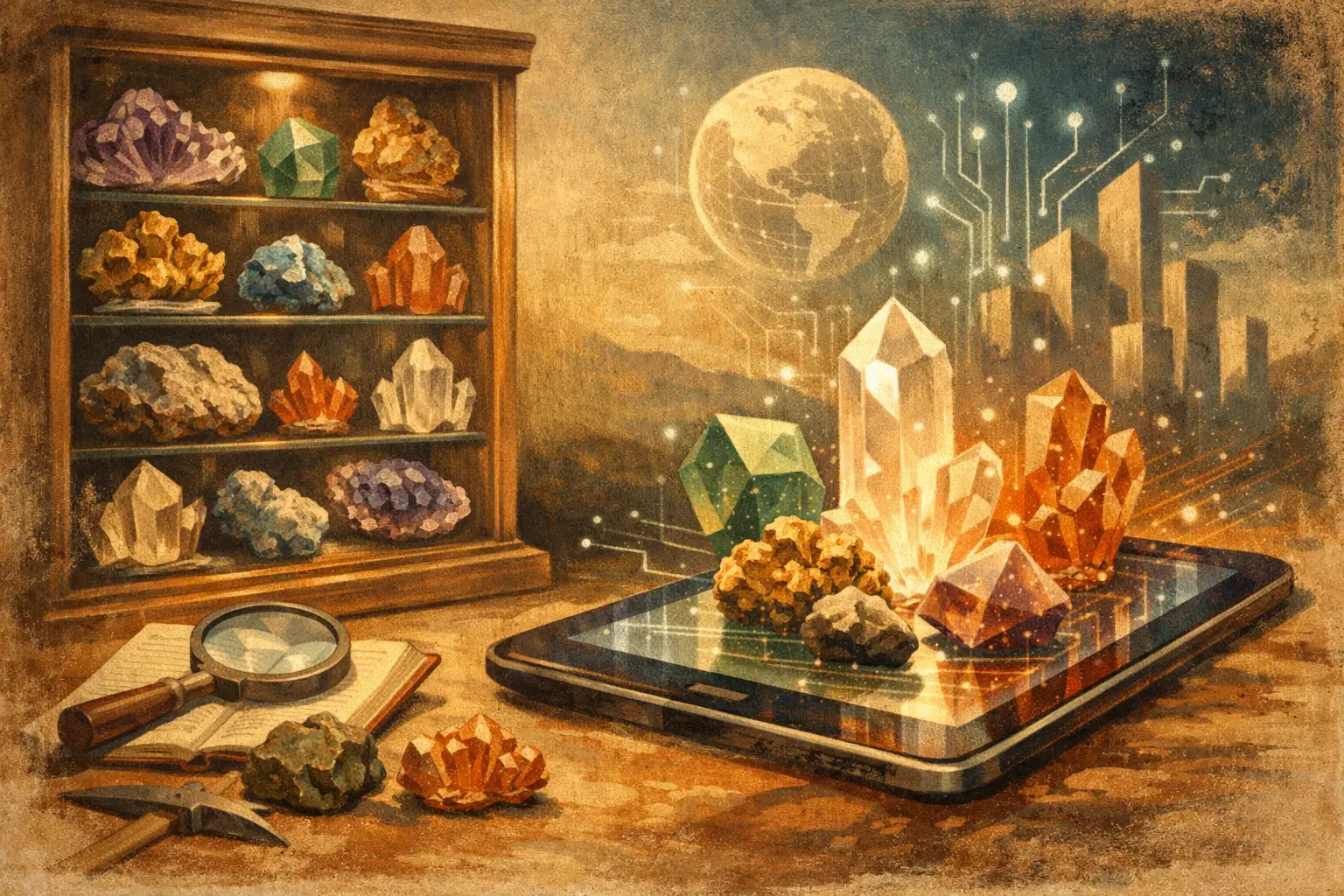
The future of digital mineral collections lies in better documentation, identification, and presentation of specimens. What will a collector gain in practice?
Until a few years ago, a digital catalog of a mineral collection was often just a spreadsheet with the name, locality, and specimen number. Today, the future of digital mineral collections looks much more ambitious: it encompasses data standardization, high-resolution imaging, provenance mapping, exhibition labels, and tools that help not only store information but actually increase the value of the collection as a set of well-documented objects.
This is a significant shift, especially for collectors who treat their collection not as a loose set of specimens, but as an organized archive. In such an approach, the mere presence of a mineral in a drawer is no longer enough. Full context matters: identification, genesis, mining site, state of preservation, acquisition history, and the quality of visual documentation.
The future of digital mineral collections is not just about "moving online"
The most common mistake in thinking about a digital collection is reducing it to a simple register. Meanwhile, a well-designed database is not a copy of a notebook, but an interpretative layer. It allows for linking mineralogical data with images, provenance, and classification systems, and then presenting the specimen in a way that is clear to both the owner and an external audience.
This has practical consequences. A collector can more easily compare similar specimens, identify gaps in the collection, control the quality of documentation, and more quickly prepare materials for insurance, sale, publication, or exhibition. Digitalization thus becomes a management tool, rather than just an archiving one.
At the same time, caution is necessary. Not every collecting platform understands the specifics of mineralogical specimens. A system that is good for art catalog cards or simple e-commerce may not suffice where fields for paragenesis, composition, crystal morphology, matrix type, or precise geological location are required.
Data will be more important than the number of specimens
In the collecting community, it is easy to overestimate the scale of a collection and underestimate the quality of the description. Meanwhile, the future belongs to collections that have complete, consistent, and verifiable data. A specimen described as "fluorite, China" is barely useful information. A specimen assigned to a specific mine, mining level, acquisition date, source of purchase, and documented photographically gains a completely different status.
This is why metadata standardization will be one of the most important directions of development. Mineral name, variety, locality, dimensions, weight, state of preservation, crystal exposure, damage, previous owners - each of these elements affects the subsequent utility of the collection. Without such a structure, even a valuable collection becomes difficult to analyze.
Well-organized data has another advantage: it can be searched, filtered, and compared. For a collector specializing in a specific type of deposit or a single mineral species, this is the difference between an impressive collection and a truly researchable one.
Imaging will become part of the description, not an add-on
Specimen photography has long had documentary significance, but its role is growing rapidly. In the future, the standard will be not only aesthetic frontal photos but also macro shots, side views showing the three-dimensionality of growth, images of damage details, and shots in controlled lighting. In many cases, only such a set allows for a reliable assessment of a specimen without physical contact.
However, it is important to distinguish between decorative and documentary images. For a serious collector, an attractive photograph is not enough. A faithful photograph is needed - with correct reproduction of color, scale, and the relationship between the mineral and the matrix. This is particularly important for specimens where quality is determined by subtleties: transparency, luster, growth zoning, or completeness of terminations.
360-degree views and microscopic images will also play an increasing role. They will not replace live inspection, but they significantly reduce the risk of misjudgment. For specimens with fine crystallization or complex surface topography, such documentation is often essential.
Digital mineral collections and specimen provenance
Provenance has long influenced collector value, but in the digital environment, it will become even more visible. A specimen without a well-described history of origin will increasingly be perceived as incomplete. It is not just about commercial value. It is about the credibility of the collection and the possibility of its subsequent use in catalogs, publications, or exhibitions.
Location maps, geographic layers, and assignment to specific sites are no longer an add-on for the most advanced. This is a natural direction for anyone who wants to maintain a collection systematically. Especially since many classic localities are now closed, altered, or difficult to describe unambiguously without good historical documentation.
Here, an important "it depends" arises. The older the specimen, the higher the risk of data gaps. In such cases, a digital system should allow for a distinction between confirmed information, information assigned with high probability, and unverified information. This is a better solution than apparent certainty.
Artificial intelligence will help, but it won't replace the collector's eye
In the discussion about the future of digital mineral collections, AI tools cannot be ignored. They can organize descriptions, suggest missing catalog fields, normalize locality naming, generate labels, and support the search for similar specimens based on images.
This is a real time-saver, especially for larger collections. If a collector digitalizes several hundred or several thousand items, automation ceases to be a convenience and becomes a condition for maintaining data quality.
At the same time, AI has clear limitations. It will not reliably resolve all identification issues based on photographs, especially with complex, altered, or poorly documented specimens. Nor will it replace knowledge of the market, the history of a specific collection, or the significance of a rare locality. It works best as a supporting layer, not as an autonomous authority.
Public presentation of the collection will be more curatorial
Digital collections do not serve the owner exclusively. Increasingly, they also fulfill an exhibition function. Public galleries, virtual display cases, and museum-style labels are changing the way a private collection is perceived. A well-presented collection ceases to be a set of photos. It becomes an ordered narrative about types of mineralization, the aesthetics of crystallization, or the history of specific sites.
This is an important direction for collectors who want to show their collection to family, other enthusiasts, clients, or institutions. The quality of presentation affects the perception of the whole almost as much as the quality of the specimens themselves. Aesthetics matter, but they are subordinate to clarity. The data layout, the way photos are framed, the consistency of naming, and the quality of labels say a lot about the standard of the entire collection.
In this area, the advantage of solutions created with collectors in mind, rather than general item cataloging, is clearly visible. A platform like Cabinet No. 40 combines sales, reference knowledge, and presentation tools, which corresponds to the actual circulation of a specimen - from acquisition, through identification and cataloging, to exhibition.
What a collector gains in practice
The coming years will bring a deepening of standards rather than a single revolution. Those collectors who start documenting their specimens consistently and in a uniform system now will benefit the most. Even a simple but well-planned data model will be better than a chaotic catalog expanded with random fields.
In practice, it is worth thinking about every specimen as an archival object. It needs an inventory number, correct identification, a good photograph, information about the locality, and acquisition history. If notes on the state of preservation, exposure, and comparative sources are added, the collection begins to function at a level that facilitates both daily management and the long-term building of the collection's value.
Not every collection needs to use 360-degree imagery, geological maps, and automatically generated descriptions right away. For some, public presentation will be key; for others, precise record-keeping of localities or the ability to quickly print labels. The direction, however, is clear: digital tools will increasingly resemble a specialized professional environment for the collector rather than a simple database.
The most sensible way to start is by asking not how much data can be added, but which data truly improves the quality of the collection. That is where a collection begins that looks good not only in a display case but also in the documentation.