How to Identify Vanadinite
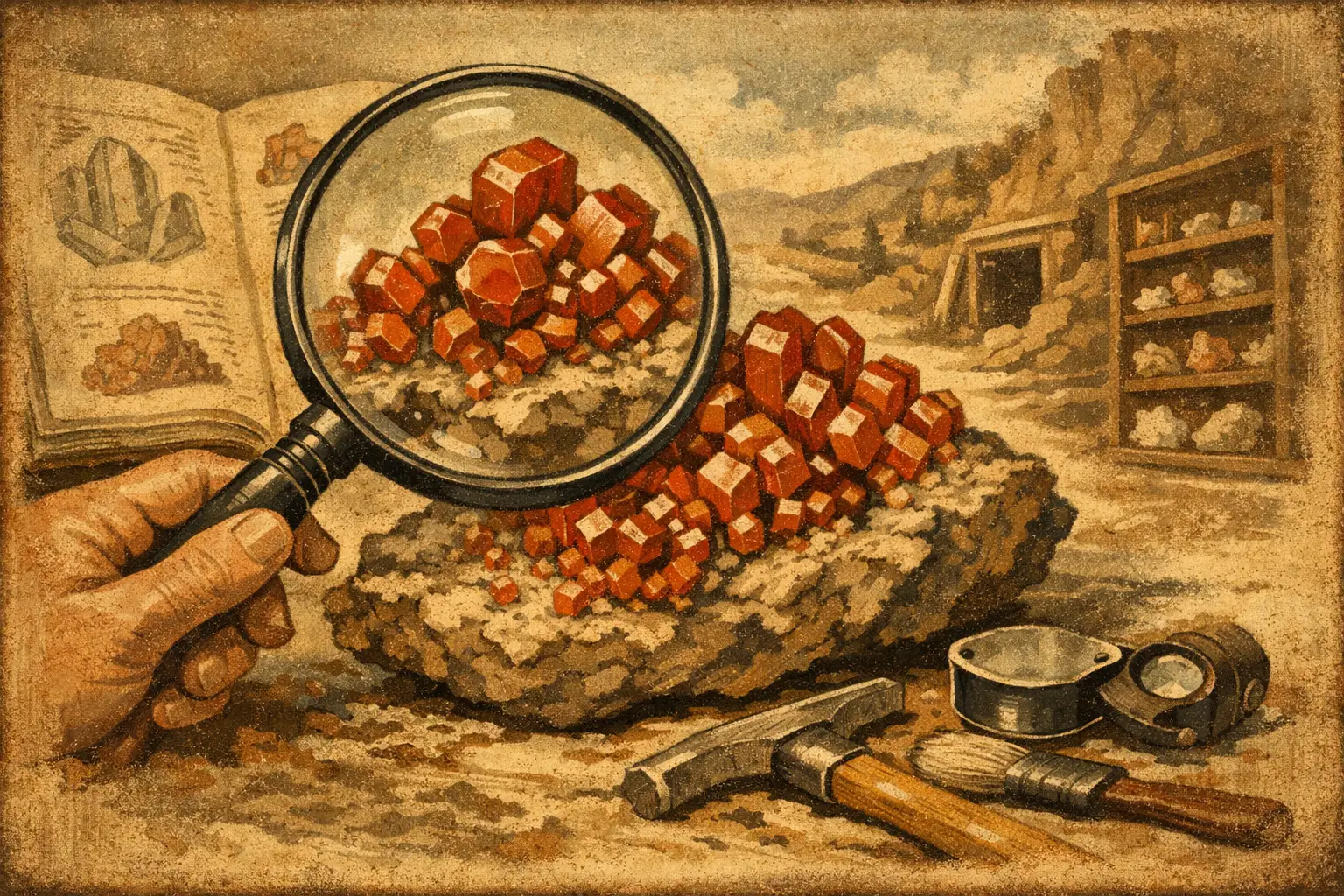
How to identify vanadinite in a collection? Check the color, crystal habit, luster, hardness, and common confusion with similar minerals.
The first signal is often very characteristic: intensely red or reddish-brown, lustrous crystals with a distinct hexagonal habit, set on a light-colored rock. If you are wondering how to identify vanadinite, it is worth starting with this combination of features, but do not stop at color alone. In the collector trade and amateur identification, this is the most common source of errors - an impressive specimen can look "like vanadinite" and yet belong to another mineral from the same group or have a similar habit.
Vanadinite is a mineral from the apatite group, chemically a lead chloro-vanadate with the formula Pb5(VO4)3Cl. For a collector, this formula has practical significance because it suggests several things at once: high density, resinous to adamantine luster, relatively low hardness, and a typical occurrence environment. It is a secondary mineral, appearing in the oxidation zones of lead deposits, often alongside other lead minerals. The location alone is not enough for identification, but it can significantly narrow the field.
How to identify vanadinite by appearance
The most recognizable feature of vanadinite is its crystal habit. It very often forms short hexagonal prisms, barrel-shaped crystals, or plates with a hexagonal cross-section. On good specimens, individual crystals look almost geometric, with flat terminations and clearly defined faces.
The color most often falls within the range from tomato red through brick and reddish-brown to brown. Yellowish, orange, and more rarely almost colorless varieties also occur, but it is the red forms that build its recognizability in collections. However, caution must be exercised - color alone is not a diagnostic feature. Many secondary lead and vanadium minerals can take on similar shades.
The luster is usually distinct, ranging from resinous to sub-adamantine. On well-preserved crystal surfaces, vanadinite reflects light quite strongly, but not as "glassy" as quartz. In macro-observation, it is precisely the combination of color, luster, and hexagonal habit that provides the most reliable first reading.
Diagnostic features more important than color alone
If identification is to be reliable, it is worth looking at a set of features rather than just one. Vanadinite has a hardness of about 3 on the Mohs scale, so it is significantly softer than quartz and is not suitable for aggressive testing. Brittleness is also important from a collector's point of view - many specimens look stable but do not handle careless cleaning and transport well.
The density is relatively high, resulting from the presence of lead. Even a small specimen can feel "heavier than it looks" in the hand. This is a valuable field and cabinet clue, though obviously subjective. When compared to minerals of similar size, the difference is often quite noticeable.
The fracture of vanadinite is uneven to conchoidal, and cleavage is poorly marked or practically irrelevant in collector observation. The streak is usually yellowish-white to pale yellow, but performing a streak test on a good specimen usually makes no sense. In collecting practice, preserving the surface condition is more important than a destructive test for a feature that can be confirmed by other methods.
What vanadinite is most commonly confused with
The most important comparison concerns mimetite. This is no coincidence - both minerals belong to the same group, can form similar hexagonal crystals, and occur in similar environments. Mimetite more often takes on yellow, honey, orange, or brown colors, but the color range partially overlaps. If a specimen does not have the classic red, distinguishing it based on a photo can be uncertain.
The second mineral worth considering is pyromorphite. It also belongs to the apatite group and forms similar crystals. It is most commonly associated with greens and yellows, but brown varieties are also found. In cabinet identification, not only color but also the association of features with the locality and specimen documentation becomes key.
Vanadinite is also sometimes confused with wulfenite, especially by beginners who focus on the red-orange color. However, this is usually a different type of crystal aesthetic. Wulfenite more often forms thin square or rectangular plates, while vanadinite yields a clearly hexagonal and more "barrel-like" habit. When you see a hexagonal cross-section and a compact crystal form, the scales tip toward vanadinite.
How to identify vanadinite in a specimen photo
Assessment from a photo has limitations, but in the collector trade and cataloging, it is a daily occurrence. First, it is worth checking the geometry of the crystals. Do they actually have a hexagonal outline? Can you see short prisms, plates, or barrels rather than thin plates of a different system? This is more important than color saturation, which is easily adjusted in photographs.
The second issue is the relationship of the crystals to the matrix. Vanadinite often occurs on a light, contrasting rock, which enhances its visual qualities, but this is not a rule. A well-documented specimen should show not only a frontal view but also close-ups and a side view, as it is the crystal profile that confirms the habit. In premium practice, macro documentation and 360-degree views provide a much more certain basis for identification than a single, heavily stylized photo.
If a specimen is described as vanadinite from classic Moroccan localities, the probability of the identification being correct increases, but it still does not replace the observation of features. Location helps; it does not decide. In a well-maintained collection catalog, it is worth noting both the commercial label and your own morphological observations.
What to watch out for during identification and purchase
The biggest mistake is equating red color with a certain identification. The collector market knows many specimens described briefly or commercially rather than strictly mineralogically. If information about the origin, crystal size, matrix, and quality of documentation is missing, caution is justified.
It is also worth remembering that vanadinite can be mechanically sensitive. Crystals may have chipped edges, micro-damage, or local dulling, which changes the perception of luster and habit. A specimen after heavy cleaning or improper storage may look less convincing, even though it is still correctly identified.
For a collector, the distinction between identifying the species and assessing the quality of the specimen also matters. One can correctly identify vanadinite and at the same time be dealing with a specimen that is mediocre in terms of aesthetics, crystal completeness, or display value. These are two different decisions: mineralogical and collector-based.
A simple scheme for specimen evaluation
The most practical approach looks like this: first look at the crystal habit, then at the luster and color, then at the perceived density and consistency with the locality and documentation. If four elements mutually confirm each other, the identification is usually strong. If one of them clearly stands out, an alternative must be considered, most often mimetite or pyromorphite.
In more advanced circles, final confirmation may require instrumental analysis, as the apatite group can be deceptive. This is not an exaggeration, but a consequence of structural and morphological similarities. For most collectors, a well-performed macro observation, comparison with reference specimens, and a reliable locality label are sufficient for practical, everyday work with a collection.
If you are building a collection consciously, treat the identification of vanadinite not as a single verdict, but as a set of data: species, locality, morphology, state of preservation, and method of presentation. Such order facilitates not only recognition but also subsequent cataloging, exchange, and quality assessment of specimens. And that is where collecting conducted with the precision that a good specimen truly requires begins.