How to Identify Quartz
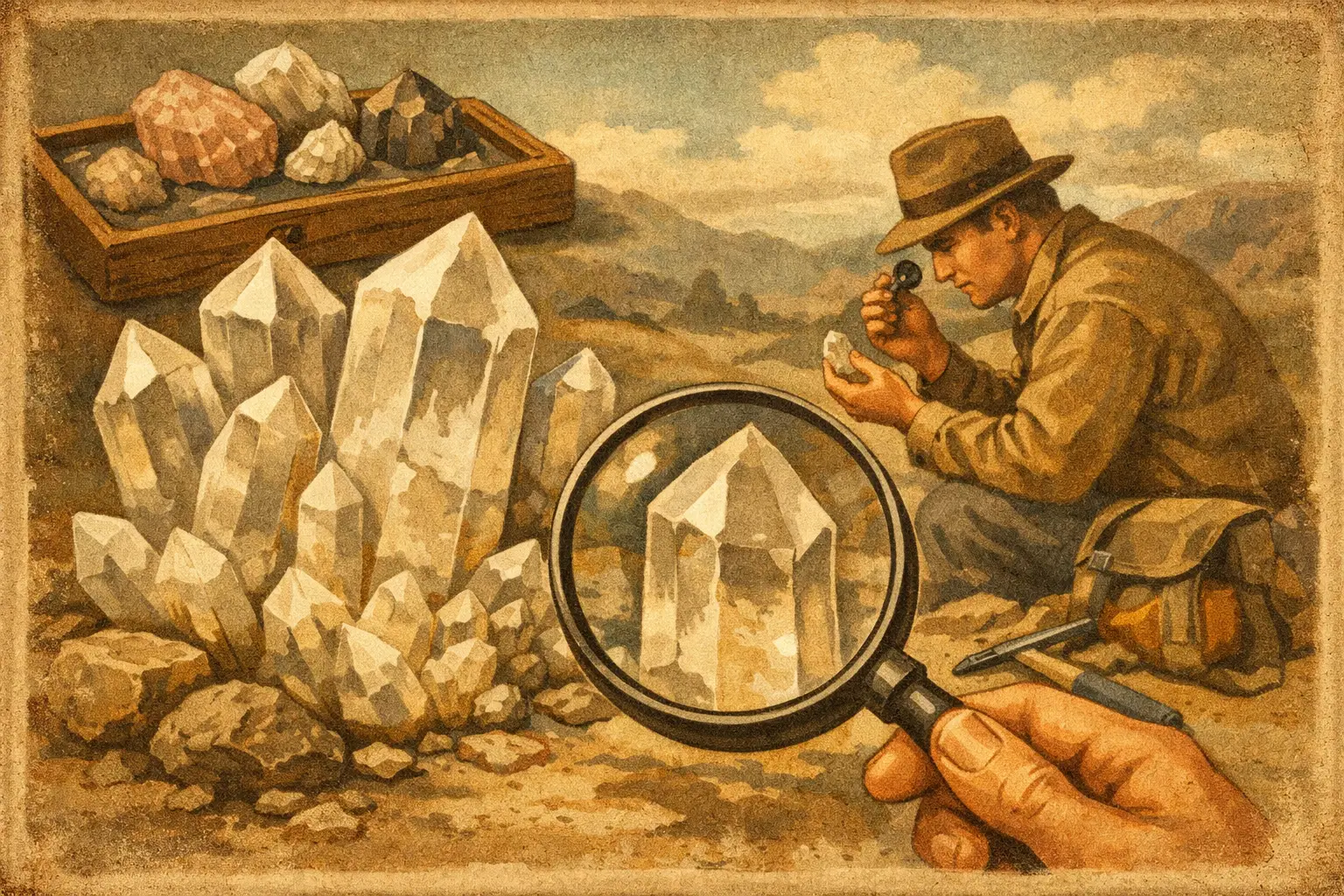
How to identify quartz in the field and in a collection? Check hardness, fracture, luster, color, and common misidentifications with calcite and glass.
Not every transparent or white mineral is quartz. In collecting practice, mistakes most often stem from two things: over-reliance on color and examining a specimen without the context of its habit, fracture, and hardness. Therefore, if the question is how to identify quartz, it is worth starting not with color, but with a set of diagnostic features that together provide a reliable identification.
How to identify quartz - where to start
Quartz is silicon dioxide, one of the most common minerals in the Earth's crust, but identifying it is not as trivial as its ubiquity suggests. In the collecting market, one encounters well-formed crystals as well as massive, granular, milky, or fine-crystalline forms. That is why a single feature is rarely enough.
It is safest to look at quartz like a specimen curator rather than a casual observer. We are interested in luster, hardness, type of fracture, lack of cleavage, typical crystal forms, and the relationship with the matrix. Only at the end is it worth considering color, as it can be misleading.
The most important diagnostic features of quartz
The most useful feature is a hardness of 7 on the Mohs scale. This means that quartz scratches glass and cannot be easily scratched by a steel blade. However, this test should not be performed thoughtlessly on an aesthetic crystal face. In the case of a collector's specimen, it is better to test a discreet fragment, preferably one already damaged, or base the identification on several other observations.
Quartz has no distinct cleavage. Instead, it shows a conchoidal fracture, meaning smooth, slightly curved break surfaces. This is very characteristic of massive forms and fragments. If a mineral breaks along flat, regular surfaces, another identification must be considered.
The luster of quartz is vitreous (glassy). In massive or slightly weathered varieties, it may appear more greasy or become dull on the surface, but a fresh fracture usually quickly restores the correct optical impression. The streak of quartz is white, although in practice this feature is less significant than with minerals that have intense diagnostic streaks.
The density of quartz is moderate, approximately 2.65 g/cm3. In the hand, it does not feel exceptionally heavy, which can be helpful in distinguishing it from some dark minerals with a similar surface appearance.
Crystal habit and surface appearance
Well-formed quartz most often forms prismatic crystals with a cross-section close to a hexagon, ending in a pyramid. This is the classic form recognized by most collectors, but it is worth remembering that in nature, many specimens are only partially formed. Crystals can be intergrown, deformed, cracked, or grow in layers within fissures.
Transverse striations or subtle growth irregularities are often visible on the faces. This is not a mandatory feature, but it can be helpful. In drusy clusters, quartz can form dense aggregates of small, shiny terminations. In vein and massive varieties, the crystal form disappears almost completely, so identification then returns to hardness, fracture, and luster.
The geological context is also important. Quartz very often occurs in hydrothermal veins, pegmatites, gas vesicles (vugs), and rock fissures. If a specimen grows on a matrix with calcite, fluorite, pyrite, or galena, it does not prove anything yet, but it fits within the typical collector's picture.
Color helps, but is not decisive
Colorless rock crystal, milky quartz, smoky quartz, amethyst, or citrine are just part of a wide spectrum of appearances. Color alone does not answer the question of how to identify quartz, because the same mineral can have many shades depending on impurities, crystal lattice defects, and irradiation history.
Even more important is that other minerals also have similar colors. Colorless calcite, white feldspar, transparent gypsum, and even ordinary glass can resemble quartz at first glance. A collector who bases identification solely on color and transparency will usually, sooner or later, mislabel a specimen.
What quartz is most often confused with
The most common mistake involves calcite. It can be colorless, white, or honey-colored, forms impressive clusters, and often occurs alongside quartz. The difference, however, is fundamental. Calcite has a hardness of 3, so it is easily scratched by steel or even a copper coin. It also has perfect cleavage in three directions, causing it to break along flat surfaces rather than conchoidally. Additionally, it reacts with dilute hydrochloric acid. Quartz does not produce such a reaction.
The second common double is glass. Especially fragments of technical or industrial glass are sometimes mistaken for quartz due to their vitreous luster and conchoidal fracture. Here, habit is the deciding factor. Glass does not form natural, hexagonal crystals with regular terminations, and its surfaces are usually too random. Bubbles or an unnaturally homogeneous material character are also often visible.
Mistakes also occur with feldspars. Light-colored feldspars have lower hardness, usually around 6, and very good cleavage in two directions. Their luster on cleavage planes can be more pearly than vitreous. Quartz is more optically compact in this regard and less geometric in its way of breaking.
How to identify quartz in the field
In the field, speed and caution matter. First, observe whether the material shows a typical vitreous luster and whether it occurs in veins, fissures, or voids. Next, check whether the visible surfaces are crystal faces or rather cleavage planes. This distinction makes a big difference.
If you have a non-collection specimen or a loose fragment, you can perform a simple hardness test. Quartz should scratch glass, but should not be easily scratched by steel itself. You just need to distinguish a real scratch from a mark left by the metal. A mark can often be wiped away; a scratch remains.
It is also good practice to observe a fresh fracture. In a quartz fragment, it will be smooth, curved, and conchoidal. If flat, repeatable surfaces appear, be more cautious with the diagnosis. In the field, it is not always possible to reach 100% certainty, but you can narrow down the possibilities significantly.
How to evaluate quartz in a collection
In a collection, identification should be more rigorous than in the field. The specimen itself is not everything—the label, locality, association with typical accompanying minerals, and the quality of photographic documentation also count. Good macro photos allow you to see growth features, color zoning, surface condition, and the nature of the contact with the matrix.
With purchased or inherited specimens, it is worth asking a few questions. Does the crystal form correspond to quartz? Is the color consistent with a natural variety, or does it look suspiciously uniform? Are there traces of processing on the surface that make evaluation difficult? For a collector, not only the name of the mineral matters, but also the certainty of attribution.
In the practice of Cabinet No. 40, this way of looking is the basis of working with a specimen—identification does not end with recognizing the species, but also includes presentation, description, and preservation of data that allow one to return to the specimen years later without losing context.
When features are not clear-cut
Not every quartz will be textbook. Heavily weathered specimens lose their luster, damaged crystal tips disrupt the habit, and fine-crystalline varieties can look completely different from classic rock crystal. Chalcedony and other cryptocrystalline varieties also belong to the silica family, but their identification is based on a slightly different set of observations than with macrocrystals.
There are also borderline situations where it is difficult to be certain without a magnifying glass, hardness test, or analysis of the geological context. This is normal. Good mineralogical identification is not about quick guessing, but about eliminating incorrect possibilities.
The shortest path to identification
If you want to act methodically, start with four questions. Does the specimen have a vitreous luster? Does it show no distinct cleavage? Does it show a conchoidal fracture? Does its hardness correspond to 7 on the Mohs scale? When the answer to all of these is yes, the probability that you are dealing with quartz is high.
And if one feature does not match, do not try to force the specimen to fit. In collecting, the most valuable thing is often not a quick label, but the discipline of observation that allows for building a truly well-described collection.