How to Identify Malachite
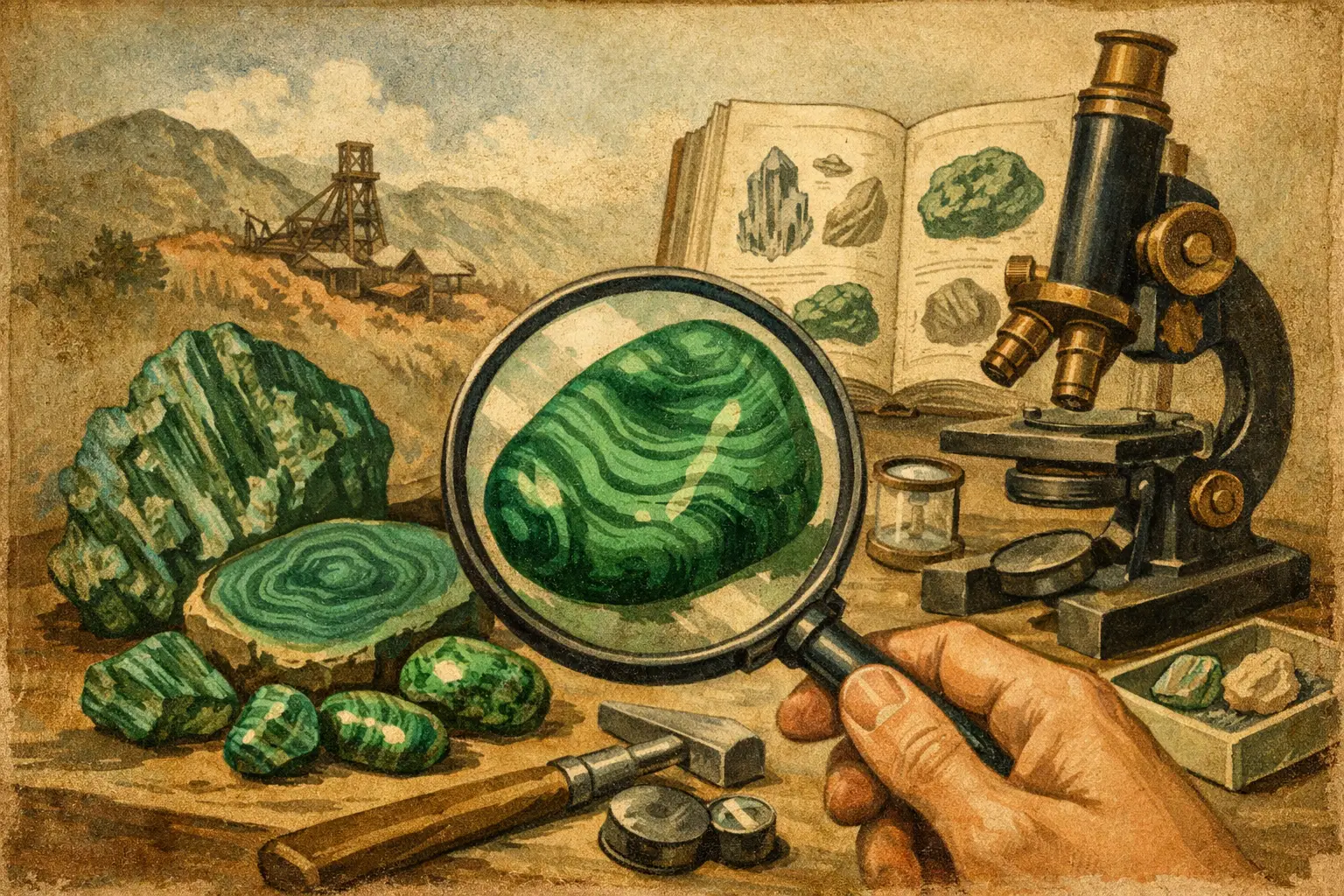
How to identify malachite? Learn about the characteristics of color, banding, hardness, and habit that help distinguish a natural specimen from an imitation.
Malachite is often identified too quickly - based on color alone. This is the easiest way to make a mistake, as intense green also occurs in other copper minerals, and dyed materials and synthetic imitations also appear on the market. If the question is how to identify malachite, it is worth starting not with a single feature, but with a set of observations: color, pattern, luster, habit, and occurrence context.
For a collector, the safest rule is simple: malachite is rarely "proven" by a single test. Reliable identification results from the consistency of several features at once. In practice, this is what distinguishes a general overview from a reliable identification of a specimen.
How to identify malachite in collecting practice
Malachite is a copper carbonate with the formula Cu2CO3(OH)2, a secondary mineral of the oxidation zones of copper ore deposits. Chemical classification alone is not enough during inspection, but it suggests what to expect: strong green, frequent co-occurrence with azurite, chrysocolla, cuprite, or limonite, and reniform, stalactitic, and fibrous forms.
The most characteristic feature is the color. Natural malachite usually shows different shades of green simultaneously - from lighter, more vivid tones to dark, deep sections. It rarely looks like a uniformly colored material. Even in massive specimens, growth zones, streaks, or concentric bands appear, resulting from the mineral's growth conditions.
The second feature is the internal pattern. When broken or cut, malachite very often reveals banding, circular, zonal, or radial arrangements. This pattern is not a decorative addition, but an effect of the aggregate's structure. That is why, in identification, it is worth looking not only at the surface of the specimen but also at the structure visible on the edges and natural exposures.
Color is not enough
The green color catches the eye, but in itself, it does not determine the identification. Malachite can be confused with chrysocolla, certain secondary copper products, and sometimes even with composite material made to imitate a zonal pattern. If the green is too homogeneous, feels "plastic" or is unnaturally clean without subtle tonal transitions, it is worth being cautious.
In natural specimens, the green usually "works" under light. Some zones appear matte, others more velvety or slightly silky. This variability results from the microstructure of the surface and the habit of the aggregate. Imitations more often give the impression of a surface-unified appearance.
Features that really help identify malachite
In practice, observing several parameters simultaneously works best. Malachite has a hardness of 3.5–4 on the Mohs scale, so it is not a particularly hard mineral. This means that the sharp edges of delicate fibrous or stalactitic forms can be prone to minor damage. If a specimen looks "technically" perfect, without the slightest irregularity, it is worth looking at it more closely.
The luster of malachite depends on its form of occurrence. Crystals are rare, but when they appear, they can have a vitreous to adamantine luster. Much more common are reniform, stalactitic, or fibrous aggregates, where the surface can be silky, velvety, or earthy. This is important because many people expect a glassily shiny green, while a good malachite specimen can be visually more subtle.
The structure is also significant. Typical collector malachite occurs in botryoidal, stalactitic, fibrous, or massive clusters. A radial or fibrous arrangement is often visible on the fracture. If a specimen is supposed to look like malachite but shows neither banding, nor fibrousness, nor reniform morphology, the identification becomes less certain.
How to identify malachite by habit and structure
The most classic specimens have reniform and stalactitic forms. Their surface resembles a group of rounded, adjacent domes. Under good lighting, subtle differences in green between successive growth zones are visible. In cross-section, such material usually shows concentric rings or a fan-like arrangement of fibers.
In velvet varieties, the surface can look soft, almost plush, although it remains mineral, of course. This is the effect of very fine, densely packed fibers. Under a magnifying glass, such a texture is often much more convincing than when viewed with the naked eye.
What malachite is often confused with
The most common mistake concerns chrysocolla. Both minerals can occur together and both are associated with copper ores, but chrysocolla usually has a more blue-green or turquoise color, often less regular, and its structure tends to be more massive and less banded. Malachite is usually more decisively green and more clearly zonal.
Confusion also occurs with azurite in altered sections. Azurite has an intense blue color but can partially transition into malachite. In such specimens, the presence of both minerals is not unusual. From a collecting standpoint, this is valuable information as it testifies to the genesis and secondary alterations, but for identification, it requires caution - not every green-blue specimen is "pure" malachite.
Imitations are a separate category. Synthetic or reconstructed materials often have excessively regular bands, too much contrast between shades, and a uniform, almost designed aesthetic. Natural malachite can be striking, but it rarely looks perfectly symmetrical. With a pattern that looks too "graphic" it is good to check the surface under a magnifying glass and assess whether the structure is truly mineral.
Which tests not to overuse
Amateur advice often encourages performing simple mechanical or chemical tests. This is not always a good idea, especially with collector specimens. Malachite is relatively soft and sensitive, so scratch tests can leave a mark. Chemical reactions can also damage the surface or the patina, which has aesthetic and documentary value.
A calm visual analysis supported by a 10x loupe, good macro photography, and information about the location is much better. Provenance does not replace identification, but it organizes it significantly. A specimen described as coming from the oxidation zone of a known copper deposit will be easier to interpret than anonymous material without data.
What to check under a loupe
Under magnification, it is worth assessing whether the banding results from the actual structure of the material or just a surface effect. One should also pay attention to the microstructure - fibrous, radial, earthy, or a compact aggregate. Small natural irregularities, transition zones, and local changes in luster usually argue in favor of authenticity.
If the specimen has a fresh fracture, you can observe the arrangement of fibers and the density of the material. Malachite should not look like resin with a printed pattern. This sounds obvious, but it is precisely on the edges and damaged areas that imitations reveal themselves most quickly.
Geological context and specimen documentation
For a collector, identifying a mineral does not end with the name. The form of occurrence, associations, and place of origin also count. Malachite from different locations can look different - from small stalactites to compact botryoidal clusters, from velvety structures to clearly zoned cross-sections. Therefore, a good label and photographic documentation are part of the identification, not an addition.
In an organized collection, it is worth noting not only the name "malachite" but also the habit, location, co-occurring minerals, and diagnostic features visible on the specimen. This is particularly useful when comparing several similar samples. Cabinet No. 40 is building exactly this way of looking at minerals - through data, image, and consistent documentation, not through guessing from a single photo.
When identification should remain cautious
Not every specimen can be determined immediately. If the material is very fine, weathered, highly porous, or is a mixture of several secondary copper minerals, it is more honest to use a cautious identification than an overly certain label. "Probable malachite" "malachite with chrysocolla" or "secondary copper minerals with a predominance of malachite" is in many cases a better description than a firm but doubtful identification.
This does not diminish the value of the collection. On the contrary - it shows documentary discipline. In the collecting community, the reliability of a description often means more than categoricity.
So, if you want to identify malachite accurately, look at it as a mineralogical object, not just a green specimen. Color matters, but only together with banding, habit, luster, structure, and provenance does it create a reliable identification. The best identifications start with an attentive eye and end with well-recorded data.