How to Identify Calcite
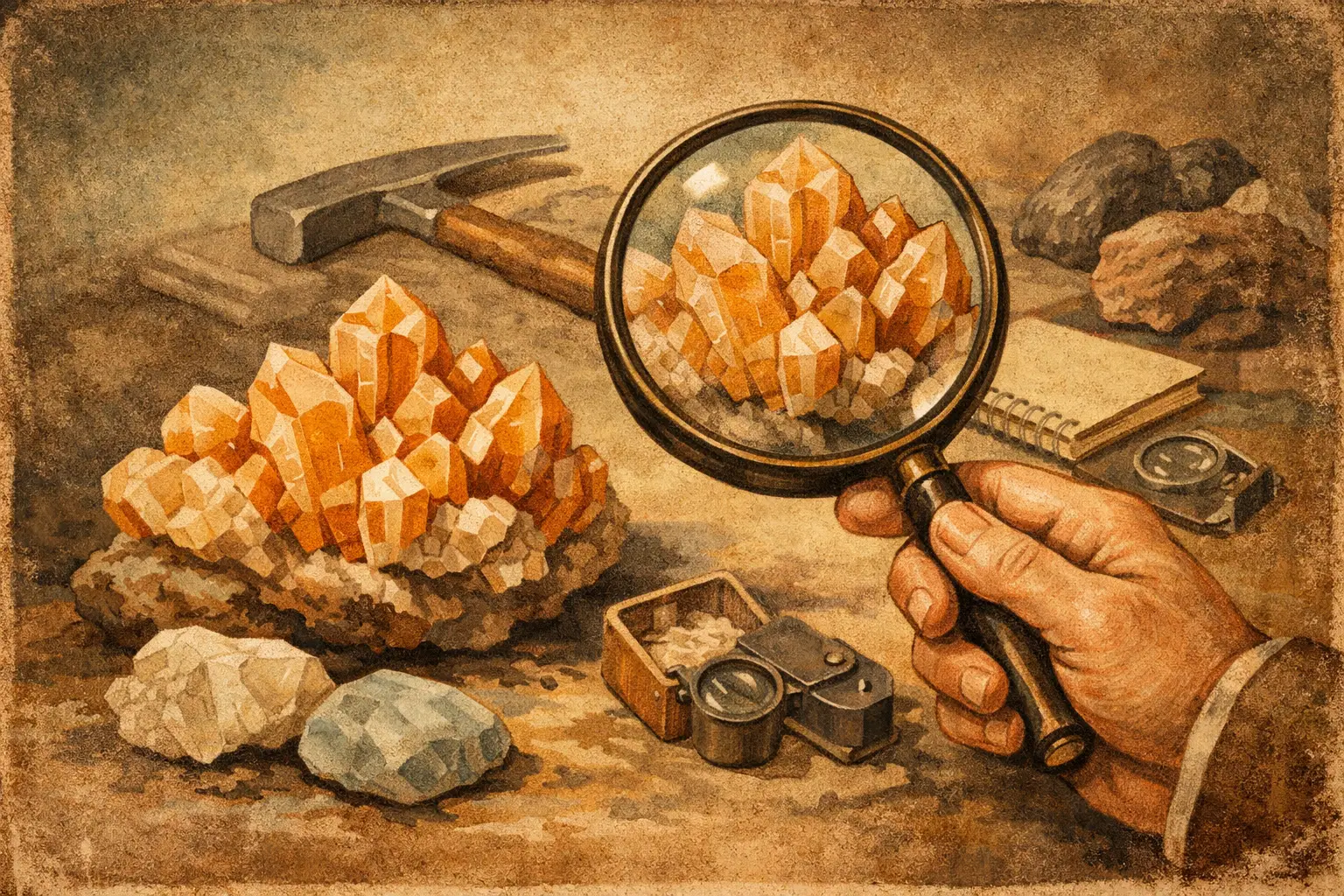
How to identify calcite in a collector's specimen? Check hardness, cleavage, acid reaction, habit, and common identification mistakes.
A collector most often misidentifies calcite not when the specimen is poor, but when it is too "pretty." Distinct crystals, intense color, impressive luster - it is in such specimens that it is easy to assign the wrong name based on associations with fluorite, aragonite, or even quartz. If you want to know how to identify calcite reliably, you must look not only at the color but, above all, at the set of diagnostic features.
Calcite is calcium carbonate with the formula CaCO3, one of the most common minerals on Earth and also one of the most diverse in terms of habit. For a collector, it is a rewarding but deceptive species. It occurs in massive, concretionary, and crystalline forms; it can be colorless, white, yellow, orange, green, bluish, brown, or even pink. Color alone, therefore, tells us very little.
How to identify calcite - features that matter
The most reliable identification is based on several observations made together. A single feature can lead to an error, whereas a combination of hardness, cleavage, chemical reaction, and habit usually yields a very strong result.
Calcite has a hardness of 3 on the Mohs scale. This means it can be scratched by a copper coin or a steel blade, but it will scratch gypsum. In collecting practice, this feature is useful, though it requires caution. On a display specimen, a scratch test can leave a permanent mark, so it is worth performing it only in a discreet place, preferably on an already damaged surface or on a fragment detached from the main display.
The second feature is perfect rhombohedral cleavage. When broken, calcite does not shatter randomly but forms smooth surfaces at characteristic angles. This is one of its most important diagnostic properties. If you are dealing with a massive material that has a conchoidal fracture like glass, quartz becomes more likely. If the break is irregular, without clear cleavage planes, you should also be cautious.
The third feature is the reaction with dilute hydrochloric acid. Calcite effervesces clearly upon contact with a cold, weak solution. This is the classic carbonate test and remains one of the best. In collecting conditions, however, two things must be remembered. First, the test is performed sparingly and at a single point, as the acid damages the surface. Second, not every carbonate reacts identically - dolomite usually reacts more weakly or only after being powdered.
It is also worth paying attention to luster and transparency. Calcite can be vitreous to pearly, sometimes almost honey-like in appearance. Transparent varieties may exhibit strong birefringence. If you see a doubling of the image when looking through the crystal, this is a very valuable clue. This effect does not appear as clearly in every specimen, but in colorless and clear fragments, it can be almost textbook-perfect.
Calcite crystal habit and appearance varieties
One of the reasons calcite is often misidentified is its enormous morphological variability. Crystals can be rhombohedral, scalenohedral, tabular, prismatic, fibrous, or concretionary. In the collector market, "dog-tooth" forms (sharply pointed scalenohedrons) are frequently encountered, as well as rhombohedrons with clean, geometric faces.
Aggregates are no less misleading. Calcite can form drusy encrustations, spherical clusters, stalactitic formations, and massive vein fillings. In such forms, it stops looking like a classic crystal from an atlas and begins to resemble other sedimentary or hydrothermal minerals. Therefore, habit alone is not enough - it must be cross-referenced with hardness and acid reaction.
The color of calcite most often results from impurities or inclusions. Yellow and orange varieties are sometimes confused with fluorite, greenish ones with prehnite, and white or translucent ones with milky quartz or aragonite. For identification, fracture, cleavage, and behavior during chemical testing are more important than color.
What calcite is most commonly confused with
The most common mistake is between calcite and fluorite. Both minerals can form aesthetic, well-developed crystals and occur in similar colors. However, the difference is fundamental. Fluorite has a hardness of 4, different cleavage, and does not react with dilute acid like calcite. If the specimen can be easily scratched and effervesces clearly, fluorite is no longer probable.
The second common pair is calcite and quartz. Especially colorless or white aggregates are often mislabeled based on general appearance. Quartz is significantly harder, lacks perfect cleavage, and does not react with acid. When a specimen looks "glassy" but is easily scratched and shows rhombohedral breakage, the identification shifts toward calcite.
Calcite is also confused with aragonite, which is more understandable as both minerals have the same chemical composition but different crystal structures. Aragonite usually occurs in more acicular, radiating, or coralloid clusters and is slightly harder. In practice, without careful observation of the habit or auxiliary tests, this pair can be difficult, especially in sedimentary and concretionary specimens.
How to identify calcite in collecting practice
If you are working with a specimen for cataloging, it is best to start with non-invasive observation. Examine the surface under side-lighting and check for visible cleavage planes, the degree of transparency, and the nature of the luster. Then, compare the crystal habit with typical calcite forms, but treat this only as a preliminary stage.
Only then proceed to tests. Hardness is useful, but on high-end collector specimens, it should be a last resort. It is much better to use a magnifying glass, good photographic documentation, and knowledge of morphology. At Cabinet No. 40, this is why macro photography and shots showing crystal geometry are so important - many features of calcite become obvious only under magnification and proper lighting.
The acid test remains very effective but should be performed only at a single point, preferably on the bottom of the matrix or on a detached fragment. In the case of a specimen with a valuable crystalline surface, a hasty test can reduce its aesthetic and collector value. This is a classic case where correct identification must go hand in hand with conservation discipline.
When identification is not obvious
Not every specimen can be identified with certainty based on a single inspection session. Minerals with secondary coatings, damaged surfaces, intense fluorescence, or unusual genesis can disrupt intuition. This applies especially to specimens from old collections where the label may be abbreviated and locality documentation incomplete.
In such situations, it is worth asking yourself a simple question: am I identifying the species, or just guessing based on appearance? If the answer is uncertain, it is better to describe the specimen as "probable calcite" than to perpetuate a wrong identification in the catalog. For a serious collector, data quality is just as important as the quality of the mineral itself.
Mistakes that most often lead to wrong identification
The most typical mistake is over-reliance on color. The second is ignoring cleavage. The third is performing overly aggressive tests on the display surface. In practice, the best results come from a calm sequence: first macroscopic observation, then analysis of physical features, and only finally tests that interfere with the specimen.
It is also worth being wary of secondary labels. In the collector trade, specimens described many years ago occasionally appear, when documentation standards were different than they are today. If the description says "calcite" but the morphology suggests something else, the label cannot be the only argument. Provenance helps, but it does not replace identification.
A well-identified calcite is not just a correct species name. It is also information about the habit, type of aggregate, locality, and surface condition. This level of description matters for cataloging, trading, appraisal, and publication of the collection. The more carefully you identify the specimen at the beginning, the fewer problems will return later when organizing the collection.
The best practice is simple: do not look for one "magic" feature of calcite. Look for the consistency of several observations at once. In mineral collecting, it is this discipline that distinguishes an attractive specimen from a well-documented one - and the difference between them becomes very significant over time.