How to Document Mineral Specimens
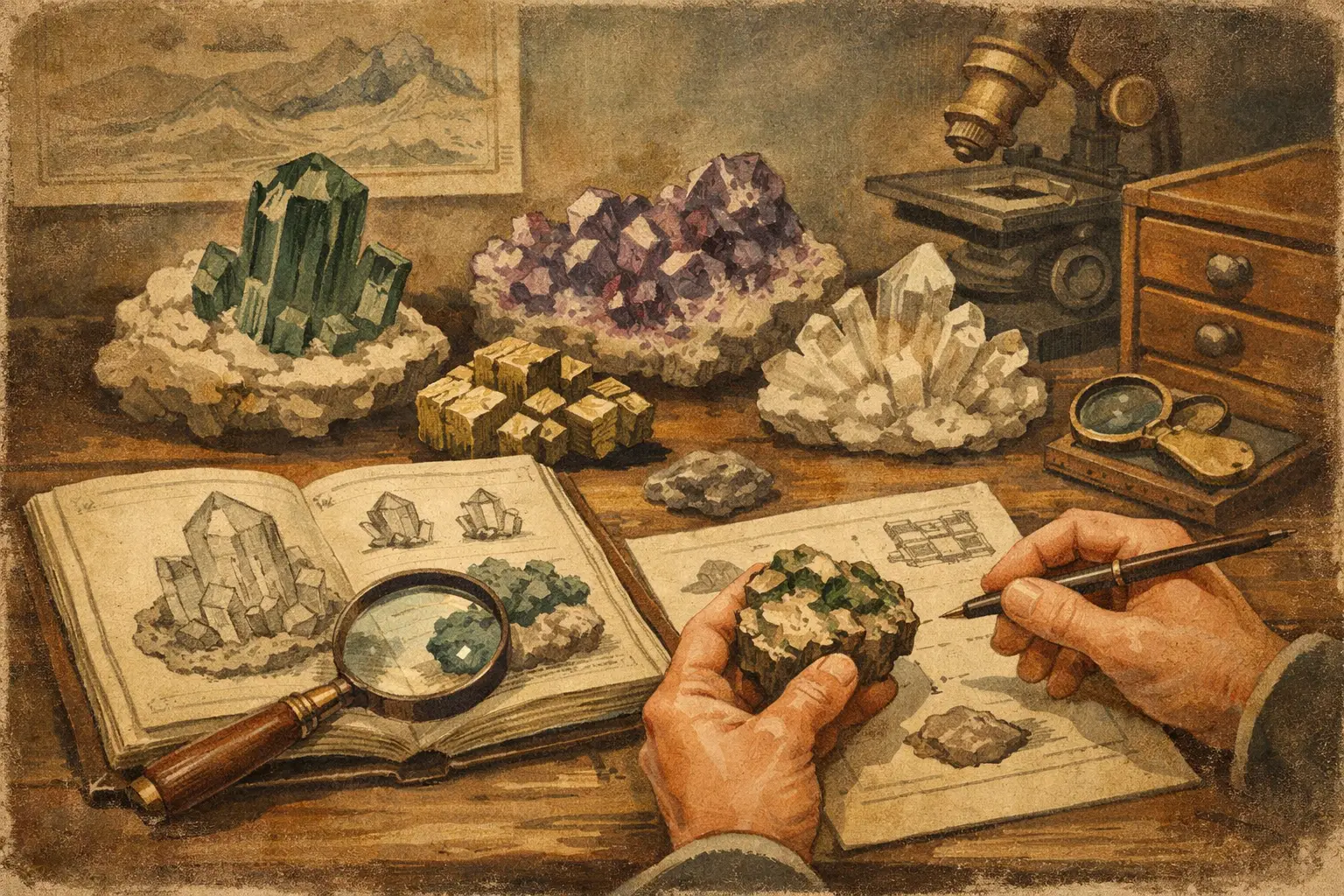
How to document mineral specimens to preserve data, provenance, and photos in a consistent catalog. A practical standard for collectors.
Two specimens of the same mineral may have similar aesthetic value, but after a few years, only one will retain its full collector's value. The difference usually doesn't come from the specimen itself, but from how mineral specimens are documented from the moment of purchase or acquisition. Without an inventory number, location, acquisition date, and good photographs, even a very good specimen quickly becomes an anonymous object in a drawer.
For a collector, documentation is not an add-on. It's an informational layer that organizes the collection, facilitates identification, supports valuation, allows for label creation, and secures provenance. The more systematic the method, the fewer problems arise when expanding the collection, making exchanges, publishing galleries, or preparing exhibits for presentation.
How to Document Mineral Specimens from Day One
The best system is one that works immediately after a new specimen enters the collection. Postponing documentation "until later" almost always results in gaps: the seller's name is lost, the place of origin gets mixed up, and photos remain unassigned to a specific specimen.
A minimum record for each specimen should include:
catalog number,
mineral species name,
location,
acquisition or collection date,
source of the specimen,
basic dimensions,
condition,
identification photo.
This is the absolute minimum. In practice, collectors who build their collections consciously also add information about mineral association, matrix type, old labels, purchase price, ownership history, and identification notes.
If you're wondering how to document mineral specimens permanently, adopt a simple rule: every specimen must exist in parallel in two orders - physical and digital. Physical means the label, packaging, and its place in a drawer or display case. Digital means the object card with data, photographs, and change history.
The Catalog Number is More Important Than the Name on a Slip of Paper
Beginner collectors often only record the mineral name and location. This is insufficient. The name may change after verification, the location may need clarification, and there may be several similar specimens in the collection. The catalog number remains a constant identifier.
Short and unambiguous systems work well, for example, year plus sequential number, or collection abbreviation and number. The most important thing is that one number designates one physical specimen and one catalog card. It's not worth encoding too much information in the number, as the system quickly becomes unreadable.
An example standard might look like this:
CN40-2026-001,
CN40-2026-002,
CN40-2026-003.
Such a record is neutral, scalable, and easy to place on a label, photo, and in a database. If a specimen consists of parts or has a separate display base, it's worth noting this in the remarks field, rather than creating a new number unnecessarily.
What Data to Record for Each Specimen
The quality of documentation depends less on the number of fields and more on their consistent completion. It's better to have 200 specimens described according to one scheme than 50 very detailed records and the rest without basic data.
The most useful set of fields includes:
Identification Data
catalog number,
mineral species name,
any variety or trade name, if present in the source and requiring distinction,
associated minerals,
mineralogical group or class.
Origin Data
country,
region,
mine, quarry, vein, or specific locality,
old and current location name, if they function in parallel,
source of acquisition: purchase, exchange, own field collection, old collection.
Collector Data
acquisition date,
seller or previous owner,
purchase price, if you maintain financial documentation,
information about historical labels,
condition and any repairs.
Physical and Visual Data
dimensions in millimeters,
weight, if relevant,
dominant color,
luster, crystal habit, transparency,
matrix type,
photos of the whole and details.
For more advanced specimens, it's worth adding a field for the identification method. Sometimes macroscopic identification is sufficient, and sometimes information about fluorescence, hardness, chemical analysis, or comparison with reference material will be genuinely significant.
Photography as Part of Documentation, Not Decoration
In mineral collections, a photograph serves as evidence and an organizing tool. It's not just about impressive presentation. Photography allows for confirming the specimen's identity, tracking changes in condition, comparing similar specimens, and working with the collection more quickly without having to remove objects from drawers every time.
The basic set of photos should include:
frontal view,
top or side view, if the specimen's structure requires it,
close-up of the most important part,
photo with a scale or a given reference dimension.
If you document specimens systematically, it's worth using the same background, similar lighting, and a consistent framing method. This facilitates comparisons and gives the collection professional consistency. For small crystals or subtle aggregates, macrophotography is useful, and for fine structures - microscopic documentation.
A good practice is to assign file names to the catalog number, not the mineral name. A file described as "CN40-2026-018_01" will always be easier to find, and confusing it with another specimen will be less likely than with a name like "new green fluorite."
The Physical Label Must Match the Digital Record
The most common mistake is not the lack of data, but the discrepancy between the two systems. A collector has a card on the computer, a separate note in a notebook, and an old label in a box. After a few years, it's no longer clear which version is current.
Therefore, the label accompanying the specimen should contain at least the catalog number, name, and location in abbreviated form. Extended information can be in the digital database, but the physical object must be unambiguously linkable to the record.
If the specimen is very small, the number can be placed on the box, stand, or insert. It's important not to create a situation where several objects lie together without individual identification. This is one of the fastest ways to lose provenance.
How to Maintain a Digital Catalog
A spreadsheet is sufficient at first, but with a larger collection, limitations begin to appear. It becomes harder to manage multiple photos, filter data by location, track change history, or prepare aesthetic labels and galleries. In such cases, a tool designed for collections works better, where the object record, photos, origin map, and public presentation function within a single system.
Regardless of the chosen digital solution, pay attention to a few issues:
vocabulary consistency,
ability to add multiple photos to one specimen,
data export,
backups,
fields for provenance and object history,
easy filtering by species, location, and status.
Control over location naming is particularly important. The same area may appear in sources under different spelling variants. If you write "Erongo" once and "Erongo Mountains" another time, the database will start to fragment. It's worth establishing your own recording standard and sticking to it consistently.
Documentation and Identification Uncertainty
Not every specimen can be described with full certainty immediately. This is normal. The problem only arises when a hypothesis is recorded as a fact. It's better to use a cautious designation than to introduce an unsubstantiated certainty into the catalog.
In such cases, it's worth separating "working identification" and "confirmed identification" fields. You can also add a note about the basis of the designation, for example, an old collection label, macroscopic features, or comparison with reference material. This practice increases the credibility of the entire collection.
It's similar with location. If you only know the country and region, don't add a specific mine just because it sounds plausible. Precision is valuable, but only when justified.
Most Common Mistakes in Documenting Specimens
Most problems stem not from a lack of mineralogical knowledge, but from haste. In practice, the most common issues are:
lack of a catalog number,
recording data only on a paper label,
mixing trade names with correct mineralogical identification,
incomplete or overly general locations,
photos not assigned to a specific record,
lack of updates after correction of designation,
lack of catalog backup.
Each of these errors can be corrected, but usually at the cost of time. The larger the collection, the more expensive it becomes to organize later. Therefore, it's worth establishing a standard early, even if it initially seems too formal.
Well-maintained documentation changes the way you interact with your collection. The collection ceases to be just a set of attractive objects and becomes an archive with its own structure, history, and cognitive value. If you want your specimens to retain their identity ten or twenty years from now, start with one simple habit: don't put off describing them.