A catalogue built to outlast the app
Six convictions from which every Cabinet No. 40 feature follows. On IMA nomenclature, print, field mode, native language, importing from chaos, and the fact tha
Cabinet No. 40 is not an app for notes about stones. It is a catalogue, in the same sense that a museum keeps a catalogue. The distinction is quiet, but everything else follows from it. A note lives as long as the app that holds it. A catalogue is meant to outlive you. Everything described below follows from that single commitment: strict nomenclature, print, export, native language, field mode, privacy. This is not a feature list. It is six convictions, and every Cabinet No. 40 feature is their consequence.
1. The name is the core of the record
A specimen without a correct identification is just a nice stone. A collection without consistent nomenclature is a pile of nice stones. Identification is the foundation, and everything else (provenance, valuation, classification, label) follows from it. If the core wavers, the rest does not matter.
The Identification Assistant (beta) supports that workflow with IMA-aligned species suggestions from specimen photos.
Cabinet No. 40 holds to nomenclature approved by the International Mineralogical Association. Every mineral has one canonical spelling. Every class and subclass comes from the official Nickel-Strunz classification. Live synchronisation with OpenMindat means that when the IMA approves a new species, changes a synonym status, or discredits an old name, your collection sees it without your involvement. A knowledge base of more than 700 mineral pages, with descriptions, formulas, hardness, and crystal systems, is linked to every specimen and every label with one click. Strict nomenclature is not pedantry. It is insurance that in five years you will still know what you actually have in the drawer.
2. The collection must leave the screen
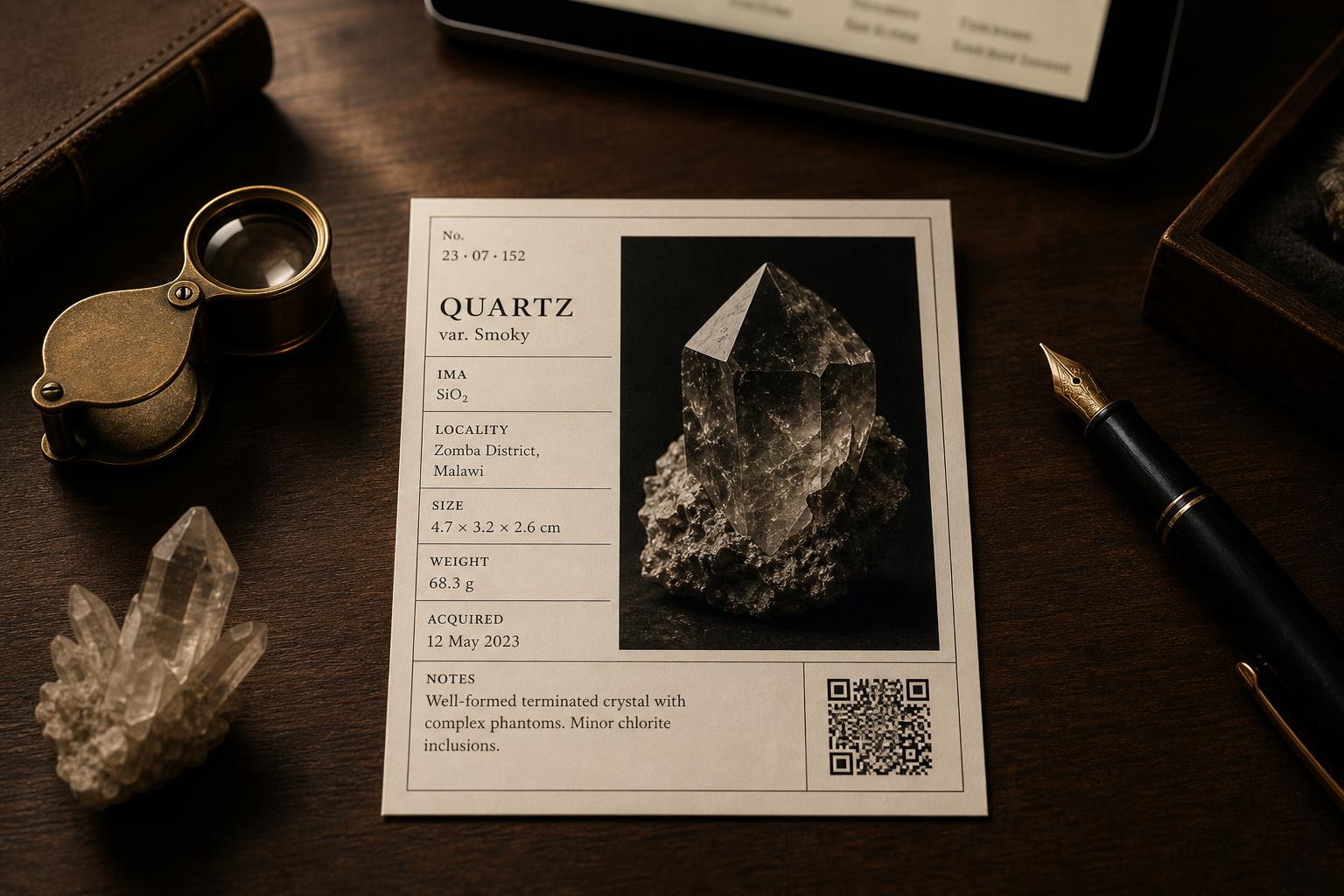
A collection that exists only inside an app is the most fragile kind. Not because apps fail, but because apps are not part of an inheritance. An heir opens a drawer and sees 800 specimens with no name, no number, no history. Or an heir opens a drawer and finds a printed card next to every specimen, with full ID, locality, weight, acquisition date, and a QR code. Print is not dead. Print is the only catalogue layer that will outlive your login credentials.
Cabinet No. 40 ships with four PDF card layouts and a layout editor that lets you build your own, down to the millimetre, margin, and field mapping. We generate labels, mini-cards, and display lists. Every card carries a QR code that resolves to a public specimen URL, openable without a login. Sixty years of archival data on a single sheet of paper. This is not nostalgia. It is durability engineering.
3. Cataloguing happens where the rock is
Most software assumes you catalogue at a desk, after the fact. That assumption costs you memory. When you pick up a specimen at a mine or at a show, you have everything in your head: the mine, the level, the seller, the price, the context. Three weeks later you have half of it. Three months later all that remains is "Brazil" written on the bag.
Field Mode in Cabinet No. 40 works offline. You take a photo, enter a working name and a locality, in the field, with no signal and no laptop battery. The data sits in IndexedDB on your phone and syncs when you come back into range. The draft waits in the panel, you finish it calmly at home. Cataloguing begins the moment a specimen enters your pocket, not weeks later. The collector's memory is the weakest link of provenance. Field Mode lets you route around it.
4. The collector's language is the native one
A Spanish collector does not want a Spanish translation of an American app. An Italian collector does not want machine Italian glued onto an English core. A Polish collector does not want to choose between "kwarc" and "quartz" in the search box. Language is not a feature of the product, it is part of the product, together with units, date format, privacy rules, and naming custom.
Cabinet No. 40 is natively multilingual: Polish, English, and Spanish across the platform, Italian in the Collector Panel. The default unit is millimetres. Local mineralogical nomenclature is respected wherever it exists alongside IMA. Data privacy follows GDPR, not because it has to, but because Cabinet is designed in Europe for collectors everywhere. This is not internationalisation. It is the starting point.
5. Import is not a form, it is a negotiation with chaos
Nobody starts a catalogue from zero. Everyone has an old Excel file, an inherited Access database, a text file from a parent, photos of labels from a private museum that no longer exists. That data is irregular, inconsistent, deduplicated badly, in three languages at once, with photos embedded in the sheet and localities written as "the place I bought from Mariusz". Software that only handles clean CSV does not handle reality.
Cabinet No. 40 import reads Excel with embedded photos, fuzzy-matches mineral names against IMA, detects duplicates by signature (full_id, name, locality, size), and shows a skip/overwrite dialog for every collision. Locality strings are decomposed into structure (country, region, mine, level) so that later you can filter "everything from Namibia below 30 mm". Import is not a form. It is the first conversation between your old collection and a new database. Cabinet is built for that conversation.
6. Your collection is yours
This should be obvious and it is not. In the economy of free apps, your photos, descriptions, transactions, and habits are the currency. They recognise you, profile you, sell you to advertisers, and feed you to language models. Cabinet No. 40 does not live off your data. Cabinet lives off the fact that you pay for a tool. That is the entire deal. The rest is yours, literally.
Export to Excel and JSON is available at any moment, with one click, in full. A public specimen URL can be shared without a login. Cross-device synchronisation runs over Realtime, so you see the same state on laptop, phone, and tablet in real time. No third-party trackers on the site. No AI model is trained on your collection. The account can be deleted, the data can be taken away, the catalogue can be printed and stored in a safe. When Cabinet eventually disappears, and every app eventually disappears, your collection remains.
Six convictions, one design decision
These six points did not come from a whiteboard. They came because Kasia knows more than most about what it means to catalogue specimens properly. Each one solves a specific pain she knows from her own drawer. The absence of a tool that understands IMA the way Mindat does. The absence of print that looks like something an heir will take seriously. The absence of a mode that works in a mine with no signal. The absence of an import that does not demand six hours of Excel cleaning. The absence of native language. The absence of data sovereignty.
Cabinet No. 40 is what we wanted to have for ourselves, built so that ten years from now your catalogue is still readable, exportable, printable, and yours. The rest can be rebuilt. The catalogue cannot.
Open a Collector Panel account or see how Cabinet No. 40 works.