Zincolivenite
Chemical formula: Cu<sup>2+</sup>Zn<sup>2+</sup>As<sup>5+</sup>O<sub>4</sub>(OH)
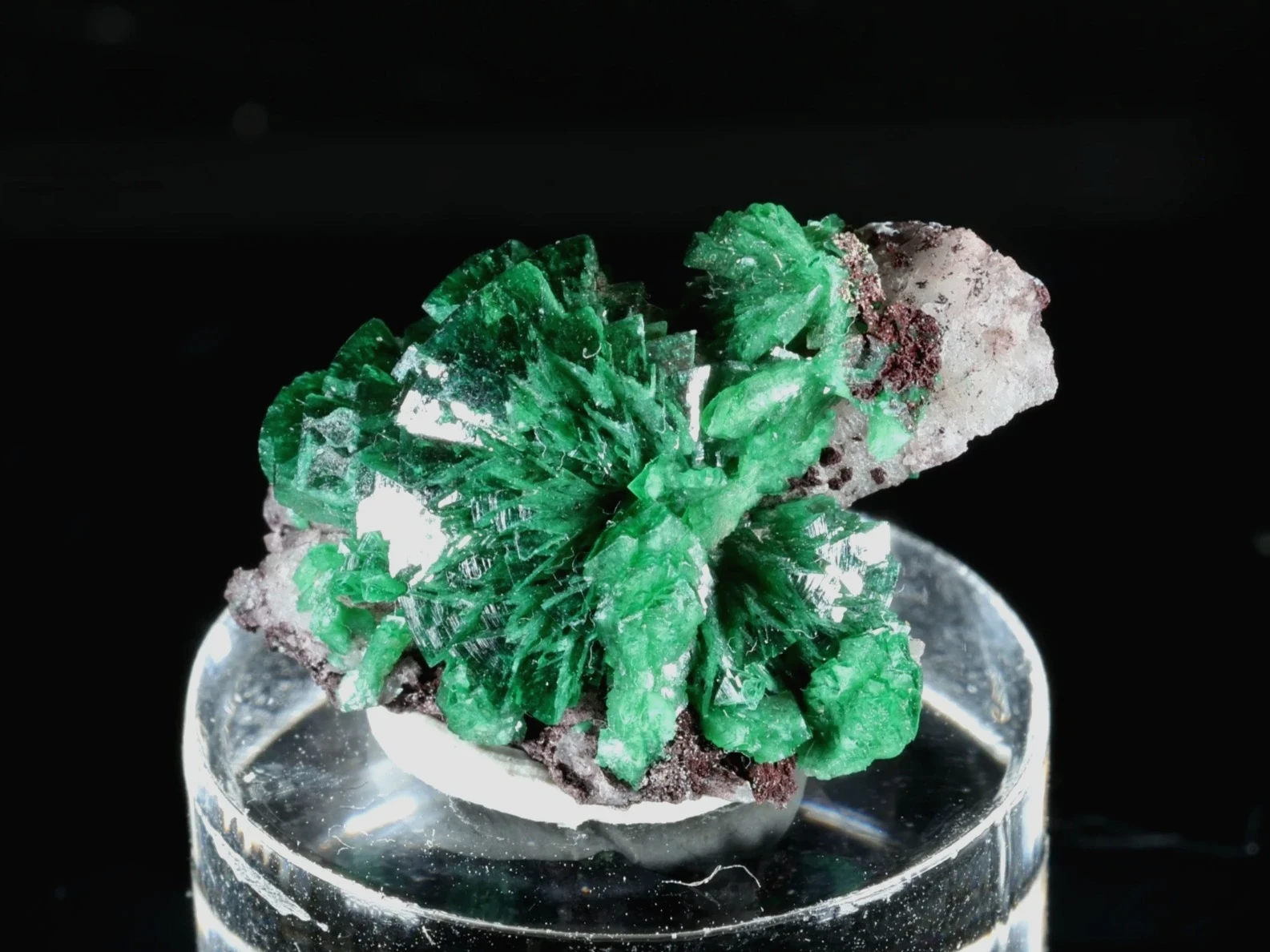
Zincolivenite is a rare copper and zinc arsenate, forming small, prismatic, green crystals, and is the zinc analogue of olivenite.
Properties
- Mohs hardness
- 3.5
- Color
- Green, greenish blue
- Luster
- Adamantine
- Streak
- White
- Density
- 4.34
- Cleavage
- Perfect on {010}, imperfect on {101}
- Fracture
- Conchoidal
- Transparency
- Translucent
- Crystal system
- Orthorhombic
Diagnostic features
## Identification The characteristic features of zincolivenite are its green color, vitreous to adamantine luster, and mode of occurrence – most often as small, acicular or prismatic crystals forming radial aggregates and crusts. A white streak is also a helpful diagnostic clue. It occurs in paragenesis with other secondary copper and zinc minerals. ## Distinguishing from Similar Minerals - **Olivenite**: It is visually almost identical. Zincolivenite and olivenite form a continuous series, and distinguishing them without advanced chemical analysis (e.g., EDS) is often impossible. Zincolivenite is usually lighter, but this is not a rule. - **Adamite**: It can have a similar color and luster, but usually forms crystals of a different shape (wedge-shaped, fan-shaped). Adamite often exhibits strong fluorescence under UV light, which zincolivenite does not possess. - **Conichalcite**: Usually occurs in botryoidal, reniform, or radial-fibrous aggregates, less often forming distinct crystals. ## Crystal Forms Zincolivenite crystals are usually small, with a prismatic, columnar, or acicular habit. It is most commonly found in the form of radial aggregates, rosettes, and also as druses of small crystals covering the surface of the host rock.
Geological environment
## Genesis Zincolivenite is a secondary mineral, formed in the oxidation (weathering) zones of polymetallic ore deposits. It forms as a result of hydrothermal processes, where arsenic-rich solutions react with primary copper and zinc minerals, such as chalcopyrite or sphalerite. ## Mineral Associations It most often co-occurs with other secondary minerals of the oxidation zone. Its typical associated minerals include: adamite, olivenite, conichalcite, tennantite, smithsonite, azurite, malachite, and quartz. ## Localities The most important and well-known localities from which high-quality zincolivenite specimens originate include: - **Namibia**: Tsumeb mine (type locality). - **Greece**: Lavrion (Laurion) mining district. - **USA**: Gold Hill mine in Tooele County, Utah. - **Germany**: Clara mine in the Black Forest. - **Chile**: Veta Negra mine, Copiapó.
Rarity
Uncommon
For collectors
## Quality Criteria The most highly prized zincolivenite specimens are characterized by sharp, well-formed crystals with an intense, saturated green color. High luster (approaching adamantine), transparency, and an attractive composition, for example, in the form of aesthetic, radial aggregates ("sunbursts"), increase its value. A contrasting rock matrix or association with other rare minerals, such as adamite, also significantly enhances its collector appeal. ## Popular Localities Historical finds from the Tsumeb mine in Namibia are considered the source of the world's best zincolivenite specimens. Specimens from Lavrion, Greece, which often feature beautiful, radial aggregates of acicular crystals, are also highly valued.
Care and storage
## Cleaning Zincolivenite specimens should be cleaned with great care. It is safest to remove dust with a soft brush or a stream of compressed air. If necessary, distilled water and a very soft brush can be used, but prolonged soaking should be avoided, and the specimen should be thoroughly dried immediately. Ultrasonic cleaners must not be used. ## What to Avoid As an arsenate, zincolivenite is toxic. Avoid inhaling dust generated during its handling and always wash hands after contact with the mineral. It is a soft mineral, susceptible to scratching. It should be protected from contact with acids and other aggressive chemicals. It is also sensitive to high temperatures. ## Storage It is recommended to store specimens in separate, sealed boxes or display cases to prevent scratching by harder minerals and to limit dust accumulation. A toxicity warning label is good practice.