Zeunerite
Chemical formula: Cu<sup>2+</sup>(U<sup>6+</sup>O<sub>2</sub>)<sub>2</sub>(As<sup>5+</sup>O<sub>4</sub>)<sub>2</sub>·12H<sub>2</sub>O
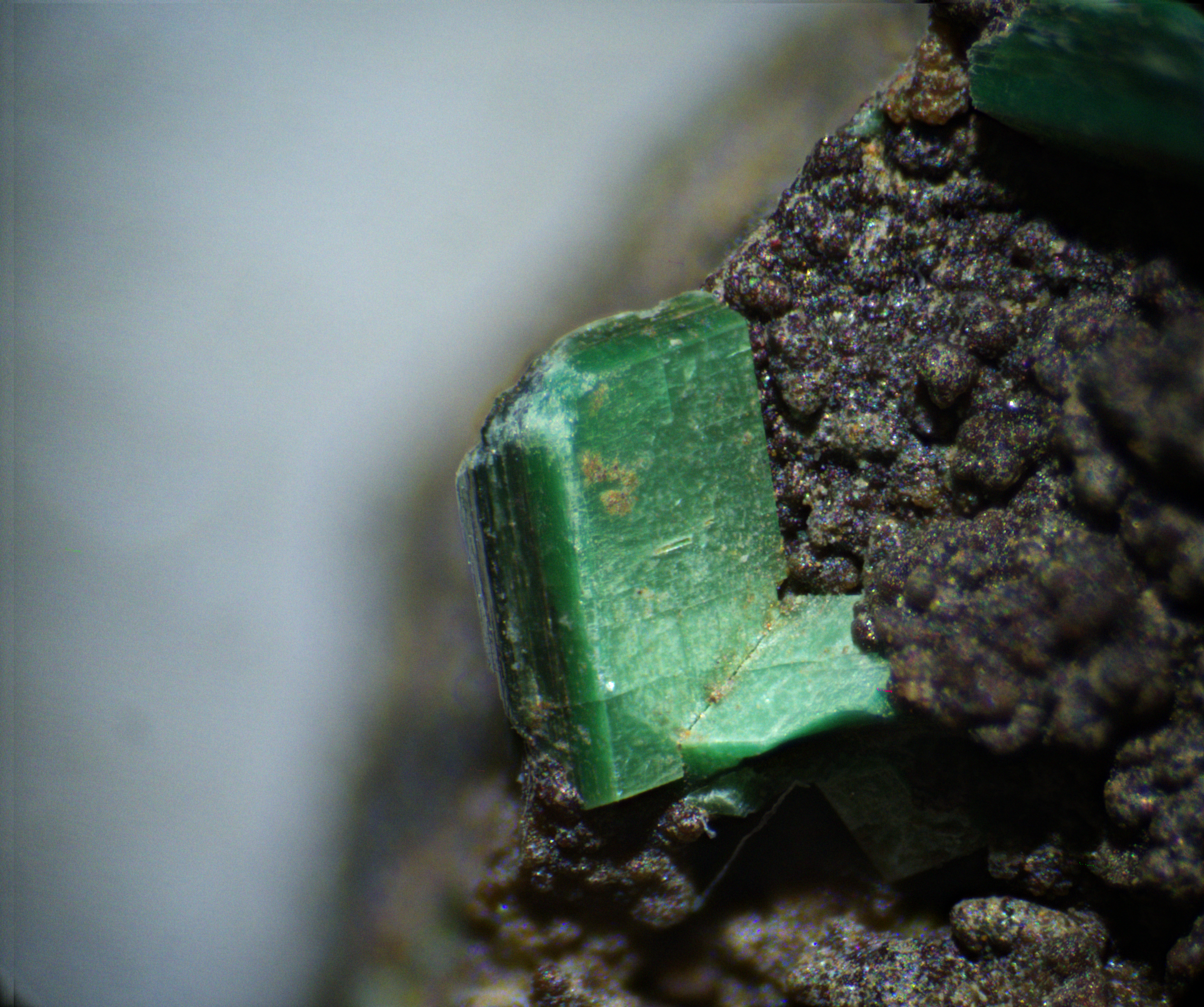
Zeunerite is a copper, uranium, and arsenic mineral, forming characteristic, tabular crystals of an intense green color.
Properties
- Mohs hardness
- 2.5
- Luster
- Pearly, Vitreous
- Streak
- Pale green
- Density
- 3.2
- Cleavage
- Perfect on {001}
- Fracture
- Uneven
- Transparency
- Transparent to translucent
- Crystal system
- Tetragonal
Diagnostic features
## Identification Key diagnostic features of zeunerite include its square, tabular crystal habit, emerald-green color, pearly luster on cleavage planes, and high radioactivity, easily detectable with a Geiger counter. The streak on a porcelain plate is pale green. Unlike autunite, zeunerite usually shows no or very weak fluorescence under ultraviolet light. ## Distinguishing from Similar Minerals Zeunerite is most often confused with torbernite and autunite. - **Torbernite** (Cu(UO₂)₂(PO₄)₂·12H₂O) has an almost identical appearance (color, habit, hardness). Certain differentiation requires chemical analysis to detect arsenic (in zeunerite) or phosphorus (in torbernite). - **Autunite** (Ca(UO₂)₂(PO₄)₂·11H₂O) usually has a more yellow hue and exhibits strong, bright green fluorescence under UV light, which zeunerite lacks. - **Metazeunerite** is a dehydration product of zeunerite and often occurs with it. It is usually less transparent and has a duller luster. ## Crystal Forms Zeunerite crystals are tabular, with a square outline, developed parallel to the basal plane {001}. They occur as single crystals, but more often form fan-shaped and rosette aggregates, as well as scaly and platy coatings on host rocks.
Geological environment
## Genesis Zeunerite is a secondary mineral, forming in the oxidation (weathering) zones of hydrothermal ore deposits rich in uranium, arsenic, and copper. It forms as a result of the alteration of primary uranium minerals, such as uraninite, in the presence of solutions containing copper and arsenate ions. ## Mineral Associations It most often co-occurs with other secondary uranium minerals. Typical associated minerals include torbernite, autunite, uranophane, troegerite, walpurgite, as well as uraninite (as a primary mineral), quartz, fluorite, and various metal sulfides. ## Localities Important and historical localities include: - **Germany**: Schneeberg in Saxony (type locality) and other deposits in the Black Forest. - **Czech Republic**: Jáchymov (St. Joachimsthal). - **United Kingdom**: Cornwall, especially in the St Just and St Austell areas (e.g., Red-Gyll mine). - **USA**: numerous occurrences in Utah, Nevada, Arizona, and New Mexico. - **France**: areas around Autun and Limousin.
Rarity
Not very common
For collectors
## Quality Criteria The most highly valued zeunerite specimens are characterized by sharp, well-formed crystals of large size and an intense, emerald-green color. The transparency of the crystals and their aesthetic arrangement on a small, contrasting rock matrix are also important. Specimens from classic, historical localities, such as Schneeberg or Cornwall, are particularly sought after by advanced collectors. ## Popular Localities Collectors especially appreciate specimens from the historic mines in Schneeberg (Germany) and Cornwall (United Kingdom), which have yielded some of the best crystals of this mineral. Attractive, though usually smaller, crystals also come from numerous small occurrences in the western US states.
Care and storage
## Cleaning Zeunerite is very soft, brittle, and sensitive to changes in humidity. For dust removal, it is best to use a soft brush or compressed air from a safe distance. Wet cleaning should be avoided; contact with water, especially warm water, can accelerate the dehydration process to metazeunerite and damage the specimen. ## What to Avoid The mineral is highly radioactive. Direct contact should be minimized, and hands should always be washed after touching it. It should not be crushed, cut, or heated to avoid inhaling radioactive dust or fumes. Exposure to direct sunlight and high temperatures, which cause water loss, fading, and dulling of crystals, should be avoided. ## Storage Zeunerite specimens should be stored in separate, tightly sealed containers (e.g., "perky boxes") to limit radon emission and protect against mechanical damage. Store away from areas of constant human presence, in a well-ventilated room. It should not be placed in a collection with radiation-sensitive minerals (e.g., some varieties of quartz, fluorite).