Emerald
Chemical formula: Be₃Al₂(Si₆O₁₈)
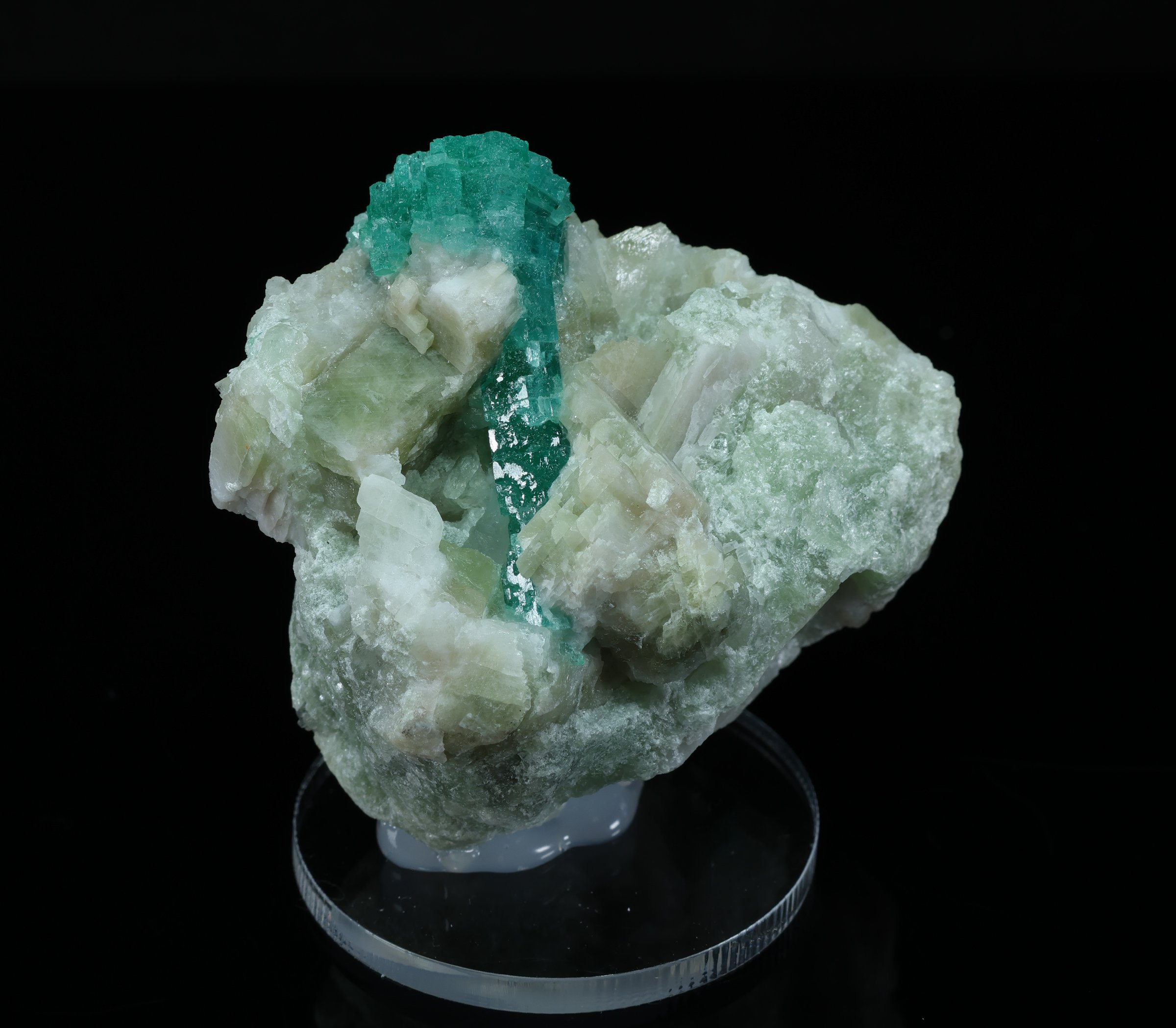
Emerald is a valuable variety of beryl, distinguished by its intense green color, prized in jewelry for thousands of years.
Properties
- Mohs hardness
- 7.5-8
- Luster
- Vitreous
- Streak
- White
- Density
- 0
- Cleavage
- None
- Fracture
- Conchoidal to uneven
- Transparency
- Transparent to translucent
- Crystal system
- Hexagonal
Diagnostic features
## Identification Emerald can be identified by its characteristic green color, vitreous luster, and hexagonal crystal habit. The presence of "jardin" type inclusions is often a good indicator of natural origin. A hardness test can help distinguish it from softer minerals. ## Distinguishing from Similar Minerals Emerald can be confused with other green minerals, such as diopside, tourmaline, demantoid garnet, or green sapphire. It is distinguished from diopside and tourmaline by its higher hardness. It differs from demantoid garnet and green sapphire in chemical composition and optical properties. Synthetic emeralds are also common and require specialized gemological examination for identification. ## Crystal Forms Emerald most commonly occurs as well-formed crystals with a prismatic, hexagonal habit. It often forms aggregates embedded in the host rock. Crystals can be short-prismatic or long-prismatic, with clearly defined prism and basal faces.
Geological environment
## Genesis Emerald forms under specific geological conditions, typically in pegmatites, pneumatolytic quartz veins, and in mica and biotite schists, where chromium or vanadium elements, essential for the green color, are present. It forms as a result of hydrothermal processes, often in contact zones of granitic intrusions with ultramafic rocks. ## Mineral Associations Emerald often co-occurs with quartz, feldspar, muscovite, biotite, fluorite, pyrite, and calcite. In some deposits, it is also accompanied by other beryl minerals, such as aquamarine. ## Localities The most famous and prized emerald deposits are located in Colombia (Muzo, Chivor, Coscuez), Zambia (Kagem), Brazil (Minas Gerais), Russia (Urals), Pakistan, and Afghanistan. Smaller deposits also occur in other countries, such as Madagascar, Nigeria, and the United States.
Rarity
Rare
For collectors
## Quality Criteria The most important quality criteria for emerald are color, clarity, cut, and carat weight. The most desirable stones are those with an intense, deep green, without eye-visible inclusions, although minor inclusions are accepted as proof of naturalness. The emerald cut, specially developed for this stone, aims to maximize its color and minimize the risk of damage. Large, clean stones of excellent color are the most valuable. ## Market Prices Emerald prices vary widely and depend on many factors, such as color, clarity, carat weight, origin, and cut quality. High-quality Colombian emeralds can fetch very high prices per carat, often exceeding the prices of diamonds of similar weight. Zambian emeralds are also highly valued. Smaller stones of lower clarity are significantly cheaper. ## Popular Localities The most prized emerald specimens come from Colombia, especially from the Muzo and Chivor mines, known for stones of exceptional color and clarity. Zambian emeralds are also highly sought after due to their intense, slightly bluish-green color. Russian emeralds from the Urals, though rarer on the market, are also highly regarded.
Care and storage
## Cleaning Emeralds should be cleaned gently, using warm water with mild soap and a soft brush. After washing, the stone should be thoroughly rinsed with clean water and dried with a soft cloth. ## What to Avoid Emeralds are sensitive to sudden temperature changes, which can lead to fractures. Ultrasonic and steam cleaning methods should be avoided, as they can damage the stone or cause the oil, with which emeralds are often treated to improve their clarity, to leach out. Contact with strong chemicals, such as acids or solvents, is also inadvisable. Prolonged exposure to direct sunlight can, in rare cases, affect the intensity of the color. ## Storage Emeralds should be stored separately from other gemstones to prevent scratching. It is best to wrap them in a soft cloth or place them in a separate compartment of a jewelry box. Due to their brittleness, emeralds require careful handling and protection from impacts.