Petarasite
Chemical formula: Na<sub>5</sub>Zr<sup>4+</sup><sub>2</sub>Si<sub>6</sub>O<sub>18</sub>(Cl,OH)(H<sub>2</sub>O)<sub>2</sub>
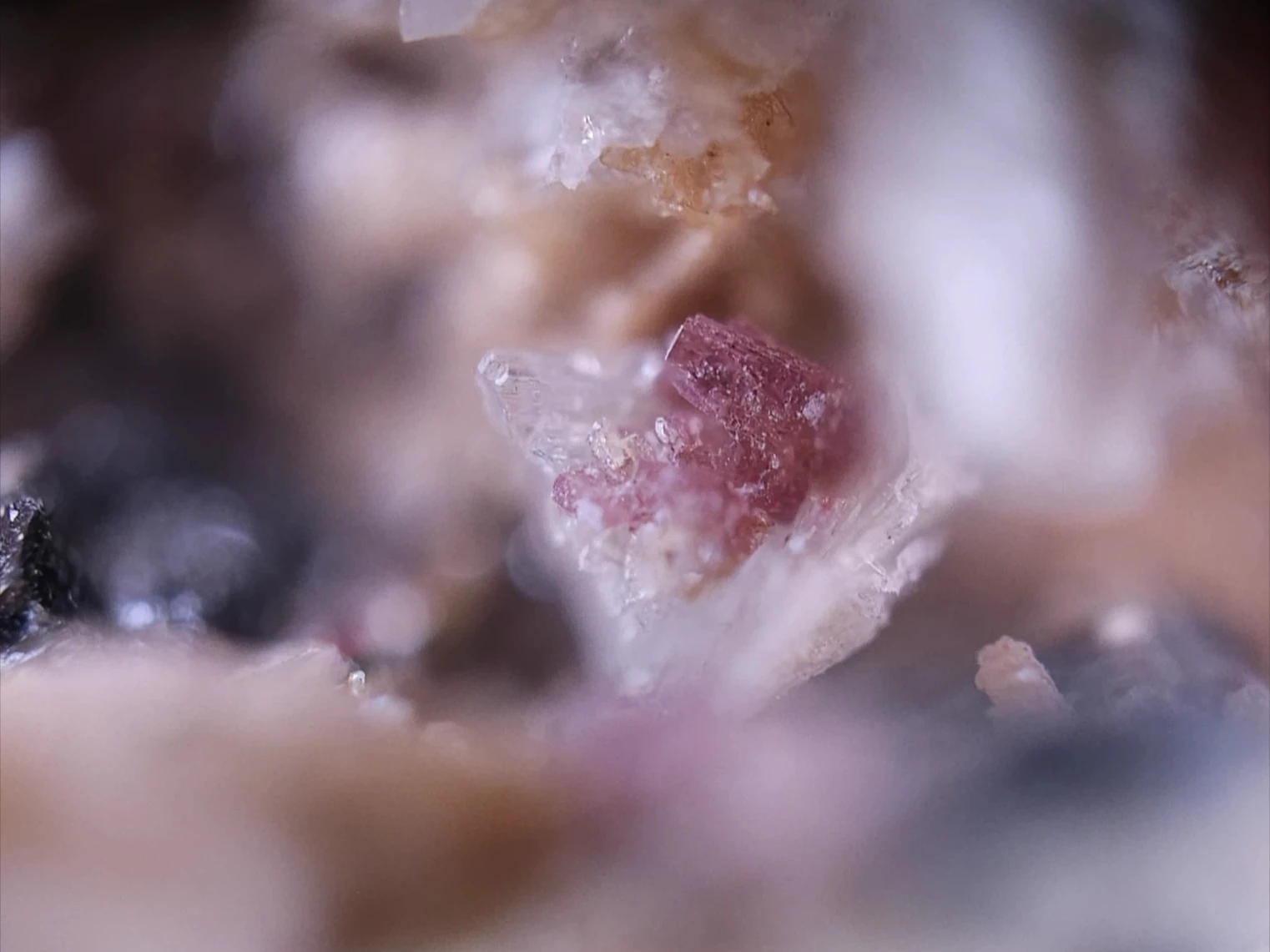
Petarasite is a very rare cyclosilicate, known for its yellow, prismatic crystals found mainly in Mont Saint-Hilaire, Canada.
Properties
- Mohs hardness
- 5-5.5
- Color
- Orange to brown, pink, yellow, white
- Luster
- Vitreous
- Streak
- White.
- Density
- 2.88
- Cleavage
- Very good on {110}, plus 2 more directions distinct.
- Fracture
- Sub-Conchoidal
- Transparency
- Translucent
- Crystal system
- Monoclinic
Diagnostic features
## Identification Petarasite can be recognized by its characteristic yellow or yellowish-green color, prismatic crystal habit, and vitreous luster. A key diagnostic feature is perfect cleavage in one direction. Its occurrence is almost exclusively limited to the specific environment of nepheline syenite pegmatites in Mont Saint-Hilaire, which is a strong identification clue. ## Differentiation from Similar Minerals At its locality, petarasite may be confused with other yellow minerals, such as catapleiite or some varieties of eudialyte. It differs from catapleiite by its crystal habit and slightly different physical properties. Final and certain differentiation often requires advanced analytical methods, such as X-ray diffraction (XRD). ## Crystal Forms Petarasite crystals are typically prismatic, elongated, or short-columnar, often with a cross-section similar to a square. They occur as single, well-formed individuals or in small, loose groups. Granular aggregates are rarer.
Geological environment
## Genesis Petarasite is an igneous mineral, crystallizing in the late stages of hydrothermal processes. It forms in cavities and fissures of nepheline syenite pegmatites that cut alkaline igneous intrusions, such as gabbros and syenites. ## Mineral Associations This mineral occurs in association with many other rare minerals typical of Mont Saint-Hilaire. The most common associations include aegirine, albite, analcime, catapleiite, eudialyte, lorenzenite, microcline, natrolite, nepheline, and serandite. ## Localities The most important and practically only source of well-formed petarasite specimens in the world is the Poudrette quarry in Mont Saint-Hilaire, in the Montérégie region, Quebec, Canada. This is the type locality for this mineral.
Rarity
Very rare
For collectors
## Quality Criteria The most highly prized petarasite specimens are those with sharp, well-terminated, and fully transparent crystals of an intense, lemon-yellow color. Crystal size is also very important – specimens exceeding 1 cm are already considered exceptional. Aesthetic compositions where yellow petarasite crystals contrast with associated minerals such as white albite, black aegirine, or pink serandite are also highly valued. ## Popular Localities The only locality from which specimens of interest to collectors originate is Mont Saint-Hilaire in Canada. Minerals from this location are the global standard for this species.
Care and storage
## Cleaning Petarasite specimens should be cleaned very carefully, using a soft brush and distilled water. Due to its perfect cleavage, the use of ultrasonic cleaners is discouraged, as they could cause cracking or delamination of the crystals. ## What to Avoid Avoid contact with strong acids and other aggressive chemicals. The mineral is brittle and sensitive to impacts and mechanical pressure, which can easily damage crystals along cleavage planes. Its particular sensitivity to light or temperature changes under household conditions is not known. ## Storage It is recommended to store specimens in separate, padded collector's boxes to protect them from dust, shocks, and contact with harder minerals. Well-formed crystals are best displayed in showcases, away from areas prone to vibrations.