Magnetoilmenite
Chemical formula: Fe²⁺(Ti,Fe³⁺)O₃
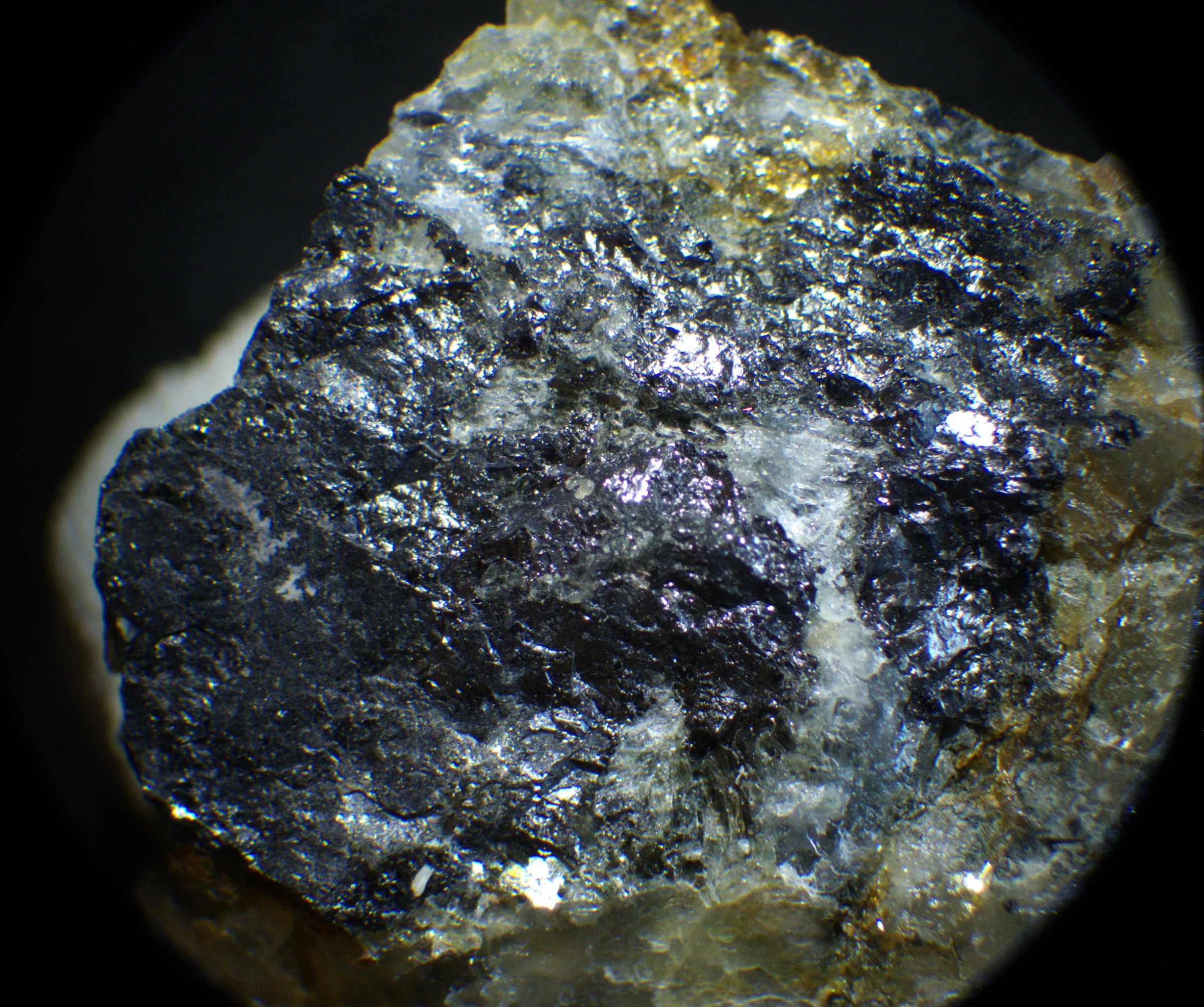
Magnetoilmenite is an iron-rich, magnetic variety of ilmenite, not recognized as a distinct mineral species.
Properties
- Mohs hardness
- 5.5-6.5
- Luster
- Metallic to sub-metallic
- Streak
- Black to brownish-black
- Density
- 0
- Cleavage
- None
- Fracture
- Conchoidal to uneven
- Transparency
- Opaque
- Crystal system
- Trigonal
Diagnostic features
## Identification The key diagnostic feature is the combination of an appearance typical of ilmenite (black color, metallic luster) with distinct magnetism – the specimen should be attracted by a strong magnet. The streak is black to brownish-black, which helps distinguish it from hematite. ## Distinguishing from Similar Minerals - **Ilmenite**: Pure ilmenite is only weakly paramagnetic and does not react to a common magnet. - **Magnetite**: It is strongly magnetic and has a black streak, similar to magnetoilmenite. Differentiation can be impossible without chemical analysis or X-ray diffraction (XRD). Magnetite crystallizes in the isometric system, and ilmenite in the trigonal system, which is rarely visible macroscopically. - **Hematite**: It has a characteristic, reddish-brown streak. Some of its varieties (e.g., martite) can be slightly magnetic, but usually weaker than magnetoilmenite. ## Crystal Forms It most often occurs as anhedral grains or massive aggregates within rock. Less commonly, it forms tabular crystals with a hexagonal outline, inherited from the ilmenite structure.
Geological environment
## Genesis Magnetoilmenite forms under high-temperature conditions as a primary mineral in igneous rocks, both mafic (gabbros, norites, anorthosites) and felsic (granites). It also forms as a result of metamorphic processes. It is often a product of partial oxidation and transformations within the ilmenite-hematite solid solution during slow cooling of magma. ## Mineral Associations It typically co-occurs with magnetite, hematite, rutile, pyroxenes (e.g., augite, hypersthene), and plagioclase. ## Localities As a rock-forming mineral, it is widely distributed worldwide. It occurs in many large titanomagnetite deposits, including the Bushveld Complex (South Africa), the Allard Lake area (Quebec, Canada), the Tellnes massif (Norway), and in gabbros and anorthosites of the Baltic Shield.
Rarity
Common
For collectors
## Quality Criteria Magnetoilmenite is not a typical collector's mineral. Its value is primarily scientific or industrial. In specialized collections, specimens with precisely documented localities, exhibiting interesting intergrowths with other minerals (e.g., exsolution lamellae visible under a microscope), or originating from classic localities for titanomagnetite deposits may be valued.
Care and storage
## Cleaning Specimens can be safely cleaned with a soft brush and distilled water. For massive, compact aggregates, ultrasonic cleaning is permissible, but with caution. ## What to Avoid Avoid contact with strong acids, which can etch the mineral surface. It is resistant to temperature changes and sunlight. ## Storage It does not require special conditions. It can be stored under standard collection conditions, in boxes or on stands. Due to its magnetism, larger specimens may affect the operation of sensitive compasses.