Lavendulan
Chemical formula: NaCaCu<sup>2+</sup><sub>5</sub>(As<sup>5+</sup>O<sub>4</sub>)<sub>4</sub>Cl(H<sub>2</sub>O)<sub>5</sub>
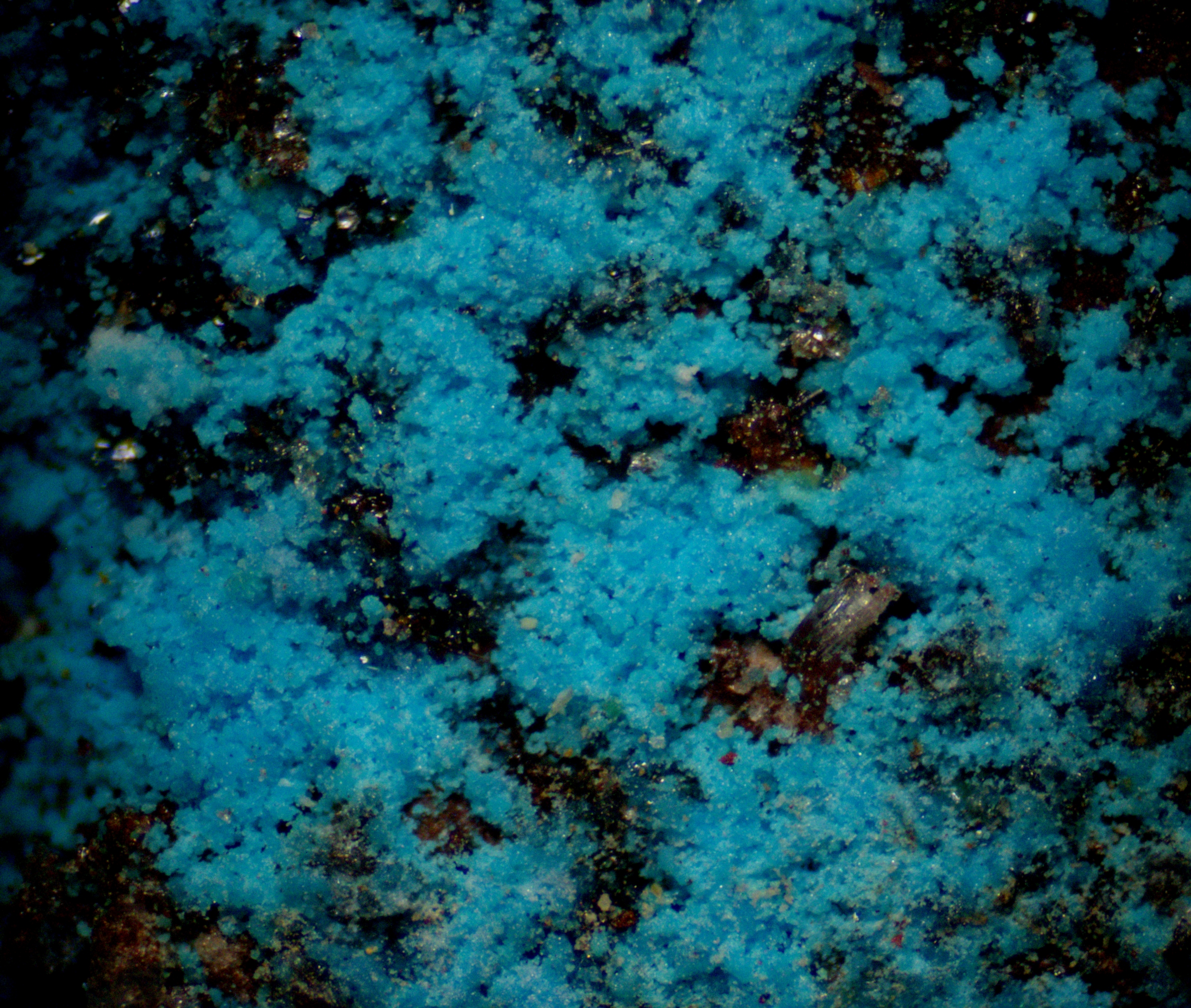
Lavendulan is a rare copper, calcium, and sodium mineral, valued by collectors for its characteristic lavender-blue color.
Properties
- Mohs hardness
- 2.5
- Color
- Turquoise-blue, greenish blue, pale blue
- Luster
- Vitreous, Waxy, Pearly
- Streak
- Light blue
- Density
- 3.54
- Cleavage
- Good on {010} Distinct on {100} {001}
- Fracture
- Uneven
- Transparency
- Translucent
- Crystal system
- Monoclinic
Diagnostic features
## Identification The most important diagnostic feature of lavendulan is its unique lavender-blue color. It usually occurs in the form of crusts, fibrous aggregates, and small spherulites. The rarity of well-formed crystals means that the form is also an important clue. A light blue streak helps in identification. ## Distinguishing from Similar Minerals Lavendulan is sometimes confused with other blue secondary minerals of the oxidation zone, such as chalcanthite, linarite, or some varieties of turquoise. Chalcanthite is water-soluble and has a different shade of blue. Linarite is usually darker and crystallizes in a different habit. Chemical analysis confirming the presence of arsenic, copper, calcium, and sodium is the ultimate identification method. ## Crystal Forms Well-formed crystals are rare and usually appear as very small, thin tablets or blades, often grouped into rosette-like or star-shaped aggregates. However, the most common forms of occurrence are fine-grained or fibrous crusts and spherical aggregates with a radial internal structure.
Geological environment
## Genesis Lavendulan is a secondary mineral, formed in the oxidation (weathering) zones of ore deposits containing arsenic and copper. It forms as a result of the action of surface waters on primary arsenical minerals, such as tennantite or arsenopyrite, in the presence of copper minerals. ## Mineral Associations It often co-occurs with other copper arsenates and minerals of the oxidation zone. Its typical associated minerals include: olivenite, erythrite, annabergite, tenorite, cuprite, malachite, azurite, as well as gypsum and calcite. ## Localities The most important historical and contemporary localities for lavendulan are Jáchymov in the Czech Republic (type locality), mines in the Saxony region of Germany, Lavrio mines in Greece, and the Atacama Desert in Chile (especially around Copiapó). Significant specimens also come from the San Juan mine in Argentina, as well as from some sites in the USA (Arizona, Utah) and Australia.
Rarity
Rare
For collectors
## Quality Criteria The most highly prized lavendulan specimens are characterized by an intense, saturated, lavender-blue color. The form of occurrence is of great importance – rich crusts covering a significant area of the host rock or well-formed, radial aggregates are more desirable than thin coatings. Exceptionally rare, macroscopic crystals fetch the highest prices. The contrast with the color of the host rock also enhances the specimen's attractiveness. ## Popular Localities Localities in Chile (e.g., Casualidad mine, Copiapó district), known for specimens with vibrant color and beautiful, spherical aggregates, are considered classic and yield the best specimens. Historically, specimens from Jáchymov (Czech Republic) and Saxony (Germany) are also valued. Specimens from Lavrio, Greece, are also sought after by collectors.
Care and storage
## Cleaning Lavendulan specimens are very delicate and sensitive. For dust removal, use only a soft brush or compressed air from a safe distance. Due to its arsenic content and water solubility, contact with water should be avoided. If absolutely necessary, the surface can be very carefully wiped with a cotton swab minimally moistened with distilled water, and then immediately dried. ## What to Avoid Lavendulan is sensitive to chemicals, especially acids, which decompose it. Ultrasonic and steam cleaners should be avoided. The mineral is also unstable at elevated temperatures, which can lead to dehydration and color change. Prolonged exposure to strong sunlight can cause fading. ## Storage It is recommended to store specimens in closed, stable containers or display cases, away from dust, moisture, and direct sunlight. Due to its brittleness and softness, it should be isolated from harder minerals to avoid scratches and mechanical damage.