Smoky Quartz
Chemical formula: SiO₂
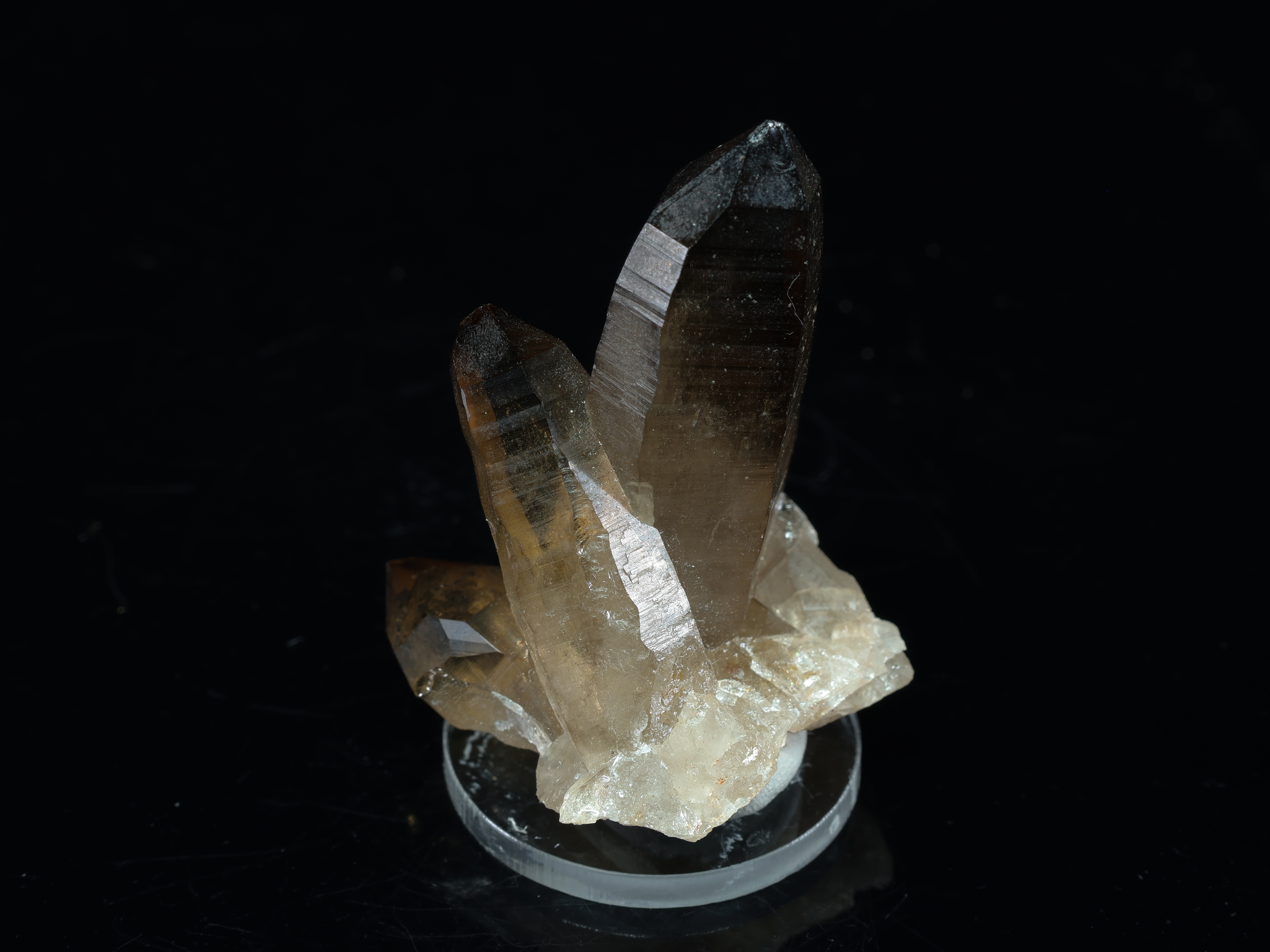
Smoky quartz is a variety of quartz ranging in color from gray to brown to black, with its coloration resulting from natural ionizing radiation.
Properties
- Mohs hardness
- 7
- Luster
- Szklisty
- Streak
- Biała
- Density
- 0
- Cleavage
- Brak
- Fracture
- Muszlowy
- Transparency
- Transparent,Translucent
- Crystal system
- Trygonalny
Diagnostic features
## Identification Smoky quartz can be identified by its characteristic color, which ranges from gray, through brown, to black. Crystals often have the typical prismatic quartz shape with pyramidal terminations. A hardness of 7 on the Mohs scale allows it to scratch glass, which is a helpful diagnostic feature. The luster is vitreous. ## Distinguishing from Similar Minerals Smoky quartz can be confused with other dark minerals, such as tourmaline (schorl) or obsidian. It differs from tourmaline by the absence of distinct pleochroism and a different crystal habit (tourmaline often has a triangular cross-section). From obsidian, which is volcanic glass, smoky quartz differs in its crystalline structure and hardness (obsidian is softer). Dark varieties of smoky quartz (morion) may resemble black varieties of quartz, but morion is usually characterized by a more intense and uniform color. ## Crystal Forms Smoky quartz most often occurs as well-formed, hexagonal prisms terminated by pyramids. Crystals can be single, form twins, or crystal druses on a rock matrix. Granular or massive aggregates are also frequently observed.
Geological environment
## Genesis Smoky quartz forms in igneous rocks, such as granites and pegmatites, as well as in hydrothermal veins. Its characteristic coloration is the result of natural ionizing radiation (e.g., from radioactive elements present in the surrounding rocks) interacting with the crystal lattice of quartz containing aluminum impurities. This process leads to the formation of color centers that absorb light, giving the mineral its smoky hue. ## Mineral Associations Smoky quartz often co-occurs with other minerals typical of pegmatitic and hydrothermal environments. These include feldspars (orthoclase, albite), micas (muscovite, biotite), tourmalines, topazes, beryls, and garnets. It can also occur in association with other varieties of quartz, such as milky quartz or rock crystal. ## Localities Significant deposits of smoky quartz are found in many places around the world. The most famous include Brazil (Minas Gerais), Switzerland (Alps), United States (Colorado, Arkansas), Madagascar, Russia (Urals), and Ukraine. In Poland, specimens of smoky quartz can be found in the Sudetes, especially in the Strzegom and Karkonosze regions.
Rarity
Very Common
For collectors
## Quality Criteria The most prized specimens of smoky quartz are characterized by intense, uniform color, high transparency, and well-formed, undamaged crystals. Large, single crystals with distinct faces and sharp edges are particularly sought after. The aesthetics of the specimen as a whole, including how the crystals are embedded in the matrix, is also important. ## Popular Localities Among the most valued localities for smoky quartz are the Swiss Alps, known for large and clear crystals, and Brazil, from which specimens of various shades of brown originate. Specimens from Colorado, USA, are also highly regarded for their quality and dark coloration.
Care and storage
## Cleaning Smoky quartz can be cleaned with warm water and a mild soap. A soft brush or cloth should be used to gently remove dirt from the mineral's surface. After washing, the specimen should be thoroughly rinsed with clean water and dried with a soft cloth. ## What to Avoid Avoid using strong chemical agents, such as acids or bases, which can damage the quartz surface. The mineral is sensitive to sudden temperature changes, which can lead to cracks. Prolonged exposure to intense sunlight can cause the color to fade, so it is recommended to store it away from direct sunlight. Smoky quartz is also sensitive to ultrasound, so cleaning it in ultrasonic cleaners is not recommended. ## Storage Smoky quartz is best stored in separate boxes or soft pouches to prevent scratching by harder minerals. Ideal conditions include stable temperature and low humidity. Specimens can be displayed in enclosed showcases, protecting them from dust and direct light.