Gormanite
Chemical formula: Fe²⁺₃Al₄(PO₄)₄(OH)₆·2H₂O
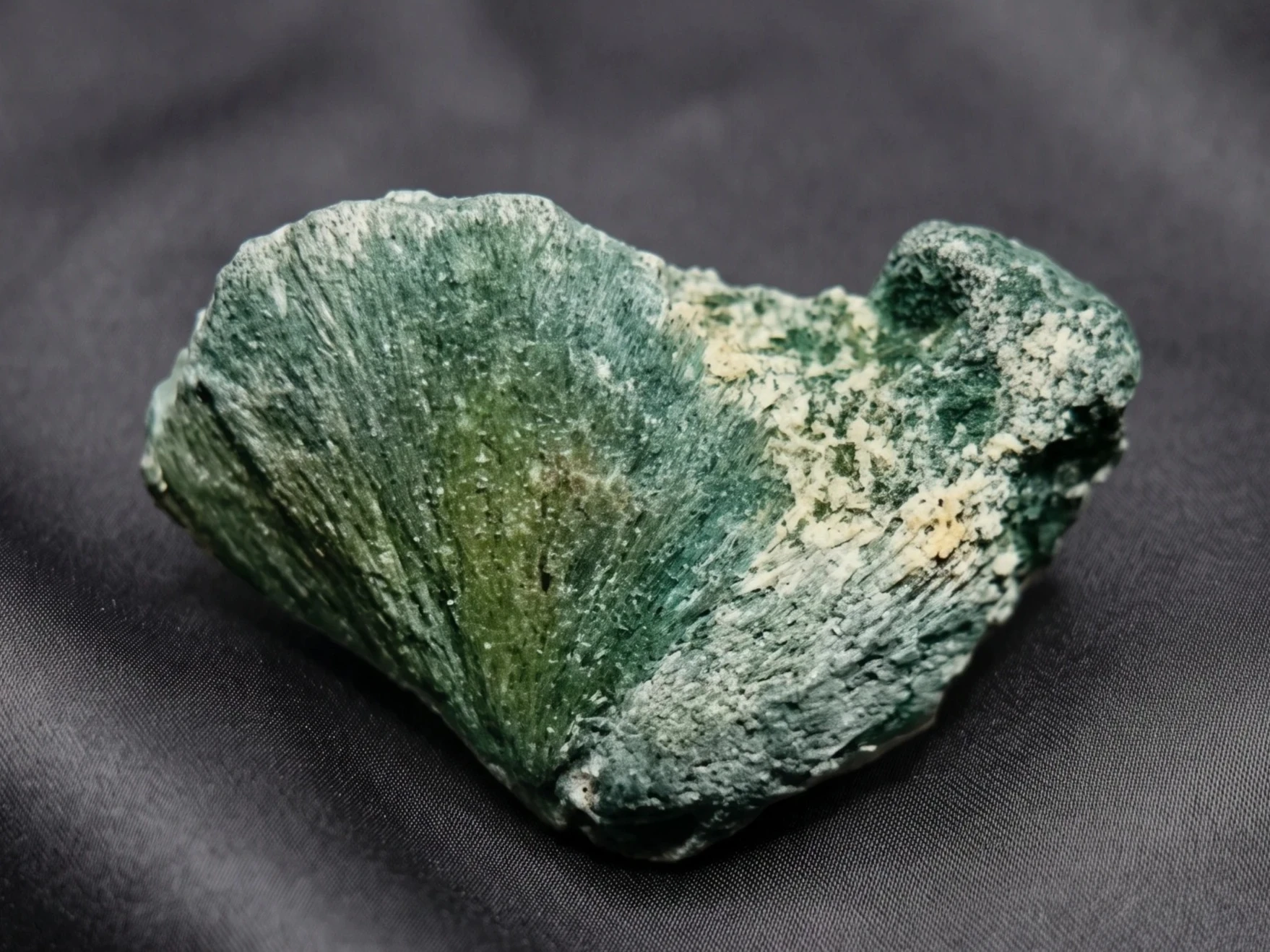
Gormanite is a rare iron and aluminum phosphate, forming dark green to blue-green aggregates in phosphate pegmatites.
Properties
- Mohs hardness
- 4-5
- Color
- Blue green to dark green
- Luster
- Vitreous
- Streak
- Pale green
- Density
- 3.10
- Cleavage
- {001}
- Fracture
- Splintery
- Transparency
- Transparent,Translucent
- Crystal system
- Triclinic
Diagnostic features
## Identification Gormanite is identified by its characteristic blue-green to dark green color, vitreous luster, and occurrence as massive or fibrous aggregates in association with other phosphates. Its relatively low hardness is a good indicator. ## Distinguishing from Similar Minerals Gormanite is sometimes confused with other green and blue phosphates, such as lazulite, vivianite, or ludlamite. It differs from lazulite by its lower hardness and usually greener hue. Vivianite often forms radial aggregates and is more sensitive to light. Accurate identification often requires advanced analytical methods, such as X-ray diffraction (XRD). ## Crystal Forms Gormanite crystals are rare. They typically have a tabular or bladed habit and are poorly formed. It is most commonly found as compact, massive, fibrous, or radial aggregates.
Geological environment
## Genesis Gormanite is a secondary mineral, forming in complex granite pegmatites rich in phosphorus. It forms as a result of hydrothermal or metasomatic processes, replacing earlier phosphate minerals. ## Mineral Associations This mineral often co-occurs with other phosphates. In its type locality (Yukon, Canada), it was found in association with quartz, lazulite, wardite, augelite, brazilianite, whitlockite, and apatite. In pegmatites from New Hampshire (USA), it occurs with ludlamite, vivianite, triplite, and other iron and manganese phosphates. ## Localities The most important and well-known gormanite localities worldwide are the Rapid Creek area in Yukon Territory, Canada (type locality), and the Palermo No. 1 mine in North Groton, New Hampshire, USA. These are the main sources of the best-formed specimens of this mineral.
Rarity
Rare
For collectors
## Quality Criteria The most prized specimens by collectors are those with well-formed, even if small, crystals of intense, blue-green color. The attractiveness is also enhanced by a contrasting rock matrix, such as light quartz, and association with other rare phosphate minerals. Specimens from the Palermo No. 1 mine, often in the form of radial aggregates, are equally sought after. ## Popular Localities Undoubtedly, the most desirable specimens come from two classic localities: the Rapid Creek area in Canadian Yukon and the Palermo No. 1 mine in New Hampshire, USA. Material from these locations is considered reference for this species.
Care and storage
## Cleaning Gormanite specimens should be cleaned very carefully, using a soft brush to remove dust. Distilled water is permissible, but prolonged soaking should be avoided. After wet cleaning, the specimen must be thoroughly dried. ## What to Avoid Contact with acids and other strong chemicals, which can damage the mineral, must be strictly avoided. Gormanite is relatively soft, so it needs to be protected from scratching by harder minerals. It should not be exposed to high temperatures or cleaned in ultrasonic cleaners. ## Storage Gormanite specimens are best stored in separate, padded boxes or display cases to prevent abrasion and mechanical damage. They should be protected from dust and moisture.