Gobbinsite
Chemical formula: Na₅(Si₁₁Al₅)O₃₂·11H₂O
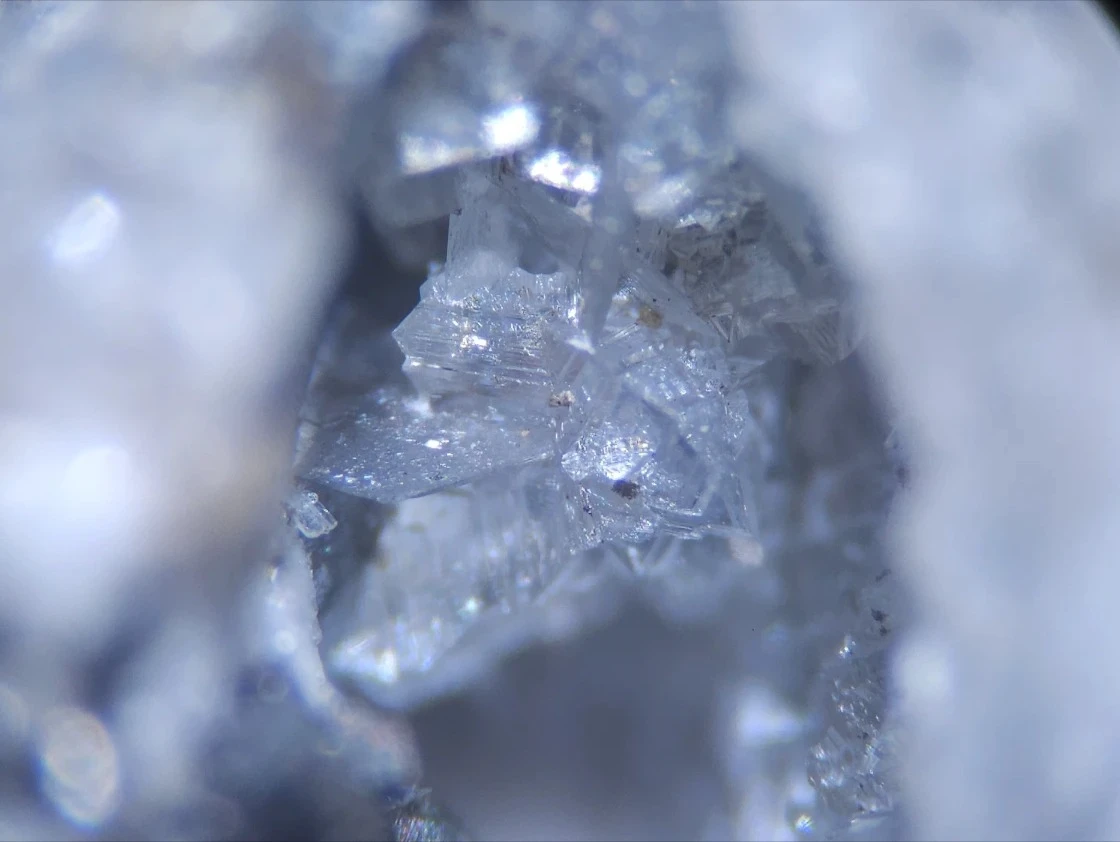
Gobbinsite is a rare mineral from the zeolite group, forming small, spherical aggregates with a silky luster.
Properties
- Mohs hardness
- 4
- Color
- White, colourless
- Luster
- Vitreous, Silky
- Streak
- White
- Density
- 0
- Cleavage
- Good on {010} and {100}
- Fracture
- Uneven
- Transparency
- Transparent,Translucent
- Crystal system
- Orthorhombic
Diagnostic features
## Identification A characteristic feature of gobbinsite is its mode of occurrence - small, white, spherical aggregates with a radial, fibrous structure and a silky luster. A key diagnostic clue is its environment of occurrence, i.e., voids and fissures in basaltic rocks, in association with other minerals from the zeolite group. ## Differentiation from Similar Minerals Gobbinsite can be confused with other fibrous zeolites, such as natrolite, mesolite, scolecite, or thomsonite. Natrolite forms similar aggregates, but its crystals are often better formed and have a different cross-section. Thomsonite also forms radial aggregates but may show subtle differences in luster and structure. Definitive differentiation of these minerals often requires advanced studies, e.g., X-ray diffraction (XRD). ## Crystal Forms Gobbinsite forms aggregates of small, acicular or fibrous crystals. Most often, they are arranged radially from a common center, forming spherical spherulites or hemispheres. Less commonly, disordered, tangled clusters of fibers are found.
Geological environment
## Genesis Gobbinsite is a hydrothermal mineral. It forms at low temperatures as a result of the activity of aqueous solutions circulating in voids and fissures (so-called amygdales) in volcanic rocks, mainly basalts. It crystallizes from post-magmatic waters, filling free spaces. ## Mineral Associations It most often co-occurs with other zeolites, such as gismondine, phillipsite, chabazite, analcime, and also with calcite. The presence of these minerals is typical for the environment in which gobbinsite forms. ## Localities The most important and classic locality for this mineral is The Gobbins in Northern Ireland. It is also known from other localities in County Antrim (e.g., Magheramorne quarry). Outside Northern Ireland, its occurrences have been reported, among others, in Kladno in the Czech Republic, in basalts in Oregon (USA), in the Southland region of New Zealand, and in the Faroe Islands.
Rarity
Rare
For collectors
## Quality Criteria The most valued specimens are those that have well-formed, undamaged spherulites with a distinct silky luster. The attractiveness is enhanced by the large size of the spherical clusters and their abundant coverage on a contrasting colored matrix rock. Specimens with clear associations with other, well-crystallized zeolites are also more highly rated. ## Popular Localities Specimens from localities in Northern Ireland, especially from the type locality (The Gobbins) and from the quarry in Magheramorne, are considered the most classic and sought after by collectors. They have historical significance and serve as a standard for this mineral.
Care and storage
## Cleaning Specimens should be cleaned very carefully, using a soft brush and distilled water. Ultrasonic cleaners should be avoided, as they can damage delicate, fibrous structures. ## What to Avoid As a zeolite, gobbinsite contains water molecules in its structure. Heating can lead to their loss and permanent damage to the mineral. Contact with acids and strong detergents should be avoided. Due to its low hardness (4 on the Mohs scale), it is susceptible to scratching by harder minerals. ## Storage It is recommended to store specimens in separate, padded boxes to protect them from mechanical damage and dust. Exposure to direct sunlight and extreme changes in humidity should be avoided.