Cornetite
Chemical formula: Cu<sup>2+</sup><sub>3</sub>PO<sub>4</sub>(OH)<sub>3</sub>
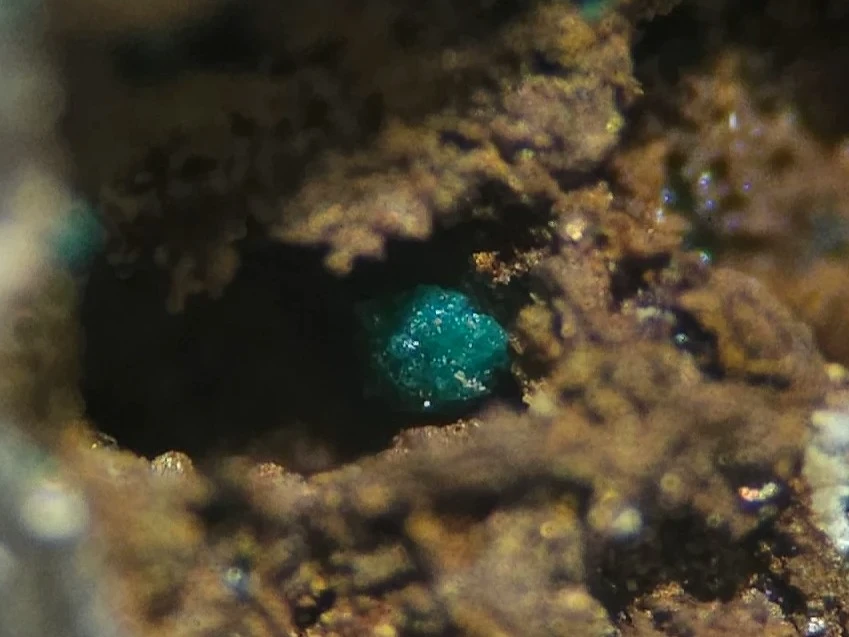
Cornetite is a rare copper phosphate, prized by collectors for its intense blue to greenish-blue color and characteristic reniform or radial aggregates.
Properties
- Mohs hardness
- 4.5
- Color
- Dark blue to green-blue; green-blue in transmitted light.
- Luster
- Vitreous
- Streak
- Pale blue
- Density
- 4.10
- Cleavage
- Poor
- Fracture
- Conchoidal to uneven
- Transparency
- Transparent,Translucent
- Crystal system
- Orthorhombic
Diagnostic features
## Identification The key diagnostic feature of cornetite is its intense, dark blue or greenish-blue color combined with its characteristic mode of occurrence – crusts, radial aggregates, or reniform masses. Its relatively high density and vitreous luster are also helpful. ## Differentiation from Similar Minerals Cornetite is sometimes confused with azurite, which has a similar color but is a carbonate and reacts vigorously with hydrochloric acid, unlike cornetite. It can also be mistaken for other rare secondary copper minerals, such as pseudomalachite or libethenite, but these differ in hue (usually greener), crystal form, and hardness. ## Crystal Forms Cornetite crystals are small, short prismatic, and belong to the orthorhombic system. They usually form druses covering the host rock, radial fans, or spherical and botryoidal aggregates with a radial internal structure.
Geological environment
## Genesis Cornetite is a secondary mineral, formed in the oxidation (weathering) zones of copper ore deposits. It forms as a result of the alteration of primary copper sulfides in a phosphorus-rich environment. ## Mineral Associations It often co-occurs with other secondary copper minerals, such as malachite, chrysocolla, libethenite, pseudomalachite, as well as manganese oxides (heterogenite) and sulfates (brochantite). ## Localities The most famous and classic cornetite specimens come from the L'Etoile du Congo (Star of the Congo) mine in Katanga Province, Democratic Republic of Congo. Significant finds have also been reported in Zambia (Bwana Mkubwa mine) and Arizona (USA).
Rarity
Rare
For collectors
## Quality Criteria The most highly valued cornetite specimens are characterized by a deep, saturated blue color and well-formed aggregates – most preferably spherical or radial. The size and richness of the crust on the host rock (matrix) are also important. Specimens with well-developed, even if small, crystals are rarer and more sought after. An aesthetic combination with other minerals, e.g., bright green malachite, can significantly increase the specimen's value. ## Popular Localities Specimens from the classic locality in the Democratic Republic of Congo (formerly Zaire) are by far the most desired by collectors. Material from this region is considered exemplary for this mineral species.
Care and storage
## Cleaning Cornetite specimens should be cleaned very carefully. It is best to use a soft brush to remove dust dry. If necessary, distilled water can be used, avoiding prolonged soaking. After wet cleaning, the specimen should be thoroughly dried immediately. ## What to Avoid Cornetite is sensitive to acids, which can damage or destroy it. Ultrasonic cleaners, strong detergents, and all chemicals should be avoided. As a mineral of medium hardness, it is susceptible to scratches, so it must be protected from contact with harder minerals. It should also not be heated or exposed to sudden temperature changes. ## Storage Collector's specimens of cornetite are best stored in separate, padded boxes or display cases to prevent abrasions and scratches. It is advisable to protect it from prolonged exposure to direct sunlight, which theoretically can affect its color, and from humidity.