Caledonite
Chemical formula: Cu<sup>2+</sup><sub>2</sub>Pb<sup>2+</sup><sub>5</sub>(S<sup>6+</sup>O<sub>4</sub>)<sub>3</sub>(CO<sub>3</sub>)(OH)<sub>6</sub>
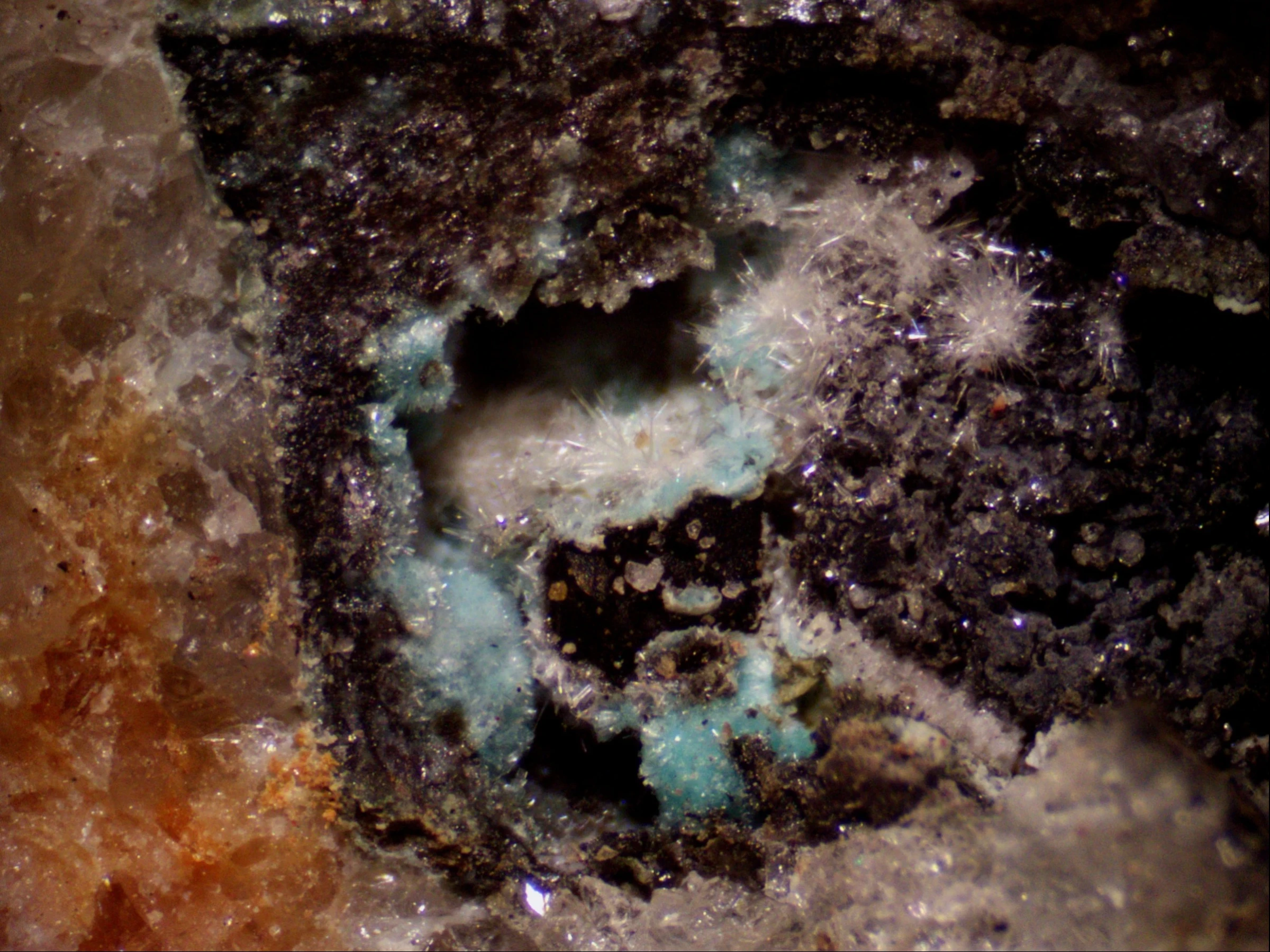
Caledonite is a rare lead and copper sulfate and carbonate, prized for its intensely blue-green, acicular crystals.
Properties
- Mohs hardness
- 2.5-3
- Color
- Dark blue to bluish-green; light bluish green in transmitted light.
- Luster
- Vitreous
- Streak
- Greenish-blue to bluish-white, paler than the sample.
- Density
- 5.75
- Cleavage
- Perfect on {010}; incomplete on {100} and {101}.
- Fracture
- Irregular/Uneven
- Transparency
- Transparent,Translucent
- Crystal system
- Orthorhombic
Diagnostic features
## Identification Key diagnostic features include its intense blue-green color, vitreous to resinous luster, and the characteristic habit of elongated, striated crystals. Co-occurrence with other secondary copper and lead minerals is also an important indicator. ## Distinguishing from Similar Minerals Caledonite is sometimes confused with linarite, which, however, has a much more intense, azure-blue color and crystallizes in the monoclinic system. It can also be confused with brochantite, which typically forms acicular crystals with a greener hue. ## Crystal Forms It crystallizes in prismatic, elongated columns, often with longitudinal striations on the faces. Crystals rarely occur individually, most often forming fan-shaped, radial, or haphazardly tangled aggregates.
Geological environment
## Genesis It is a typical secondary mineral, forming in the oxidation (weathering) zones of ore deposits containing both copper and lead. It forms as a result of reactions of surface waters with sulfides, such as galena and chalcopyrite. ## Mineral Associations It most often occurs in association with other secondary Cu-Pb minerals, such as linarite, anglesite, cerussite, brochantite, malachite, azurite, and leadhillite. ## Localities The most important historical locality is Leadhills in Scotland (United Kingdom). Beautiful specimens come from the Mammoth-St. Anthony mine in Arizona and Blue Bell in California (USA). Other known localities include Red Gill in Cumbria (England), Tsumeb (Namibia), and Broken Hill (New South Wales, Australia).
Rarity
Rare
For collectors
## Quality Criteria Specimens with well-formed, transparent crystals of intense, blue-green color are most highly valued. Rich crystal groups on a contrasting rock matrix and aesthetic associations with linarite or cerussite are particularly sought after. ## Popular Localities Classic, most prized specimens come from Leadhills in Scotland and from mines in Arizona (USA). Specimens from these localities fetch the highest prices in the collector's market.
Care and storage
## Cleaning It should be cleaned very carefully, using only distilled water and a soft brush. Ultrasonic cleaners should not be used, as they can damage the delicate crystals. ## What to Avoid Caledonite is sensitive to chemicals, especially acids, in which it readily dissolves. Sudden temperature changes and prolonged exposure to direct sunlight should be avoided. It is a brittle mineral, susceptible to mechanical damage. ## Storage Caledonite specimens are best stored in separate, sealed boxes or display cases to protect them from dust and damage. Due to its softness, it should not come into contact with harder minerals.