Bavenite
Chemical formula: Ca<sub>4</sub>Be<sub>2-3</sub>Al<sub>2-1</sub>Si<sub>9</sub>O<sub>26-25</sub>(OH)<sub>2-3</sub>
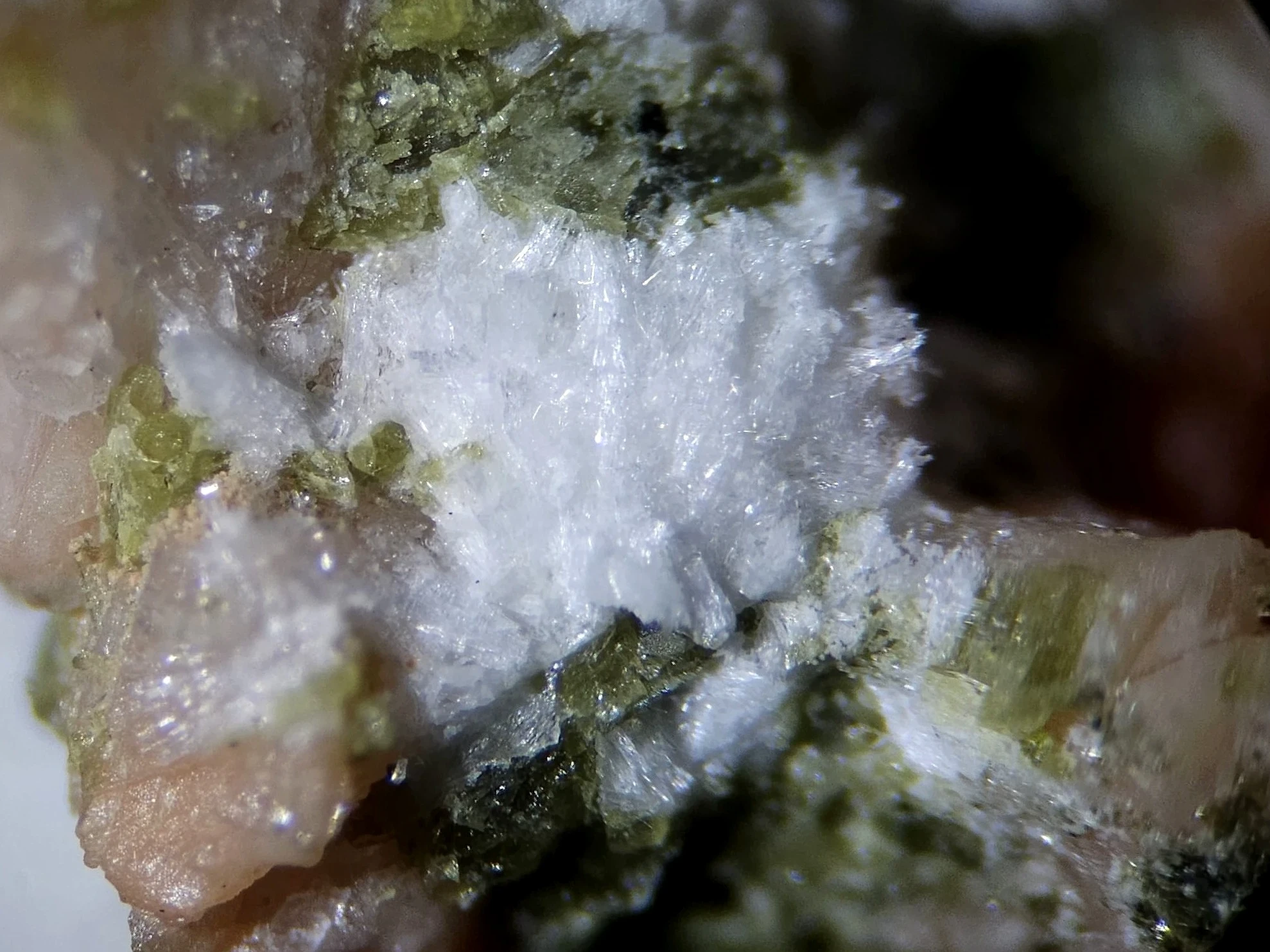
A calcium, beryllium, and aluminum silicate, forming characteristic radial aggregates with a pearly luster.
Properties
- Mohs hardness
- 5.5
- Color
- White
- Luster
- Vitreous, pearly
- Streak
- White
- Density
- 2.71
- Cleavage
- Perfect on {001}, fair on {100}
- Fracture
- Uneven
- Transparency
- Transparent,Translucent
- Crystal system
- Orthorhombic
Diagnostic features
## Identification The most important diagnostic feature of bavenite is its mode of occurrence – radial or fan-shaped aggregates composed of thin, bladed crystals. The characteristic pearly luster on cleavage surfaces is also distinctive. Its hardness (5.5) and co-occurrence with pegmatitic minerals, especially beryl, are key indicators. ## Distinguishing from Similar Minerals Bavenite is sometimes confused with some fibrous zeolites, such as scolecite or natrolite. It differs from them by its greater hardness and density. It may also resemble wollastonite or tremolite, but its genesis (usually pegmatitic) and association with beryllium minerals (beryl, herderite, phenakite) allow for its differentiation. ## Crystal Forms Bavenite forms bladed or thin-platy crystals, elongated and flattened. They almost always occur as aggregates: radial, fan-shaped, spherulitic, or in disordered clusters. Well-formed, single crystals are very rare and highly prized.
Geological environment
## Genesis Bavenite is a hydrothermal mineral, typical of the late stages of crystallization in granitic pegmatites. It often forms as an alteration product of beryl or gadolinite. It occurs in vugs and miarolitic cavities within pegmatites and Alpine-type granites. It is also found in skarns and some Alpine-type veins. ## Mineral Associations It most often co-occurs with minerals typical of pegmatitic environments, such as quartz, feldspars (albite, orthoclase), micas (muscovite, lepidolite). Its key associated minerals are other beryllium minerals, primarily beryl, as well as bertrandite, phenakite, and herderite. Fluorite is also a common associate. ## Localities The most important and historical locality is Baveno in Italy. Beautiful, classic specimens also come from the Pala region in California (USA). In recent years, the collector's market has been dominated by excellent specimens from pegmatites in Afghanistan and Pakistan, which often feature exceptional form and purity. Other known occurrences include Russia (Urals), Brazil, and Switzerland.
Rarity
Not very common
For collectors
## Quality Criteria The most highly valued bavenite specimens are those that form large, well-defined, radial "suns" or fans with sharp, undamaged crystals. High luster (especially pearly) and a clean, white color are important. Specimens on a contrasting rock matrix, especially in association with other minerals such as beryl, fluorite, or quartz, command significantly higher prices. Minimal damage is crucial, as the mineral is very brittle. ## Popular Localities Although the type locality is Baveno, Italy, currently the most desirable collector specimens come from Afghanistan and Pakistan. They provide specimens of exceptional aesthetics – sharp, white aggregates on a dark matrix. Classic specimens from Baveno and from San Diego County, California, are also highly valued by collectors due to their historical significance.
Care and storage
## Cleaning Bavenite is brittle and has perfect cleavage, so it requires delicate handling. For removing dust and loose debris, it is best to use a soft brush. If necessary, it can be rinsed in lukewarm distilled water, avoiding a strong stream. It should be dried quickly and thoroughly, for example, using low-pressure compressed air. ## What to Avoid Ultrasonic cleaners should be absolutely avoided, as they can cause aggregates to disintegrate along cleavage planes. The mineral is sensitive to sudden temperature changes, strong chemicals, and acids. As a beryllium mineral, its dust is toxic if inhaled, so caution should be exercised during mechanical processing (which is not recommended for amateurs). ## Storage Bavenite specimens are best stored in separate, padded boxes to protect them from impacts and contact with harder minerals. It should be protected from dust, which can accumulate in crevices between fibrous crystals. It is not sensitive to sunlight.