Andradite
Chemical formula: Ca<sub>3</sub>Fe<sup>3+</sup><sub>2</sub>(SiO<sub>4</sub>)<sub>3</sub>
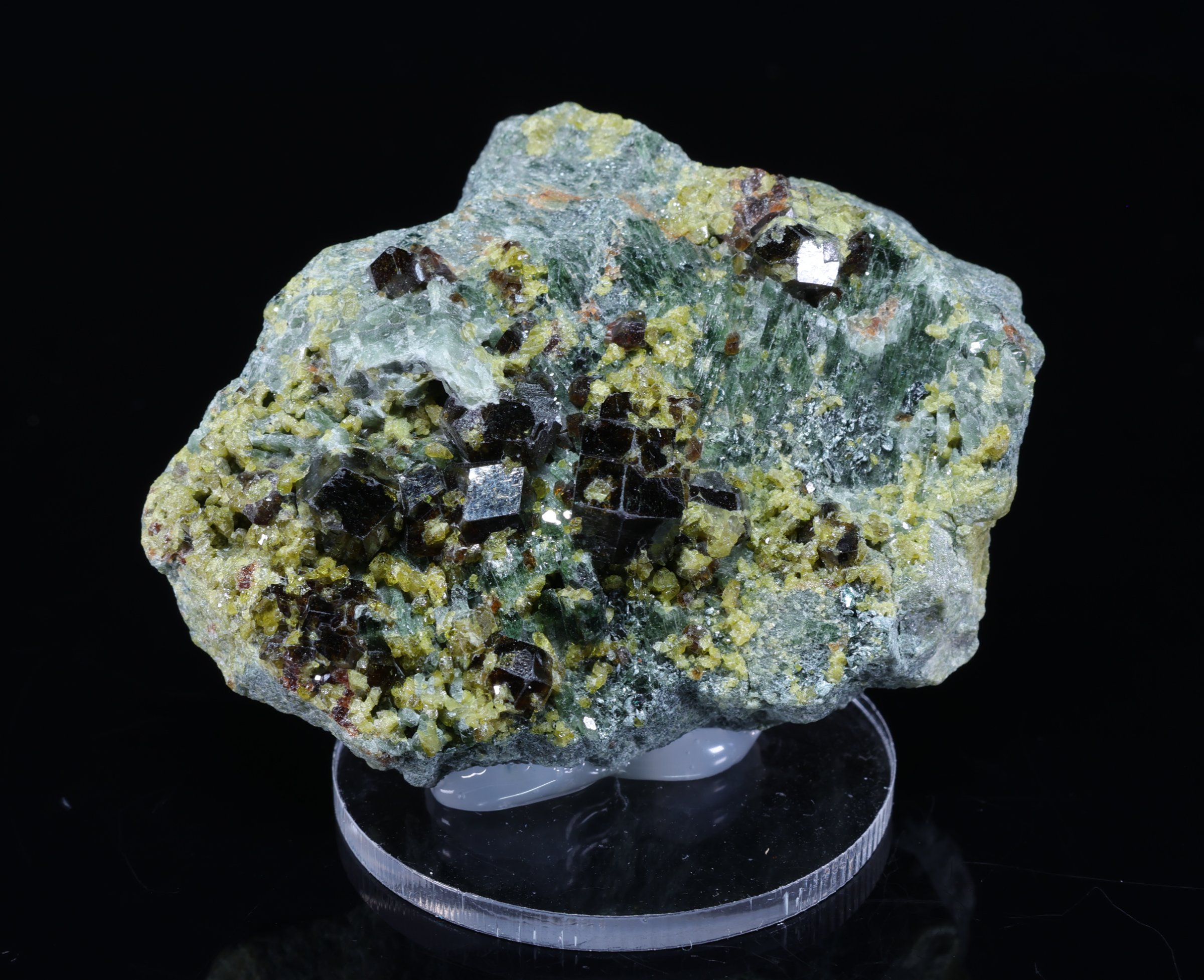
Andradite is a mineral from the garnet group, a calcium iron silicate, valued for its variety of colors, from yellow to emerald green and black.
Properties
- Mohs hardness
- 6.5-7
- Luster
- Vitreous, Resinous
- Streak
- White
- Density
- 3.8
- Cleavage
- Brak
- Fracture
- Muszlowy do nierównego
- Transparency
- Transparent,Translucent
- Crystal system
- Isometric
Diagnostic features
## Identification Andradite can be identified by its characteristic colors, vitreous or resinous luster, and typical crystal forms, such as rhombic dodecahedra. A hardness of 6.5-7 on the Mohs scale and a white streak are also important diagnostic features. ## Distinguishing from Similar Minerals Andradite can be confused with other garnets, such as grossular or almandine. It is usually distinguished from grossular by its darker color and the presence of iron. It differs from almandine in its chemical composition (lack of magnesium and higher calcium content) and often in its color hue. The demantoid variety can be confused with emerald, but demantoid has a higher refractive index and a characteristic "fiery" brilliance. ## Crystal Forms Andradite most commonly forms well-developed crystals with a rhombic dodecahedral or deltoidal icositetrahedral habit. It also occurs in massive, granular, or radiating aggregate forms.
Geological environment
## Genesis Andradite forms in metamorphic rocks, especially in skarns, which are created by the metasomatic alteration of carbonate rocks (limestones, dolomites) in contact with magmatic intrusions. It can also occur in some igneous rocks, such as syenites and serpentinites. ## Mineral Associations Andradite often co-occurs with minerals such as: calcite, epidote, diopside, vesuvianite, magnetite, chlorites, and quartz. In skarns, it is often accompanied by other garnets and ore minerals. ## Localities Important andradite deposits are found in Russia (Urals, where demantoid was discovered), Italy (Val Malenco, Piedmont), the United States (California, Arizona), Mexico, Madagascar, Namibia, and Iran. In Poland, andradite occurs in the Sudetes, near Strzegom and Kłodzko.
Rarity
Very Common
For collectors
## Quality Criteria The most prized andradite specimens are those with intense, uniform coloration, high transparency, and distinct luster. Crystals with well-formed faces and no visible inclusions are particularly sought after. For demantoid, an intense emerald-green color and the characteristic "horsetail" inclusions of amphibole asbestos fibers are important. ## Popular Localities The most prized demantoid specimens come from the Urals in Russia. Large black melanites are sought after from Italy. Topazolite specimens from Italy and Pakistan are also highly regarded by collectors.
Care and storage
## Cleaning Andradite can be cleaned using a soft brush and lukewarm water with mild soap. After washing, rinse the mineral thoroughly with clean water and dry with a soft cloth. ## What to Avoid Avoid contact of andradite with strong acids and bases, which can damage the mineral's surface. High temperatures and sudden temperature changes can also negatively affect its structure. Prolonged exposure to intense sunlight is not recommended, although andradite is relatively stable. ## Storage Andradite is best stored in separate boxes or soft pouches to prevent scratches from harder minerals. Ideal conditions include stable temperature and moderate humidity. Jewelry specimens should be stored away from other stones to prevent mutual damage.