Alabandite
Chemical formula: Mn<sup>2+</sup>S<sup>2-</sup>
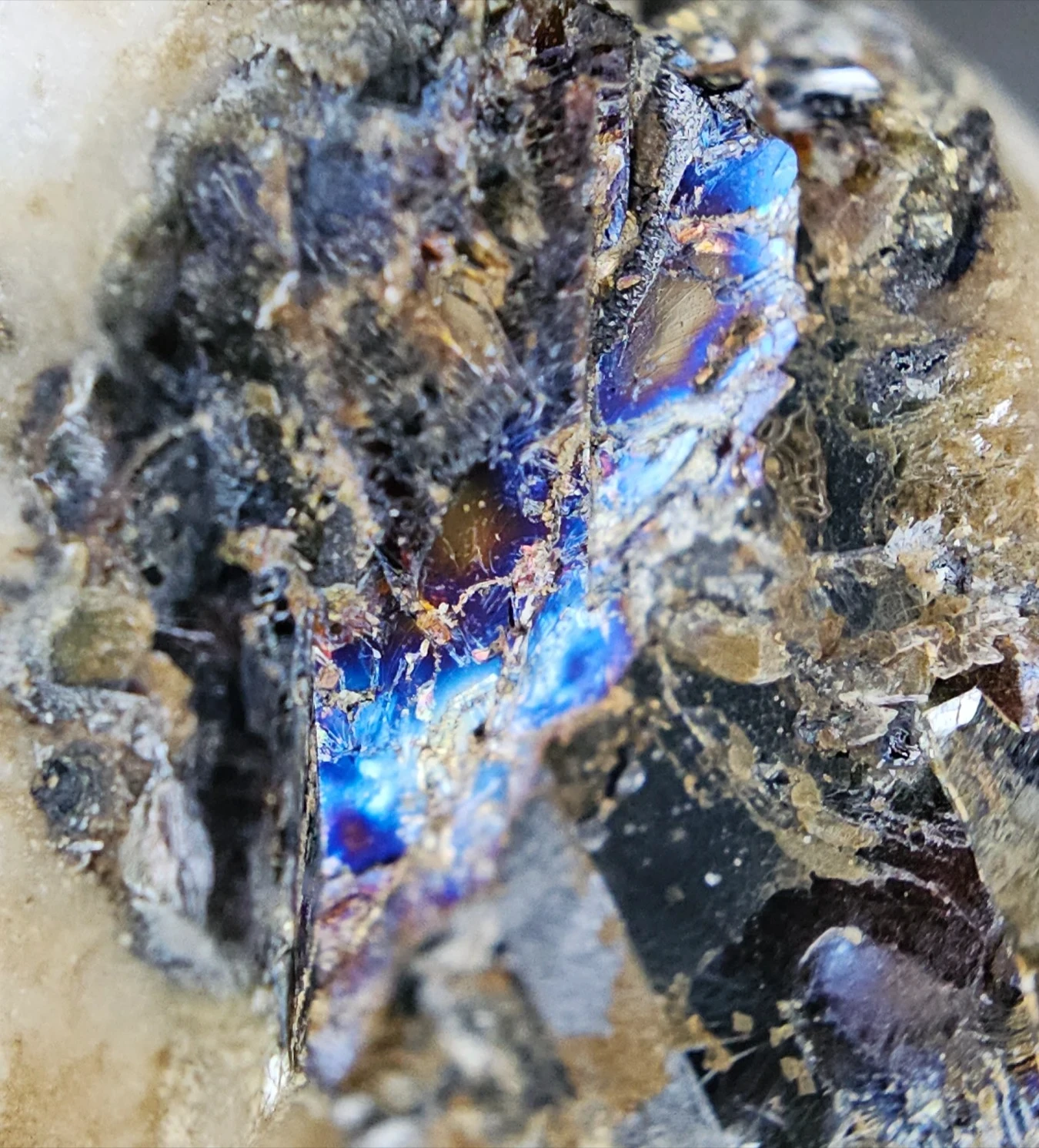
Alabandite is a manganese sulfide with a metallic luster, which is black on fresh surfaces but quickly tarnishes, and its diagnostic feature is a green streak.
Properties
- Mohs hardness
- 3.5-4
- Color
- Iron black, brown, greyish black, green; dull brown (tarnished)
- Luster
- Sub-Metallic to Metallic
- Streak
- dark green, brown
- Density
- 3.95
- Cleavage
- on {100}
- Fracture
- Irregular/Uneven
- Transparency
- Opaque
- Crystal system
- Isometric
Diagnostic features
## Identification The most important diagnostic feature of alabandite is its olive-green or green streak, which strongly contrasts with the mineral's black color. Other helpful features include the isometric crystal form (cubes), excellent cleavage, high density, and rapid tarnishing in air. ## Distinguishing from Similar Minerals Alabandite can be confused with other black, metallic minerals: - **Sphalerite (Marmatite):** Dark varieties of sphalerite can be similar, but usually have a lighter, brown or yellowish streak and often a resinous luster. - **Galena:** Has a much higher density, a lead-gray streak, and does not tarnish as quickly or in the same way as alabandite. - **Magnetite:** Is strongly magnetic, which alabandite is not. Its streak is black. ## Crystal Forms It crystallizes in the isometric system. Most often, it forms cubes, less commonly octahedra or rhombic dodecahedra. However, it usually occurs as granular aggregates, masses, or as inclusions in other minerals.
Geological environment
## Genesis Alabandite forms under hydrothermal conditions, in medium- and low-temperature ore veins. It is a typical mineral for polymetallic deposits, especially those rich in manganese. It can also form as a result of metamorphic processes in manganese deposits. It is very rarely found in meteorites. ## Mineral Associations It often co-occurs with other sulfides, such as sphalerite, galena, pyrite, chalcopyrite, as well as with rhodochrosite, calcite, and quartz. In some localities, it is accompanied by other, rarer manganese minerals. ## Localities Important historical localities include deposits in Romania (Săcărâmb, Cavnic) and Germany. Currently, well-formed crystals come from the Uchucchacua mine in Peru, from the Santa Eulalia district in Mexico, and from numerous localities in Japan. In the USA, it is known from Arizona (Tombstone) and Utah.
Rarity
Not very common
For collectors
## Quality Criteria The most prized by collectors are specimens with well-formed, sharp crystals of isometric habit (cubes, octahedra). The size of the crystals and the preservation of a fresh, black surface with a metallic luster are key. Untarnished and untarnished specimens are much rarer and more valuable. Aesthetic associations with other minerals, e.g., with pink rhodochrosite, also enhance their appeal. ## Popular Localities Classic specimens come from Romania (Săcărâmb). In recent decades, the collector's market has been dominated by excellent crystals from Peru (Uchucchacua mine), which often occur in association with rhodochrosite. Good quality material also comes from Mexico (Chihuahua) and Bolivia (Poopó).
Care and storage
## Cleaning Alabandite is sensitive to moisture and air, so it should only be cleaned dry, using a soft brush to remove dust. Avoid contact with water, which accelerates the tarnishing and oxidation process. ## What to Avoid This mineral is unstable in humid environments and tarnishes easily in air. It should be protected from moisture, water, and chemicals, especially acids, in which it readily dissolves. Prolonged exposure to air leads to irreversible loss of luster. ## Storage Alabandite specimens are best stored in airtight, sealed containers or "membrane boxes" to limit access to air and moisture. Storage in a dry place is crucial for preserving its original appearance.