Zeunerite
Chemical formula: Cu<sup>2+</sup>(U<sup>6+</sup>O<sub>2</sub>)<sub>2</sub>(As<sup>5+</sup>O<sub>4</sub>)<sub>2</sub>·12H<sub>2</sub>O
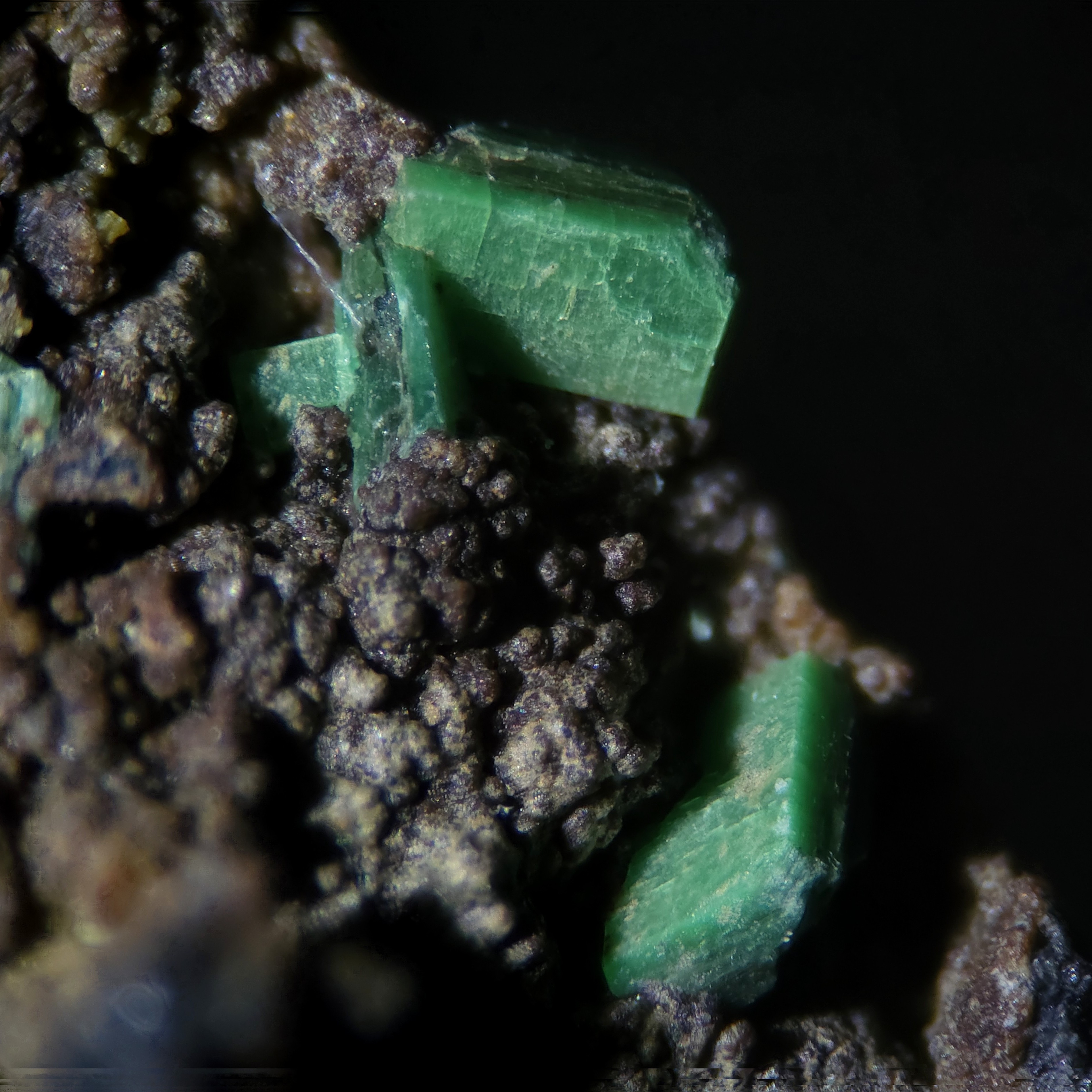
Zeunerite is a mineral from the autunite group, an hydrated copper uranyl arsenate, forming characteristic, tabular crystals of an intense green color.
Properties
- Mohs hardness
- 2-2.5
- Luster
- Vitreous, pearly
- Streak
- Light green
- Density
- 3.2-3.4
- Cleavage
- Perfect on {001}
- Fracture
- Uneven
- Transparency
- Transparent to translucent
- Crystal system
- Tetragonal
Diagnostic features
## Identification Key features include square, tabular crystals of emerald-green color, excellent platy cleavage, and high radioactivity. The mineral also exhibits strong, green fluorescence under ultraviolet (UV) light. ## Distinguishing from Similar Minerals Zeunerite is visually almost identical to torbernite. A definitive distinction between these two minerals is only possible through chemical analysis (e.g., EDS), which confirms the presence of arsenic (in zeunerite) or phosphorus (in torbernite). From other green uranyl minerals, such as uranospinite or nováčekite, it differs by the presence of copper in its composition. ## Crystal Forms It most often forms thin, square tabular crystals. These can occur individually, but more often form fan-like, radial, or book-like aggregates. It is also found in the form of crusts and coatings.
Geological environment
## Genesis It is a secondary mineral, formed in the oxidation (weathering) zones of hydrothermal uranium deposits that are also rich in arsenic and copper. It crystallizes from aqueous solutions under low-temperature conditions. ## Mineral Associations It often co-occurs with other uranyl minerals, such as torbernite, autunite, uranophane, and uraninite (pitchblende). It is also accompanied by copper sulfides and arsenides, e.g., chalcocite, tennantite, as well as olivenite and cornwallite. ## Localities Significant specimens come from historical localities in Germany (Schneeberg, Wittichen). It also occurs in Cornwall (Great Britain), France, the Czech Republic (Jáchymov), and the USA (Utah, Arizona, Nevada). In Poland, it is known from the vicinity of Kowary and Radoniów in Lower Silesia.
Rarity
Not very common
For collectors
## Quality Criteria The most highly valued specimens are those with sharp, well-formed, transparent crystals of intense, emerald-green color. The aesthetic arrangement of crystals on a contrasting rock matrix is of great importance. Specimens that have not undergone dehydration (have not transformed into metazeunerite) are significantly more valuable. ## Popular Localities Classic, historical specimens come from mines in Schneeberg, Germany. Beautiful crystals have also been found in uranium mines in the USA, as well as in Cornwall, in modern times.
Care and storage
## Cleaning Specimens should only be dry-cleaned, using a soft brush or compressed air from a safe distance. Contact with water can accelerate the dehydration process and damage delicate crystals. ## What to Avoid Zeunerite is highly radioactive – direct, prolonged contact should be avoided, and hands should be washed after each handling of the specimen. Dust formation and inhalation must be prevented. The mineral is sensitive to heat and direct sunlight, which cause water loss and transformation into metazeunerite, leading to a loss of transparency and color intensity. ## Storage It is recommended to store specimens in sealed, transparent containers (e.g., "perky boxes"), which limit radon emission and stabilize humidity, slowing down dehydration. It should be kept away from areas of permanent human presence, especially bedrooms and living rooms.