Vivianite
Chemical formula: Fe<sup>2+</sup><sub>3</sub>(PO<sub>4</sub>)<sub>2</sub>·8H<sub>2</sub>O
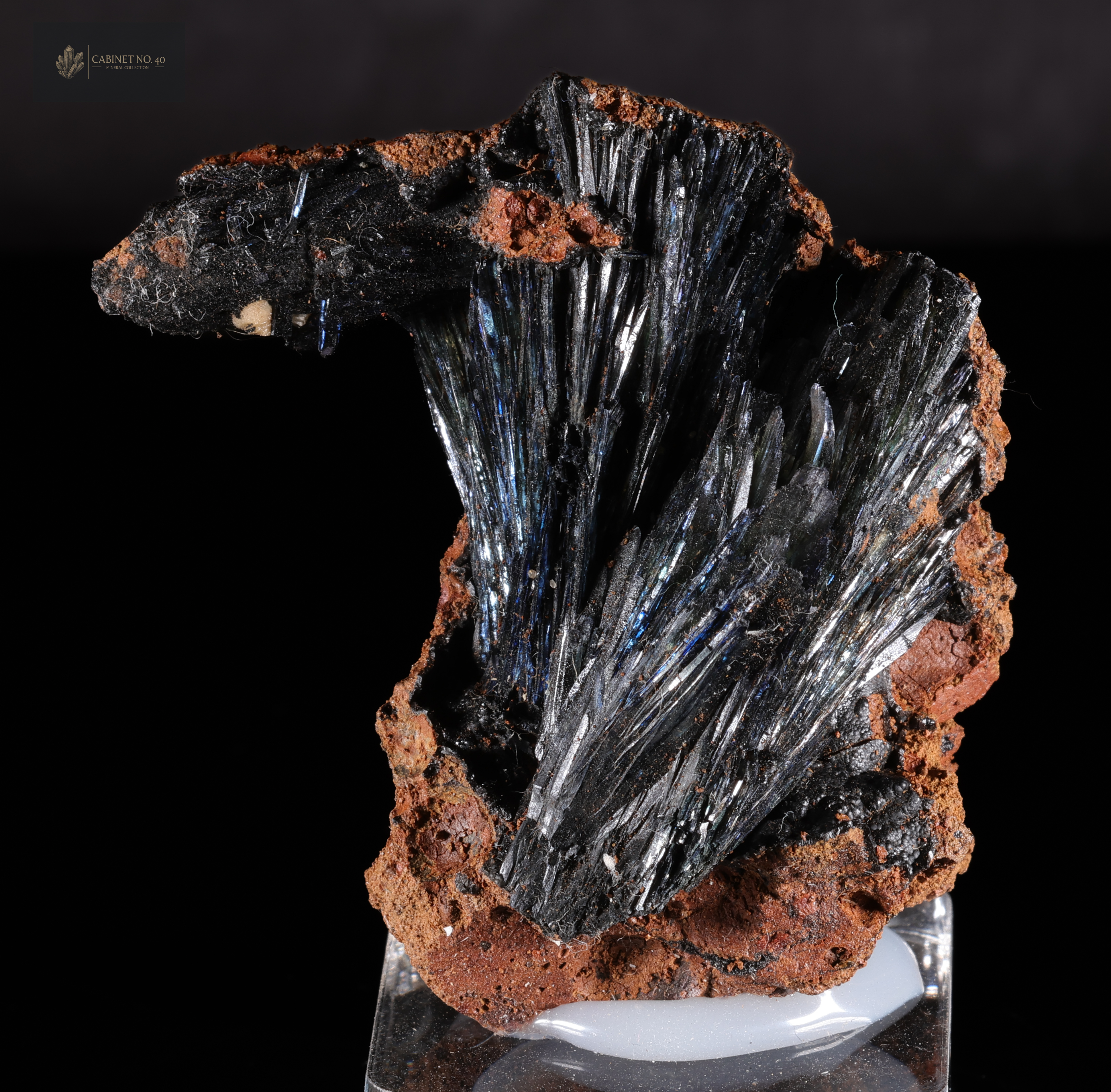
Vivianite is a rare phosphate mineral, known for its intense color, which changes under light, and characteristic elongated crystals.
Properties
- Mohs hardness
- 1.5-2
- Color
- Colourless and transparent when fresh, quickly turning pale to deep blue, greenish-blue or bluish-green.
- Luster
- Vitreous, Earthy
- Streak
- Colourless to bluish white, quickly changing to dark blue or brown
- Density
- 2.67
- Cleavage
- Perfect on {010}, in traces on <mi>{_106}</mi> and {100}.
- Fracture
- Fibrous
- Transparency
- Transparent,Translucent
- Crystal system
- Monoclinic
Diagnostic features
## Identification Vivianite can be identified by its characteristic, often intensely blue or blue-green color, which develops upon exposure to light. Elongated, columnar crystals with perfect cleavage along their length are also helpful. The softness of the mineral (it can be scratched with a fingernail) is also a diagnostic feature. ## Distinguishing from Similar Minerals Vivianite is sometimes confused with lazurite, azurite, or indicolite (blue tourmaline) due to similar coloration. However, vivianite is much softer and has perfect cleavage, which the aforementioned minerals lack. The color change under light is also a unique feature of vivianite. ## Crystal Forms Vivianite most often occurs as elongated, columnar, acicular, or fibrous crystals. It often forms radial or stellate aggregates. It can also occur as compact masses, concretions, or as coatings and incrustations.
Geological environment
## Genesis Vivianite is a secondary mineral, forming in reducing environments rich in phosphates and iron. It often forms in weathering zones of iron ore deposits, in lake and bog sediments, in peat bogs, and also in the bones and teeth of fossilized animals. It can also occur in pegmatites and hydrothermal veins. ## Mineral Associations Vivianite often co-occurs with other phosphate minerals, such as phosphorite, apatite, as well as with pyrite, marcasite, siderite, and limonite. In sedimentary environments, it can be associated with organic matter. ## Locations Significant vivianite deposits occur in many places around the world. The most important include: Bolivia (Siglo XX mine, Llallagua), where some of the largest and most beautiful crystals have been found; Russia (Kerch, Taman Peninsula); United States (Colorado, New Jersey); Australia (Queensland); England (Cornwall); Germany (Saxony); and Cameroon.
Rarity
Rare
For collectors
## Quality Criteria The most prized vivianite specimens are those with an intense, deep blue color, high transparency, and well-formed, undamaged crystals. Crystal size is also important, with larger, aesthetic specimens being more sought after. Minimal inclusions and absence of cracks are also crucial. ## Popular Localities The most sought-after vivianite specimens come from the Siglo XX mine in Llallagua, Bolivia, famous for its large, intensely blue crystals. Other valued localities include Russia (Kerch) and Australia.
Care and storage
## Cleaning Due to its softness and brittleness, vivianite requires gentle cleaning. It is best to use a soft, dry cloth or brush to remove dust. For heavier soiling, a cloth lightly dampened with distilled water can be used, but prolonged contact with water should be avoided. ## What to Avoid Vivianite is very sensitive to sunlight, which accelerates the oxidation process and darkening of the mineral. Exposure to direct sunlight and strong artificial lighting should be avoided. The mineral is also sensitive to high temperatures and sudden temperature changes, which can lead to cracks. Due to its softness, it should be protected from scratches and impacts. Contact with acids and strong bases should also be avoided. ## Storage Vivianite specimens are best stored in a dark, cool, and dry place, away from light sources. Airtight containers or display cases that protect against dust and moisture are ideal. It is worth considering storage in containers with moisture-absorbing material to prevent its accumulation. Due to its brittleness, each specimen should be secured against movement and contact with other minerals.