whitlockite
Chemical formula: Ca<sub>9</sub>Mg(PO<sub>4</sub>)<sub>6</sub>(PO<sub>3</sub>OH)
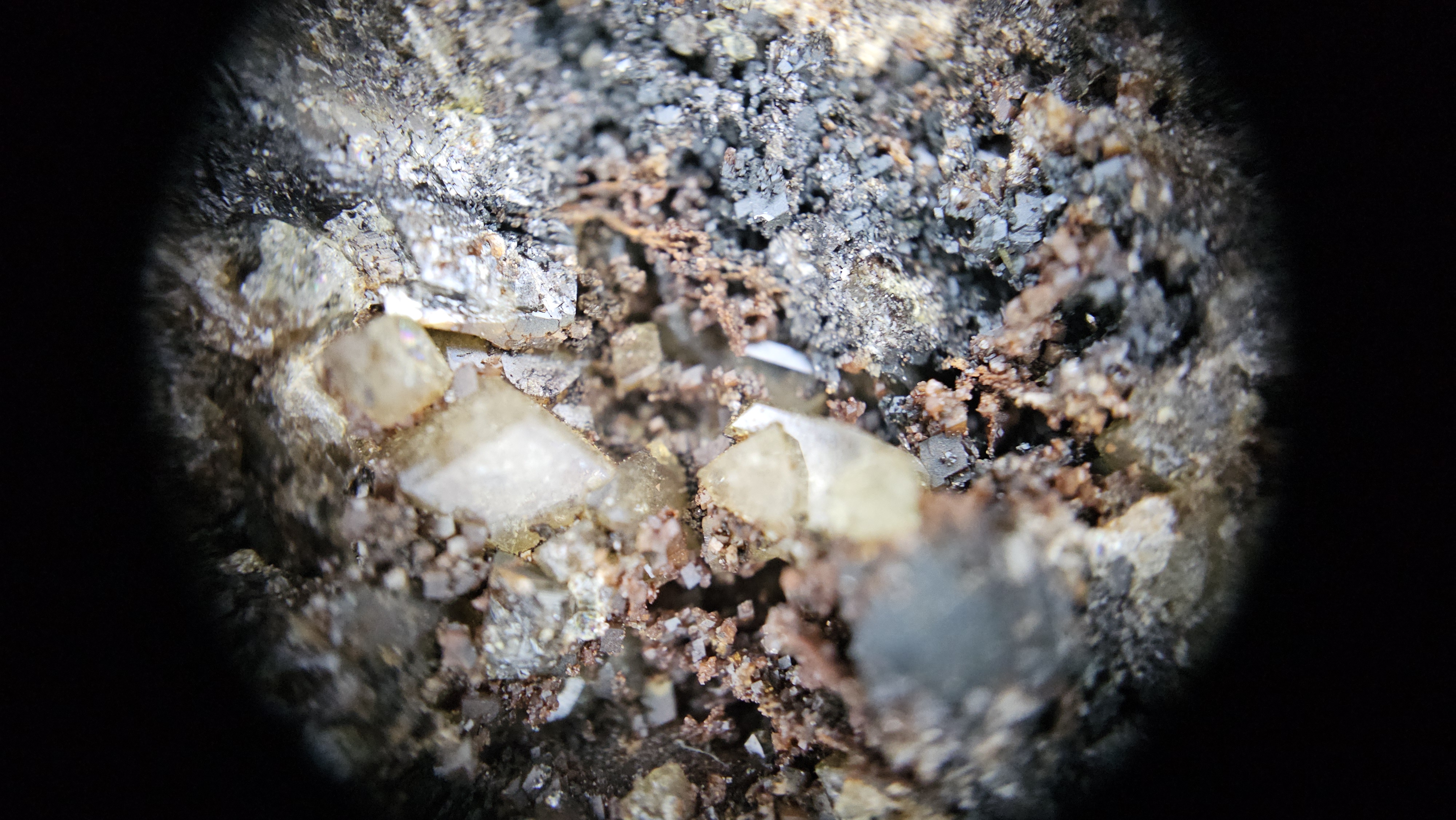
A rare calcium and magnesium phosphate, known for its occurrence in terrestrial pegmatites and as an important component of lunar rocks and meteorites.
Properties
- Mohs hardness
- 5
- Color
- Colourless, grey-white, light pink, light yellow; colourless in transmitted light.
- Luster
- Vitreous to resinous
- Streak
- White
- Density
- 3.12
- Cleavage
- None
- Fracture
- Conchoidal to uneven
- Transparency
- Transparent to translucent
- Crystal system
- Trigonal
Diagnostic features
## Identification Identifying features include characteristic, often rhombohedral crystals, hardness (5 on the Mohs scale), and lack of cleavage. Occurrence in paragenesis with other phosphates in granitic pegmatites is also a strong indicator. It sometimes exhibits weak, pinkish fluorescence under UV light. ## Distinguishing from Similar Minerals Whitlockite is sometimes confused with apatite, which is hexagonal and often forms prismatic crystals. It is distinguished from quartz by its significantly lower hardness (5 versus 7). Dolomite and calcite are much softer and react vigorously with hydrochloric acid, while whitlockite dissolves slowly in it. ## Crystal Forms Most commonly found are small, rhombohedral or thick tabular crystals. The mineral also forms granular aggregates, radial aggregates, and rounded nodules and concretions.
Geological environment
## Genesis Whitlockite is a secondary mineral, formed in complex granitic pegmatites, where it crystallizes in the late stages of hydrothermal processes. It is also found in sedimentary phosphorite deposits. Importantly, it is an important accessory mineral in extraterrestrial rocks – it has been identified in samples from the Moon and in many types of meteorites (chondrites, achondrites, pallasites). ## Mineral Associations In pegmatites, it coexists with other phosphates such as ludlamite, fairfieldite, triphylite, as well as with quartz, siderite, and mica. In meteorites, it is accompanied by olivine, pyroxenes, plagioclase, and troilite. ## Localities The most famous localities with well-formed crystals are mines in the USA, including the Palermo Mine in New Hampshire (type locality) and the Tip Top Mine in South Dakota. This mineral is also found in many other locations worldwide, including Australia, Germany, and Sweden, but rarely in the form of attractive specimens. Its presence has been confirmed in numerous meteorite finds globally.
Rarity
Uncommon
For collectors
## Quality Criteria The most highly prized whitlockite specimens are those with sharp, well-formed, and transparent crystals, set on a contrasting rock matrix. Crystal size is a key factor – specimens exceeding a few millimeters are already considered significant. Aesthetic associations with other rare phosphate minerals also add to their attractiveness. ## Popular Localities Two American localities are considered classic and provide the best whitlockite specimens in the world: the Palermo No. 1 mine in New Hampshire and the Tip Top mine in South Dakota. Specimens from these locations set the standard against which other finds are compared.
Care and storage
## Cleaning Whitlockite specimens can be safely cleaned with lukewarm water and a mild soap, using a soft brush. Ultrasonic cleaners should be avoided, as they can cause cracks in brittle crystals. ## What to Avoid As a phosphate, the mineral is sensitive to strong acids. A hardness of 5 means it can be scratched by harder minerals (e.g., quartz) or steel tools, so contact with them should be avoided. It is stable under normal lighting and temperature conditions. ## Storage It is recommended to store specimens in separate, padded boxes to protect them from scratches and mechanical damage. This applies especially to well-formed, small crystals, which are particularly delicate.