Vauxite
Chemical formula: Fe<sup>2+</sup>Al<sub>2</sub>(PO<sub>4</sub>)<sub>2</sub>(OH)<sub>2</sub>·6H<sub>2</sub>O
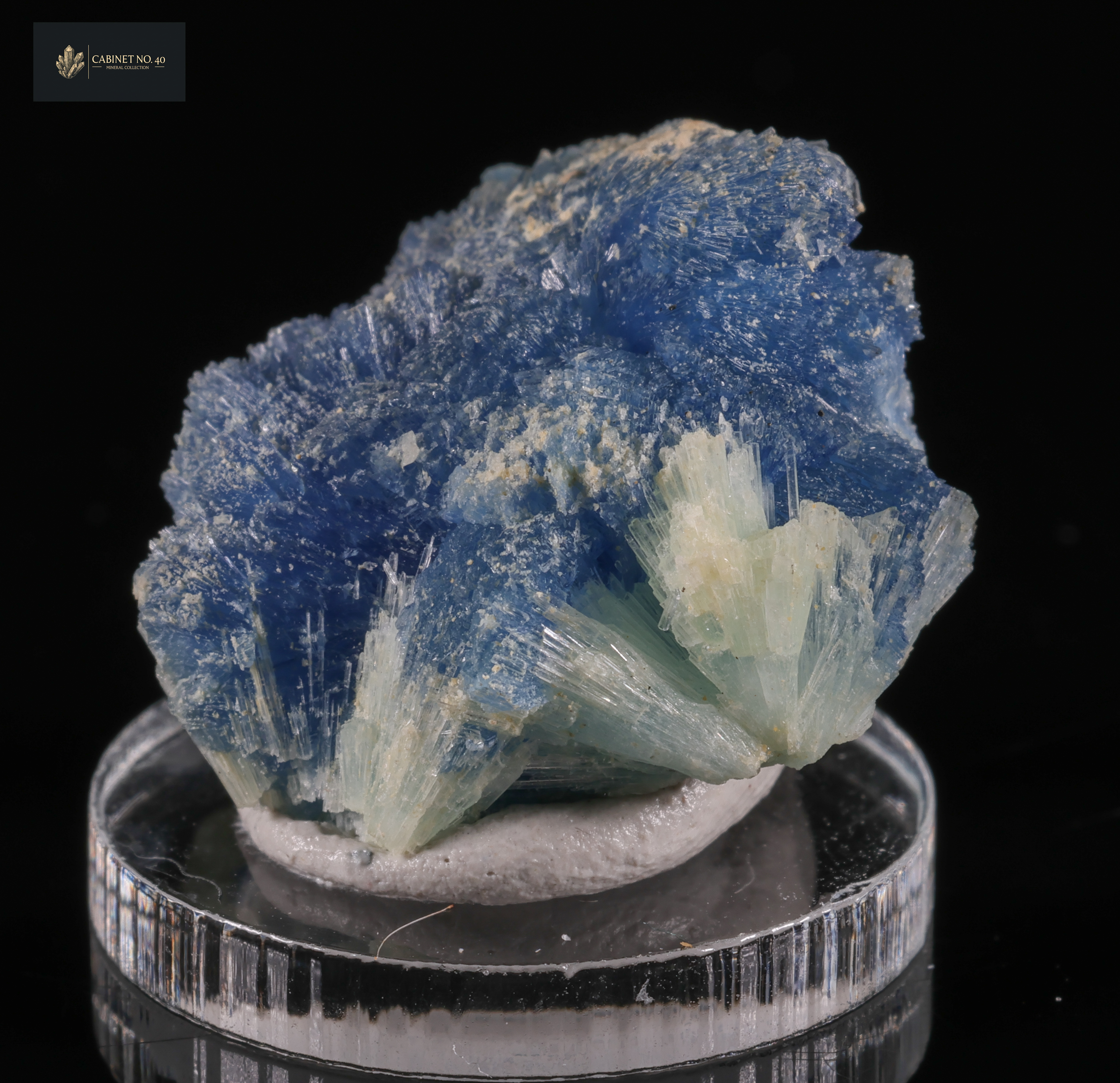
Vauxite is a rare hydrated iron aluminum phosphate, typically forming small, blue crystals or radial aggregates.
Properties
- Mohs hardness
- 3.5
- Streak
- White
- Density
- 2.39
- Transparency
- Transparent
- Crystal system
- Triclinic
Diagnostic features
## Identification Vauxite can be identified by its characteristic blue color, acicular or tabular crystal habit, and the formation of radial aggregates. Its softness (3.5 on the Mohs scale) is also a diagnostic feature. ## Distinguishing from Similar Minerals Due to its blue color, vauxite can be confused with other blue phosphate minerals, such as lazulite or wardite. However, its specific crystal habit and lower hardness help in differentiation. Lazulite is usually harder and has a different crystal habit. Wardite also has different crystallization. ## Crystal Forms Vauxite most often forms small, tabular or acicular crystals, which frequently arrange into radial, fan-shaped, or fibrous aggregates. Crystals are typically euhedral, with well-defined faces.
Geological environment
## Genesis Vauxite is a secondary mineral, formed in the oxidation zones of phosphate deposits, often in pegmatites. It forms through low-temperature hydrothermal processes where solutions rich in phosphates, iron, and aluminum react with existing minerals. ## Mineral Associations Vauxite often co-occurs with other phosphate minerals, such as paravauxite, laueite, strunzite, rockbridgeite, as well as with quartz and limonite. ## Localities The most known and prized vauxite specimens come from the Siglo XX mine (Llallagua) in Bolivia. Other, less significant occurrences have been reported in the Waux mine in Belgium (type locality) and the Rapid Creek mine in Yukon, Canada.
Rarity
Very Rare
For collectors
## Quality Criteria The most desirable vauxite specimens are those with intense, pure blue color, well-formed, distinct crystals, and aesthetic aggregates. Crystal size, though usually small, also influences collector value. Specimens with minimal damage and an attractive matrix are highly prized. ## Popular Localities The most valued vauxite specimens come from the Siglo XX mine (Llallagua) in Bolivia, known for producing some of the best specimens of this mineral in the world.
Care and storage
## Cleaning Gentle cleaning of vauxite can be performed using a soft brush and lukewarm distilled water. Avoid vigorous rubbing to prevent damage to the delicate crystals. ## What to Avoid The mineral is sensitive to acids, so contact with chemical substances should be avoided. Due to the water content in its structure, vauxite may be sensitive to sudden temperature changes. Prolonged exposure to direct sunlight can potentially affect the intensity of its color, so it is recommended to store it in a place shielded from the sun. ## Storage Vauxite specimens are best stored in enclosed display cases or boxes to protect them from dust and mechanical damage. Due to its softness, contact with harder minerals should be avoided.