Wardite
Chemical formula: NaAl<sub>3</sub>(PO<sub>4</sub>)<sub>2</sub>(OH)<sub>4</sub>·2H<sub>2</sub>O
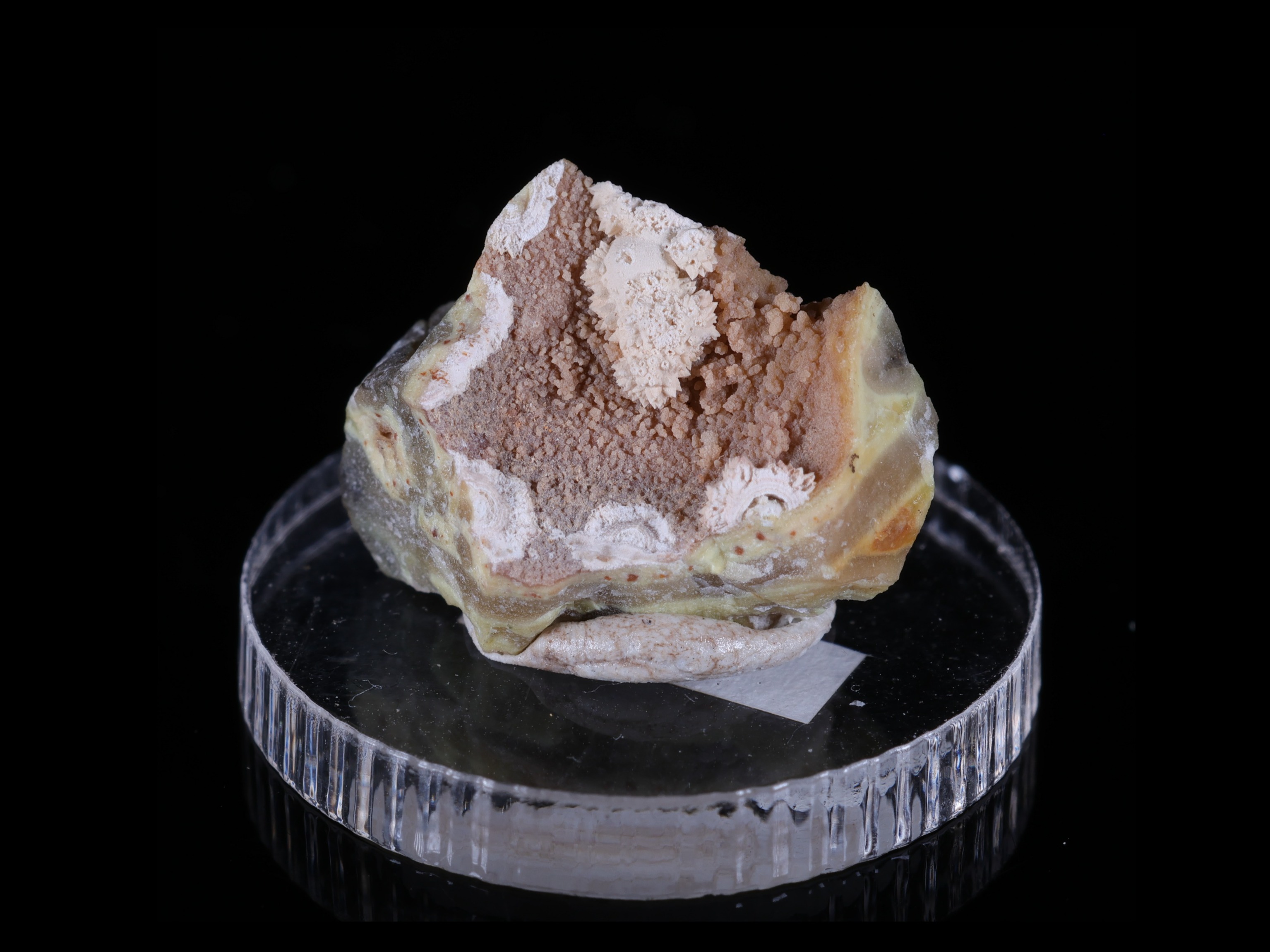
Wardite is a rare hydrated sodium aluminum phosphate, typically forming small, tetragonal crystals, often with a bluish or greenish tint.
Properties
- Mohs hardness
- 5
- Luster
- Szklisty
- Streak
- Biała
- Density
- 2.81
- Cleavage
- On {001}, perfect.
- Fracture
- Nierówny do muszlowego
- Transparency
- Transparent,Opaque
- Crystal system
- Tetragonal
Diagnostic features
## Identification Wardite can be identified by its tetragonal crystallographic system, often bipyramidal or prismatic crystal habit. Its characteristic colors, especially delicate shades of blue and green, and perfect cleavage are also distinctive. ## Distinguishing from Similar Minerals Wardite can be confused with other phosphates, but its tetragonal crystallographic system, specific cleavage, and crystal habit help in differentiation. Chemical analysis is the ultimate identification method. ## Crystal Forms Wardite most often forms bipyramidal or prismatic crystals. Radial aggregates, spherical masses, or crusts are also common.
Geological environment
## Genesis Wardite is a secondary mineral, forming in the oxidation zones of phosphate deposits, often in pegmatites, where it occurs in fissures and cavities. It forms as a result of low-temperature hydrothermal processes. ## Mineral Associations Wardite often co-occurs with other phosphate minerals, such as lazulite, augelite, zircon, as well as quartz and muscovite. ## Localities Known localities of wardite include the United States (e.g., Clay Canyon mine, Fairfield County, Utah; Big Chief mine, Pennington County, South Dakota), Brazil (Minas Gerais), and Canada (Yukon).
Rarity
Rare
For collectors
## Quality Criteria The most prized wardite specimens are those with well-formed, distinct crystals, with intense and uniform coloration (especially blue or green) and without visible damage. Crystal size also affects collectible value. ## Popular Localities Specimens from historical localities in the United States, such as the Clay Canyon mine in Utah, known for its aesthetic wardite crystals, are particularly sought after.
Care and storage
## Cleaning Wardite can be cleaned gently using a soft brush and lukewarm water. For more stubborn dirt, distilled water can be used to avoid hard water deposits. ## What to Avoid Avoid using strong chemical agents that can damage the mineral's surface. Wardite is not particularly sensitive to sunlight or temperature changes, but it is always advisable to avoid extreme conditions. ## Storage Wardite specimens are best stored in enclosed display cases or boxes, protecting them from dust and accidental mechanical damage. Due to its hardness (5 on the Mohs scale), contact with harder minerals that could scratch it should be avoided.