Väyrynenite
Chemical formula: Mn<sup>2+</sup>Be(PO<sub>4</sub>)OH
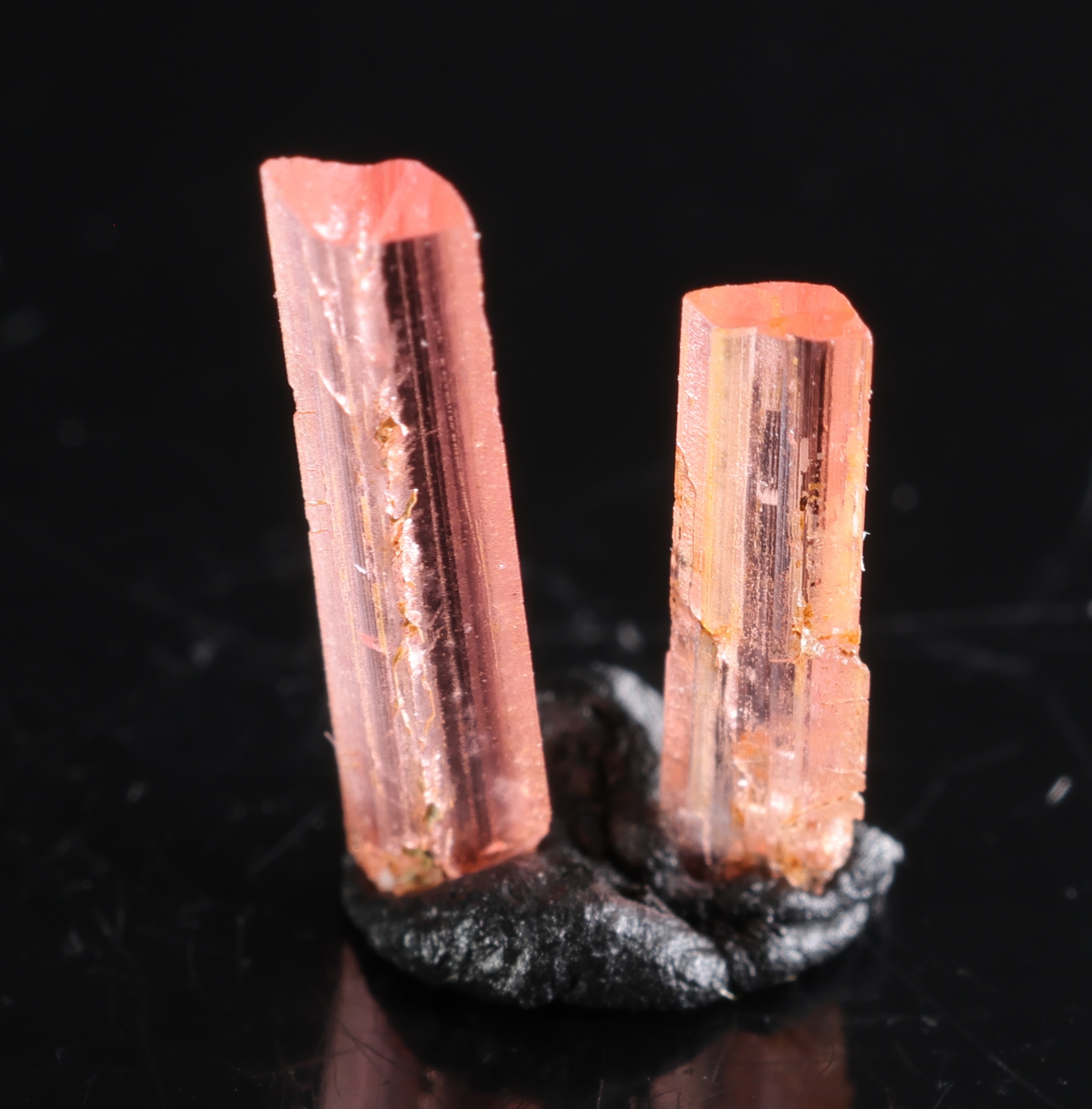
Väyrynenite is a rare manganese beryllium phosphate, prized by collectors for its attractive, often pink or reddish crystals.
Properties
- Mohs hardness
- 5
- Luster
- Vitreous
- Streak
- White
- Density
- 3.23-3.26
- Cleavage
- Perfect on {001}
- Fracture
- Conchoidal to uneven
- Transparency
- Transparent to translucent
- Crystal system
- Monoclinic
Diagnostic features
## Identification Väyrynenite can be identified by its characteristic pink or reddish color, vitreous luster, and prismatic or tabular crystal habit. It often occurs in pegmatites, which is an additional diagnostic clue. ## Distinguishing from Similar Minerals It can be confused with some varieties of tourmaline or rhodonite due to similar coloration. It differs from tourmaline by the absence of distinct pleochroism and lower hardness. It differs from rhodonite by its crystallographic system and the presence of beryllium in its chemical composition. ## Crystal Forms Väyrynenite most commonly forms prismatic or tabular crystals, often with an elongated habit. Crystals are usually well-formed, with distinct faces and sharp edges. It can also occur as granular aggregates.
Geological environment
## Genesis Väyrynenite is a secondary mineral, forming in pegmatite deposits, especially in granite pegmatites rich in phosphates. It forms in the late stages of pegmatite crystallization, in a hydrothermal environment where elements such as manganese and beryllium are present. ## Mineral Associations Väyrynenite often co-occurs with other pegmatite minerals, such as quartz, feldspars, muscovite, tourmaline, beryl, as well as other phosphates, such as triplite, lithiophilite, apatite, and lazulite. ## Localities The most important localities for väyrynenite are in Finland (Viitaniemi, Eräjärvi), Pakistan (Gilgit-Baltistan), Afghanistan (Nuristan), Russia (Kola Peninsula), and the United States (Maine, California).
Rarity
Rare
For collectors
## Quality Criteria The most prized väyrynenite specimens are those with intense, uniform pink or red color, with well-formed, transparent crystals of distinct habit. Large, undamaged crystals are particularly sought after. Clarity and lack of inclusions also affect the value of the specimen. ## Market Prices The prices of väyrynenite vary and depend on the size, quality, and rarity of the specimen. Small, poorly formed crystals can cost tens of dollars, while large, perfectly formed, and intensely colored specimens can fetch prices from several hundred to several thousand dollars. ## Popular Localities The most prized väyrynenite specimens come from Pakistan, especially from the Gilgit-Baltistan region, where crystals of exceptional size and color are found. Finland is also a source of high-quality specimens.
Care and storage
## Cleaning To clean väyrynenite, use a soft brush and lukewarm water. Distilled water can also be used to avoid hard water deposits. Gentle washing under running water is usually sufficient to remove dust and superficial dirt. ## What to Avoid Avoid using strong chemicals, acids, and bases, which can damage the mineral's surface or alter its color. Väyrynenite is sensitive to high temperatures, so it should not be exposed to direct heat sources. Prolonged exposure to intense sunlight can cause color fading. The mineral should not be stored in a high-humidity environment. ## Storage Väyrynenite specimens are best stored in closed display cases or boxes, away from dust and direct light. It is advisable to place moisture-absorbing materials, such as silica gel, in display cases to maintain stable conditions. Due to its hardness of 5 on the Mohs scale, väyrynenite should be stored separately from harder minerals to avoid scratches.