Uvarovite
Chemical formula: Ca<sub>3</sub>Cr<sup>3+</sup><sub>2</sub>(SiO<sub>4</sub>)<sub>3</sub>
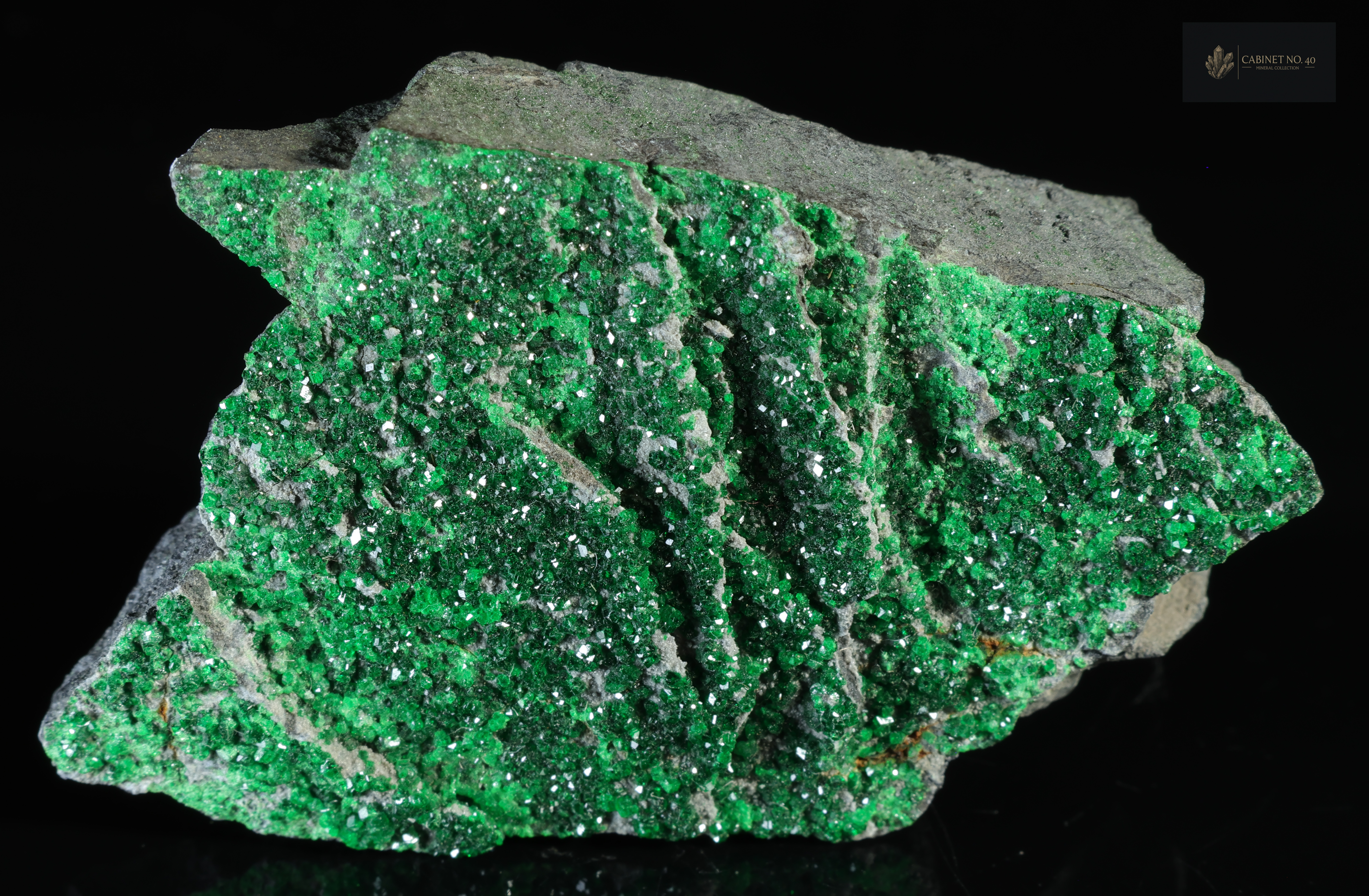
Uvarovite is a rare mineral from the garnet group, distinguished by its intense emerald-green color, resulting from the presence of chromium.
Properties
- Mohs hardness
- 6.5-7
- Luster
- Vitreous, resinous
- Streak
- White
- Density
- 3.77
- Cleavage
- Brak
- Fracture
- Muszlowy do nierównego
- Transparency
- Transparent,Translucent
- Crystal system
- Isometric
Diagnostic features
## Identification Uvarovite is relatively easy to identify due to its characteristic, intensely emerald-green color and typical crystal habit, which often form small, shiny coatings on rocks. The presence of chromium is key to its color. It often occurs in association with chromite. ## Distinguishing from similar minerals Uvarovite can be confused with other green garnets, such as demantoid (a variety of andradite) or grossular (a variety of tsavorite). However, uvarovite is distinguished by a more intense, pure emerald green, which is a result of the presence of chromium, not iron (as in demantoid) or vanadium (as in tsavorite). The streak of uvarovite is white, which can help distinguish it from other green minerals. ## Crystal forms Uvarovite crystallizes in the isometric system, most often forming well-developed rhombic dodecahedra or trapezohedra. Crystals are usually small, often forming druses or crusts on rock surfaces, less commonly occurring as single, larger specimens.
Geological environment
## Genesis Uvarovite forms in metamorphic rocks, especially in serpentinites and other ultramafic rocks that are rich in chromium. It forms as a result of metasomatic processes, where calcium and silicon-rich solutions react with chromium-bearing rocks. It often occurs in hydrothermal veins cutting through these rocks. ## Mineral associations Uvarovite often co-occurs with other chromium minerals, such as chromite, and with serpentine minerals, such as antigorite and chrysotile. It can also occur with diopside, calcite, and quartz. ## Localities The most important and well-known localities for uvarovite are in Russia, especially in the Ural region (e.g., Saranovskoe). Other significant occurrences include Finland (Outokumpu), Turkey, Canada (Quebec), United States (Oregon, California), and Greece (Corinthia).
Rarity
Uncommon
For collectors
## Quality criteria The most prized uvarovite specimens are those with an intense, emerald-green color, with well-formed, shiny crystals. High transparency and the absence of visible inclusions also increase collector value. Specimens with large, distinct crystal druses on an aesthetic matrix are particularly sought after. ## Popular localities The most prized uvarovite specimens come from the Urals in Russia, especially from the Saranovskoe mine, where some of the most beautiful and largest crystals have been found. Other well-known localities include Outokumpu in Finland, which also yields high-quality specimens.
Care and storage
## Cleaning Uvarovite is a mineral of moderate hardness, so it is best to clean specimens using a soft brush and lukewarm water. For heavier dirt, a mild soap can be used, followed by thorough rinsing with distilled water to avoid mineral deposits. ## What to avoid Avoid using strong acids and bases, which can damage the mineral's surface or its matrix. Uvarovite is stable under typical conditions, but prolonged exposure to intense sunlight can theoretically affect the intensity of its color, although this is not a commonly observed feature. Temperature changes should not be a problem, but sudden thermal shocks are always inadvisable for minerals. ## Storage Uvarovite specimens are best stored in enclosed display cases or boxes, protecting them from dust and mechanical damage. Due to its intense color, it is worth displaying it in a well-lit place that will highlight its aesthetic qualities.