Green Tourmaline
Chemical formula: (Na,Ca)(Li,Mg,Fe²⁺,Mn,Al)₃Al₆(BO₃)₃Si₆O₁₈(OH)₄
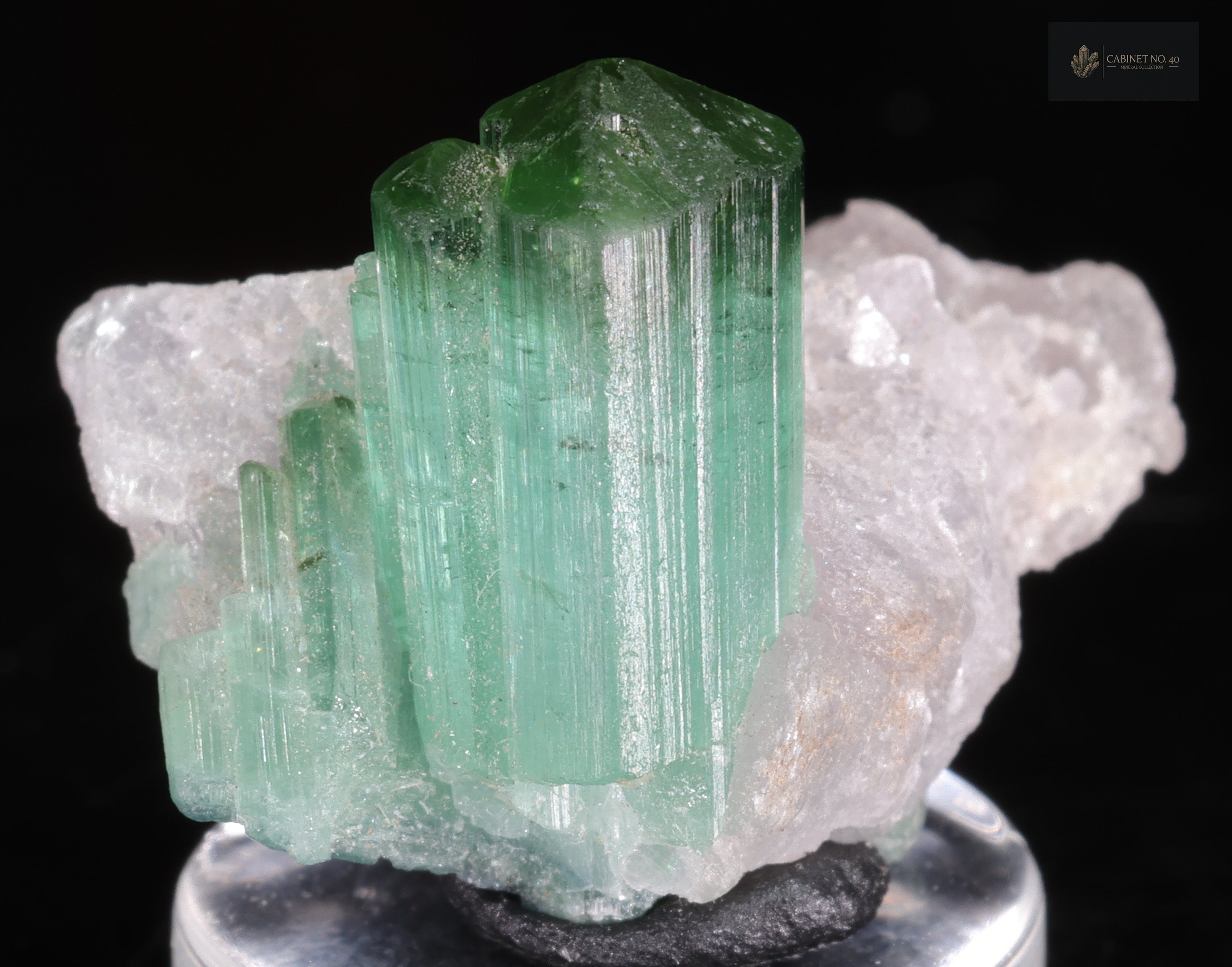
Green tourmaline, also known as verdelite, is a boron aluminum cyclosilicate, valued for its intense color and often found in well-formed crystals.
Properties
- Mohs hardness
- 7-7.5
- Luster
- Szklisty
- Streak
- Biała
- Density
- 3.03-3.25
- Cleavage
- Brak
- Fracture
- Muszlowy do nierównego
- Transparency
- Przezroczysty do przeświecającego
- Crystal system
- Trigonalny
Diagnostic features
## Identification Green tourmaline can be identified by its characteristic green color, vitreous luster, and often by its prismatic crystal habit with longitudinal striations. Its hardness (7-7.5 on the Mohs scale) is a key feature that distinguishes it from many other green minerals. ## Differentiation from Similar Minerals Green tourmaline is sometimes confused with emerald, diopside, peridot, or garnet. It differs from emerald typically by the absence of characteristic emerald inclusions and a different crystal structure. Diopside is significantly softer (5-6 on the Mohs scale), and peridot usually has a more olive-green hue and a different density. Green garnets (e.g., grossular) have different hardness and crystallographic systems. ## Crystal Forms Green tourmaline most commonly occurs as elongated, prismatic crystals with a triangular or hexagonal cross-section. Characteristic striations parallel to the main crystal axis are often observed. It can also form radial, acicular, or massive aggregates.
Geological environment
## Genesis Green tourmaline primarily forms in granitic pegmatites and hydrothermal veins. It crystallizes under conditions of high temperature and pressure, in the presence of solutions rich in boron and other elements. It can also occur in metamorphic rocks, such as schists and gneisses, and in sedimentary clastic rocks as a detrital mineral. ## Mineral Associations Green tourmaline often co-occurs with quartz, feldspar, muscovite, lepidolite, topaz, beryl, and other tourmaline varieties. ## Localities Significant deposits of green tourmaline are found in Brazil (Minas Gerais), Madagascar, Pakistan, Afghanistan, Nigeria, Namibia, USA (California, Maine), and Russia (Urals).
Rarity
Not very common
For collectors
## Quality Criteria The most prized specimens of green tourmaline are those with intense, saturated color, high transparency, and a minimal number of inclusions. Large, well-formed crystals with a distinct habit are particularly sought after. Specimens with unique shades of green or those exhibiting a cat's eye effect are also highly valued. ## Popular Localities The most prized specimens of green tourmaline come from Brazil, especially from the state of Minas Gerais, where many crystals of exceptional quality have been discovered. Other important sources include Pakistan and Afghanistan, known for beautiful, transparent crystals, and Namibia, offering tourmalines with characteristic green hues.
Care and storage
## Cleaning Green tourmaline can be cleaned using warm water with mild soap. A soft brush should be used to remove dirt from crevices. After washing, the stone should be thoroughly rinsed with clean water and dried with a soft cloth. ## What to Avoid Avoid cleaning green tourmaline in ultrasonic cleaners, especially if the stone has inclusions or fractures, as vibrations can cause damage. Also avoid contact with strong chemicals, acids, and bases, which can negatively affect the stone's surface. Prolonged exposure to direct sunlight can, in some cases, lead to color fading. ## Storage Green tourmaline should be stored separately from harder minerals to prevent scratching. It is best to wrap it in a soft cloth or place it in a separate pouch or compartment in a jewelry box. Storage in a stable temperature and humidity, away from sudden changes, is recommended.