Turquoise
Chemical formula: Cu<sup>2+</sup>Al<sub>6</sub>(PO<sub>4</sub>)<sub>4</sub>(OH)<sub>8</sub>·4H<sub>2</sub>O
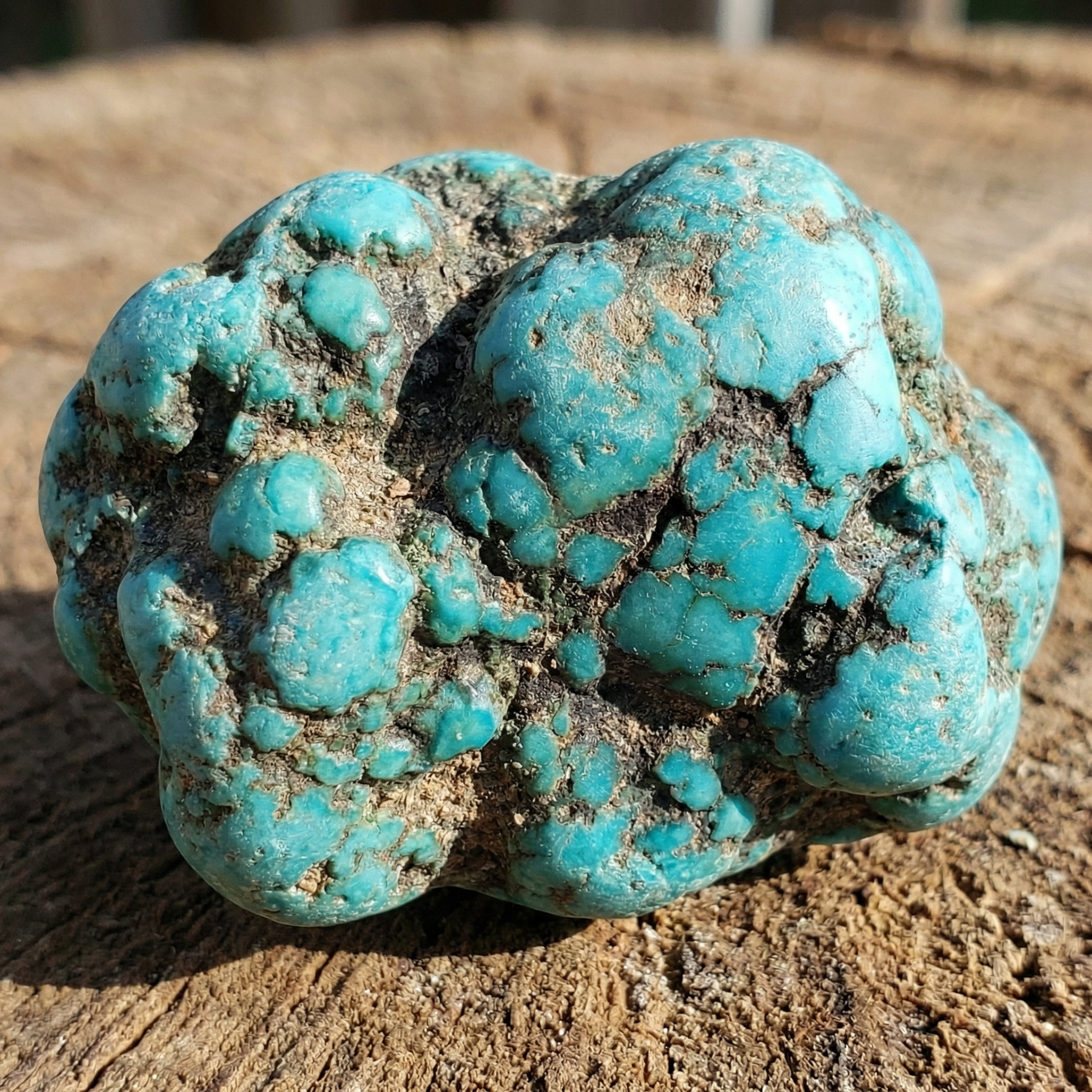
Turquoise is a hydrated phosphate of copper and aluminum, valued for its characteristic, intensely blue-green color, often occurring as reniform aggregates or veins.
Properties
- Mohs hardness
- 5-6
- Luster
- Woskowy do matowego
- Streak
- Pale greenish blue to white
- Density
- 2.6
- Cleavage
- on {001}, good on {010}
- Fracture
- Muszlowy do nierównego
- Transparency
- Transparent,Translucent,Opaque
- Crystal system
- Triclinic
Diagnostic features
## Identification Turquoise is primarily recognizable by its characteristic blue-green color. It usually occurs in compact, reniform, botryoidal aggregates or as veins. Its luster is waxy to dull. The streak of turquoise is pale greenish-blue to white. Dark veins or spots, forming the so-called matrix, often occur in it. ## Distinguishing from Similar Minerals Turquoise is sometimes confused with chrysocolla, variscite, lazulite, or dyed howlite. Chrysocolla is usually softer and has a more vitreous luster. Variscite has similar hardness and color, but is often greener and has a different chemical composition. Lazulite is usually more violet-blue. Dyed howlite can be distinguished by its lower hardness and often more uniform, unnatural color. A streak test can help in differentiation, as turquoise leaves a light, greenish-blue streak. ## Crystal Forms Turquoise rarely forms macroscopic crystals. It most often occurs as cryptocrystalline aggregates, such as reniform, botryoidal, spherical, incrustations, coatings, or veins. Sometimes it forms small, tabular or prismatic crystals in druses or fissures, but these are very rare and usually only visible under a microscope.
Geological environment
## Genesis Turquoise is a secondary mineral, formed in weathering zones of rocks rich in aluminum, copper, and phosphorus. It forms as a result of hydrothermal processes, where aqueous solutions permeate through rocks, precipitating the mineral in fissures and voids. It most often occurs in dry, desert regions where weathering processes are intense. It typically forms in volcanic and sedimentary rocks, such as porphyries, sandstones, and shales. ## Mineral Associations Turquoise often co-occurs with other secondary minerals, such as kaolinite, limonite, quartz, chalcedony, chrysocolla, malachite, and azurite. The presence of these minerals can affect the color and appearance of turquoise, creating interesting patterns and inclusions. ## Localities The most important turquoise deposits are found in Iran (historic Persia, especially the Nishapur mine), the United States (Arizona, Nevada, New Mexico, Colorado), Egypt (Sinai), China (Hubei), Mexico, Afghanistan, Australia, and Chile. Iranian turquoise from Nishapur is historically prized for its intense, pure color.
Rarity
Common
For collectors
## Quality Criteria The most valued turquoise specimens are characterized by an intense, uniform sky-blue color, without greenish hues. The clarity of the stone is also important - absence of cracks, inclusions of other minerals (unless they form an attractive matrix), and uniform texture. Large, well-formed nuggets or specimens with a beautiful, natural matrix are particularly sought after. Specimens with high hardness and low porosity are more durable and less prone to color changes. ## Popular Localities The most prized turquoise specimens come from the historic mines in Nishapur, Iran, which are famous for turquoise of deep, pure blue. In the United States, turquoise from Arizona (e.g., Sleeping Beauty, Kingman mines) and Nevada (e.g., Lander Blue, Lone Mountain mines) is also highly valued, often due to unique matrix patterns.
Care and storage
## Cleaning Turquoise is a porous and relatively soft mineral, therefore it requires gentle cleaning. It is best to use a soft cloth and lukewarm water. A mild soap solution can be used, followed by thorough rinsing with clean water. Avoid strong water jets and brushes, which can scratch the surface. ## What to Avoid Turquoise is sensitive to many factors. Avoid contact with chemicals such as perfumes, cosmetics, detergents, acids, and bases, which can permanently alter its color. It is also sensitive to high temperatures and sudden temperature changes, which can cause cracks. Prolonged exposure to direct sunlight can lead to color fading. Due to its porosity, turquoise can absorb sweat and oils from the skin, which can also affect its color, so it is recommended to remove turquoise jewelry before bathing, household chores, or intense physical exertion. ## Storage Turquoise should be stored separately from other, harder minerals to avoid scratches. It is ideal to wrap it in a soft cloth or store it in a separate compartment in a jewelry box. Avoid areas of high humidity or dryness, as well as extreme temperatures.