Tobermorite
Chemical formula: Ca<sub>5</sub>Si<sub>6</sub>O<sub>16</sub>(OH)<sub>2</sub>·nH<sub>2</sub>O
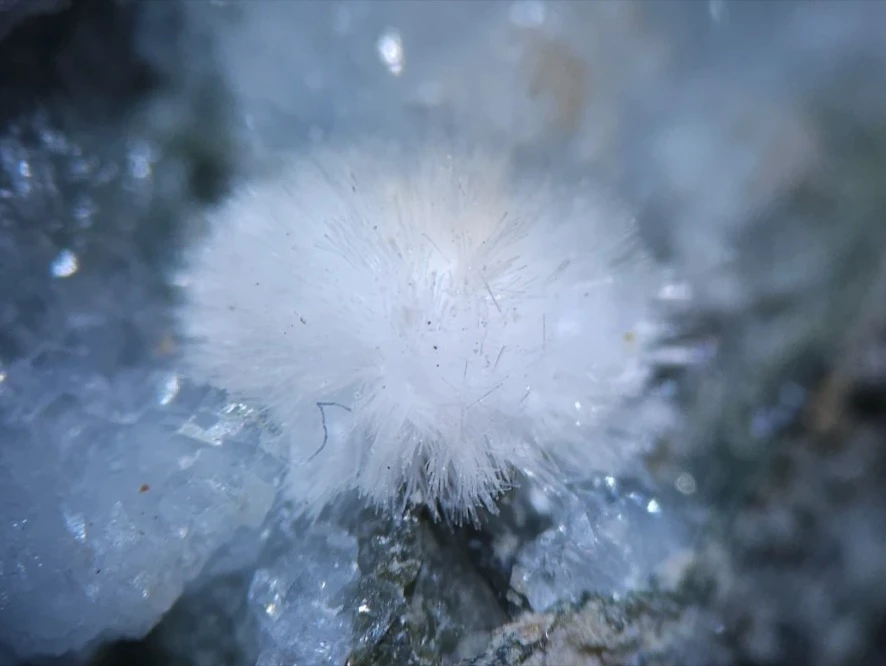
Tobermorite is a hydrated calcium silicate, typically forming small, white or pinkish crystals, often occurring as fibrous or platy aggregates.
Properties
- Mohs hardness
- 2.5
- Luster
- Szklisty do perłowego
- Streak
- Biała
- Density
- 2.423
- Cleavage
- Perfect on {001}, imperfect on {100}.
- Fracture
- Nierówny
- Transparency
- Transparent,Translucent
- Crystal system
- Monoclinic
Diagnostic features
## Identification Tobermorite can be identified by its characteristic small, platy or fibrous aggregates, often white or light pink in color. Its low hardness (2.5 on the Mohs scale) and vitreous to pearly luster are also helpful. Occurrence in a hydrothermal environment or in altered calcareous rocks may also indicate this mineral. ## Distinguishing from Similar Minerals Tobermorite can be confused with other hydrated calcium silicates, such as calcite, zeolites, or other minerals of the tobermorite group. It differs from calcite by the absence of a strong conchoidal fracture and a different reaction to hydrochloric acid (calcite reacts strongly, tobermorite does not). It can be distinguished from zeolites based on chemical analysis or more detailed optical studies. ## Crystal Forms Tobermorite crystals are typically very small, platy, or acicular. They often form fibrous, radial, spherical, or compact aggregates. Well-formed, single macroscopic crystals are rare.
Geological environment
## Genesis Tobermorite forms in hydrothermal environments, typically in altered calcareous rocks, skarns, and in calcite veins. It is also an important component of Portland cement hydration products, where it forms as a result of the reaction of calcium silicates with water. ## Mineral Associations Tobermorite often co-occurs with calcite, zeolites (such as chabazite, stilbite), apophyllite, prehnite, and other hydrated calcium silicates. In artificial environments, it is associated with cement phases. ## Localities Known localities for tobermorite include the Isle of Mull in Scotland (type locality), Crestmore in California (USA), Italy (near Rome), Japan, and Russia (Kola Peninsula).
Rarity
Uncommon
For collectors
## Quality Criteria The most prized tobermorite specimens are those that display well-formed, aesthetic crystal aggregates, especially in the form of radial aggregates. A pure, white or delicately pink color and the absence of mechanical damage also increase the value of the specimen. Larger, clearly visible aggregates are more sought after by collectors. ## Popular Localities The most valued tobermorite specimens come from the type locality on the Isle of Mull in Scotland and from Crestmore in California, where aesthetic aggregates of this mineral have been found.
Care and storage
## Cleaning Tobermorite is a relatively soft mineral, so it requires gentle cleaning. It is best to use a soft brush and lukewarm water. Distilled water can also be used to avoid mineral deposits from hard water. ## What to Avoid Avoid using strong chemicals, acids, and bases, which can damage the mineral's surface. Due to its softness, specimens should be protected from scratches. Prolonged exposure to direct sunlight can lead to fading of delicate colors. Also, avoid sudden temperature changes. ## Storage Tobermorite specimens are best stored in separate, soft-lined containers or display cases to prevent mechanical damage. Maintaining stable temperature and humidity is important to prevent mineral degradation.