Strontianite
Chemical formula: Sr(CO₃)
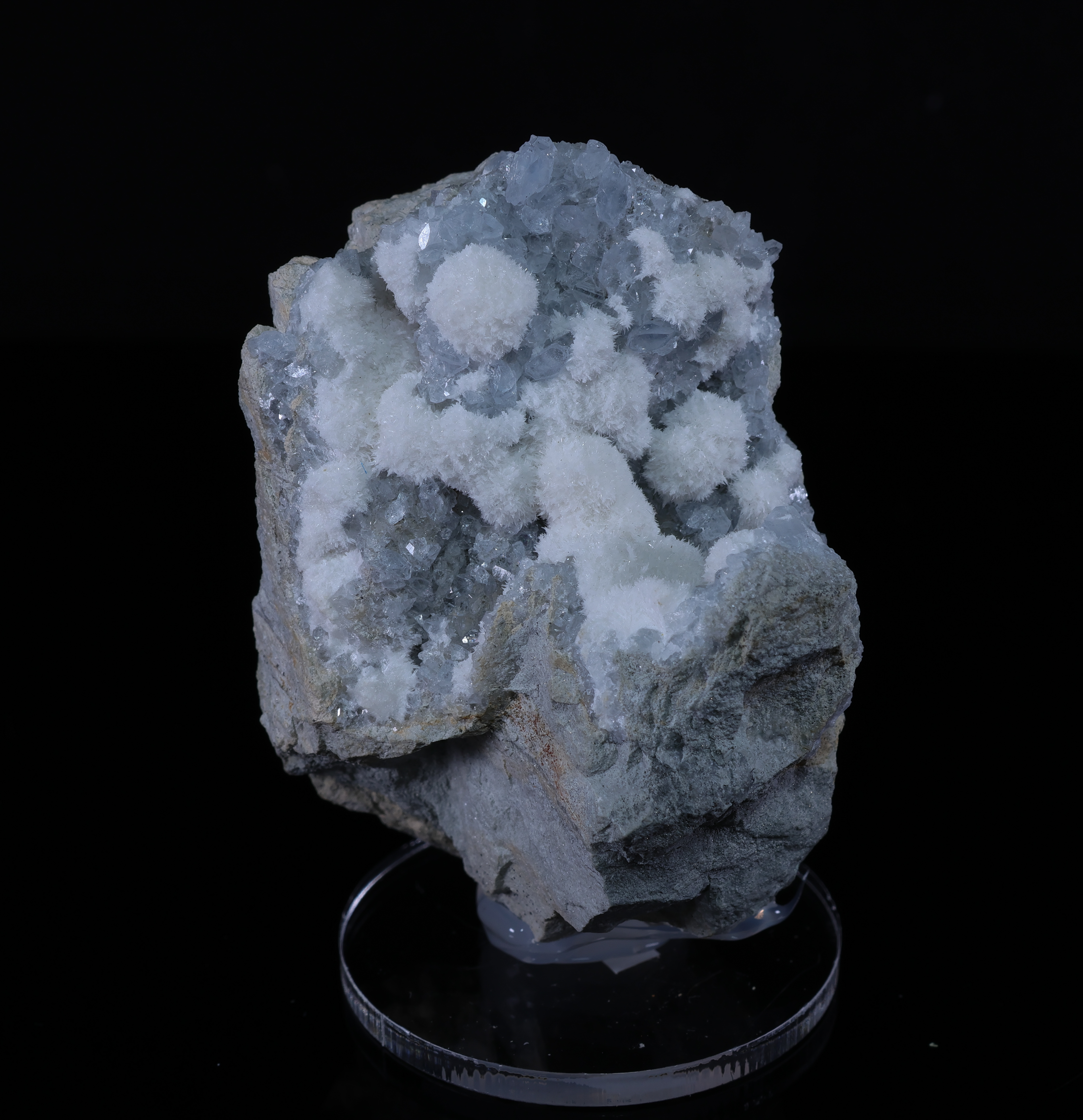
Strontianite is a carbonate mineral, specifically strontium carbonate, often occurring in acicular or radial aggregates.
Properties
- Mohs hardness
- 3.5
- Luster
- Szklisty do żywicznego
- Streak
- White
- Density
- 3.74
- Cleavage
- On {110} nearly perfect; on {021} poor; on {010} in traces.
- Fracture
- Nierówny do muszlowego
- Transparency
- Transparent,Translucent
- Crystal system
- Orthorhombic
Diagnostic features
## Identification Strontianite can be identified by its characteristic acicular or radial aggregates, often forming spherical concretions. Its hardness (3.5 on the Mohs scale) and reaction with acids (emission of carbon dioxide) are also helpful. Vitreous to resinous luster and a white streak are additional diagnostic features. ## Distinguishing from Similar Minerals Strontianite can be confused with aragonite, which is also a carbonate and crystallizes in the orthorhombic system, forming similar shapes. However, strontianite is heavier (density 3.74 g/cm³ compared to 2.95 g/cm³ for aragonite) and often exhibits a characteristic red flame color during a pyrochemistry test (due to the presence of strontium). ## Crystal Forms Strontianite crystals are usually columnar, prismatic, or acicular, often with distinct striations. It also occurs in compact, granular, fibrous, or spherical aggregates.
Geological environment
## Genesis Strontianite primarily forms in low-temperature hydrothermal veins, often in limestones, marls, and other sedimentary rocks. It can also occur in the oxidation zones of barite and celestine deposits as a secondary product. ## Mineral Associations Strontianite often co-occurs with other carbonate minerals, such as calcite and aragonite, as well as with barite, celestine, gypsum, fluorite, and sulfide minerals. ## Localities Known strontianite localities include Strontian in Scotland (type locality), Westphalia in Germany, Cave-in-Rock in Illinois (USA), near Faringdon in England, and various locations in Canada and Mexico.
Rarity
Not very common
For collectors
## Quality Criteria The most prized strontianite specimens are those with well-formed, transparent crystals of intense color (if present) and distinct form. Large, aesthetic acicular aggregates or spherical concretions on matrix are also highly sought after. Purity and absence of mechanical damage are key factors influencing collectible value. ## Popular Localities Specimens from the historic locality in Strontian, Scotland, are highly valued due to their historical significance. Other popular localities include Westphalia, Germany, known for well-formed crystals, and Cave-in-Rock, Illinois (USA), where aesthetic concretions occur.
Care and storage
## Cleaning Strontianite is a relatively soft mineral, so it requires gentle cleaning. It is best to use a soft brush or a cotton cloth moistened with distilled water. Avoid vigorous rubbing, which could scratch the mineral's surface. ## What to Avoid Strontianite should not be exposed to acids, as it is a carbonate and reacts with them, which can lead to damage to the specimen. Also, avoid sudden temperature changes and prolonged exposure to direct sunlight, which can affect its color. The mineral is brittle, so it should be protected from impacts. ## Storage Strontianite is best stored in a closed display case or box to protect it from dust and mechanical damage. Due to its brittleness, it should be provided with stable support to prevent the specimen from tipping over. A dry and stable environment, away from heat and moisture sources, is ideal.