Spodumene
Chemical formula: LiAlSi<sub>2</sub>O<sub>6</sub>
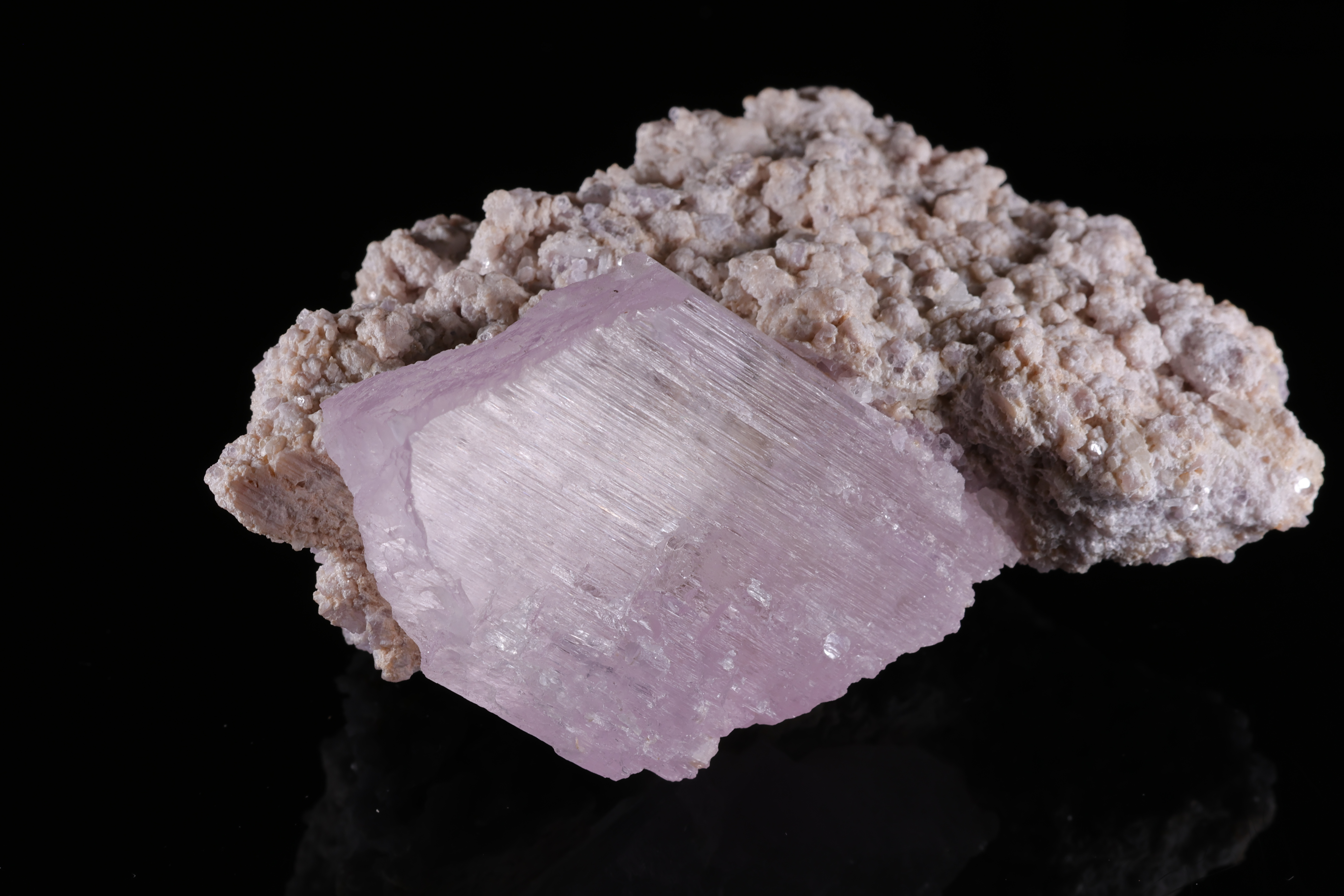
Spodumene is a mineral from the silicate group, valued for its transparent gem varieties such as kunzite and hiddenite.
Properties
- Mohs hardness
- 6.5-7
- Luster
- Vitreous
- Streak
- White
- Density
- 3.1
- Cleavage
- (110), (110) ^ <mi>(1_10)</mi> ~87
- Transparency
- Transparent,Translucent
- Crystal system
- Monoclinic
Diagnostic features
## Identification Spodumene can be identified by its characteristic columnar habit, often with visible striations parallel to the long axis of the crystal. A hardness of 6.5-7 on the Mohs scale and a vitreous luster are also helpful in identification. Occurrence in lithium pegmatites is a strong indicator. ## Distinguishing from Similar Minerals Spodumene can be confused with orthoclase, beryl, or topaz. It differs from orthoclase by its greater hardness and different cleavage. It differs from beryl and topaz by its density and often more elongated crystal habit. In the case of colored varieties, kunzite and hiddenite are recognizable by their specific color shades. ## Crystal Forms Spodumene most often forms elongated, prismatic crystals, often with a square or rectangular cross-section. Crystals can be striated along the long axis. It can occur as granular or lamellar aggregates.
Geological environment
## Genesis Spodumene primarily forms in lithium pegmatites, which are igneous rocks with a high lithium content. It forms in the final stages of magma crystallization, under conditions of high temperature and pressure, often in the presence of hydrothermal solutions. ## Mineral Associations Spodumene often co-occurs with other pegmatitic minerals, such as quartz, albite, muscovite, lepidolite, tourmaline, beryl, and lithium minerals like petalite and amblygonite. ## Localities Known spodumene deposits are found in many places around the world. Important localities include Brazil (Minas Gerais), Afghanistan (Nuristan), Pakistan (Gilgit-Baltistan), United States (North Carolina, California, South Dakota), Canada (Manitoba), Australia (Western Australia), and Madagascar.
Rarity
Very Common
For collectors
## Quality Criteria The most prized spodumene specimens are those with distinct, well-formed crystals, with intense and uniform color, especially in the case of kunzite and hiddenite varieties. Transparency, lack of inclusions, and mechanical damage also affect collectible value. Large, complete crystals are particularly sought after. ## Popular Localities The most prized spodumene specimens, especially kunzite and hiddenite, come from Brazil, Afghanistan, Pakistan, and Madagascar. These regions are famous for producing large, clear, and beautifully colored crystals.
Care and storage
## Cleaning Spodumene can be cleaned with a soft cloth or brush and lukewarm water with mild soap. Avoid strong streams of water, which could damage delicate crystals. ## What to Avoid The mineral is sensitive to sudden temperature changes, which can lead to cracks. It should not be exposed to strong acids and bases. Colored varieties, especially kunzite, may fade with prolonged exposure to sunlight. ## Storage Spodumene specimens are best stored in a dark place, away from direct sunlight and heat sources. It is recommended to place them in separate, softly lined containers to prevent scratching by harder minerals.