Sodalite
Chemical formula: Na<sub>4</sub>Si<sub>3</sub>Al<sub>3</sub>O<sub>12</sub>Cl
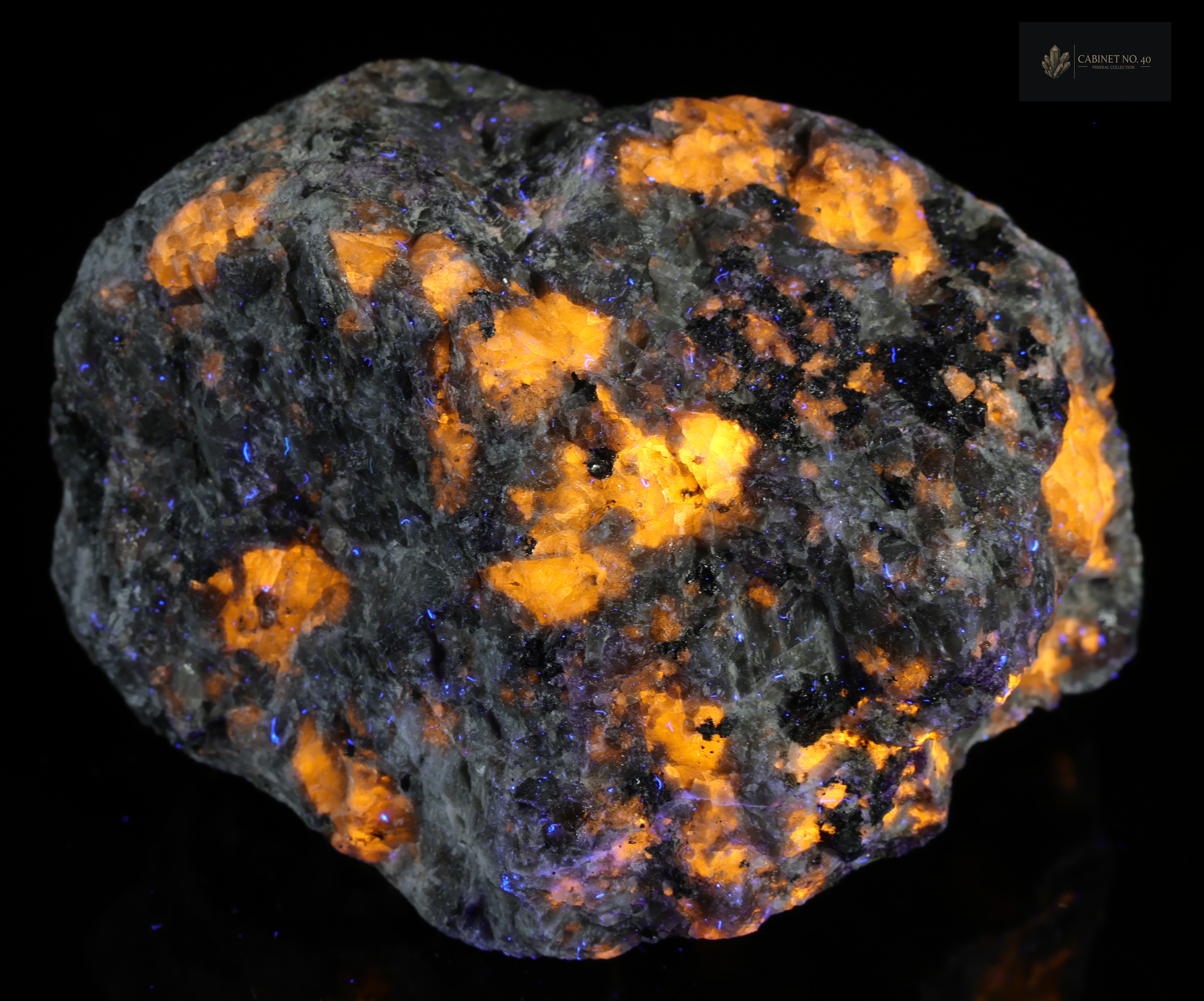
Sodalite is a mineral from the silicate group, valued for its intense, often blue colors, as well as for its ability to fluoresce and exhibit tenebrescence in some varieties.
Properties
- Mohs hardness
- 5.5-6
- Luster
- Szklisty do tłustego
- Streak
- White
- Density
- 2.27
- Cleavage
- Poor on {110}
- Transparency
- Transparent,Translucent
- Crystal system
- Isometric
Diagnostic features
## Identification Sodalite can be identified by its characteristic, often intensely blue color, vitreous or greasy luster, and white streak. It often occurs as massive or granular aggregates. Many sodalite specimens, especially the hackmanite variety, exhibit fluorescence under UV light, which is an important diagnostic feature. ## Distinguishing from Similar Minerals Sodalite is often confused with lazurite, to which it is related. The main difference is the absence of pyrite in sodalite, which is often present in lazurite. Sodalite is also harder than lazurite. Another similar mineral is dumortierite, which, however, has a fibrous habit and is harder. Lapis lazuli is a rock in which sodalite is one of the main components. ## Crystal Forms Sodalite most often occurs as massive, granular, or compact aggregates. Less frequently, it forms well-developed crystals, which usually have the form of rhombic dodecahedra or hexahedra. Crystals are usually small and embedded in the rock.
Geological environment
## Genesis Sodalite forms in alkaline, silica-poor igneous rocks, such as nepheline syenites, phonolites, and trachytes. It crystallizes in the late stages of magma crystallization. It can also occur in metamorphic rocks that have undergone sodic metasomatism. ## Mineral Associations Sodalite often co-occurs with other alkaline minerals, such as nepheline, albite, microcline, aegirine, arfvedsonite, and with minerals from the garnet group, e.g., andradite. It can also be found in association with calcite and biotite. ## Localities Known sodalite deposits are found in many places around the world. The most important include: Kola Peninsula in Russia, Ilimaussaq in Greenland, Bancroft in Ontario (Canada), Litchfield in Maine (USA), Fichtelgebirge in Germany, as well as Brazil, Namibia, and Afghanistan.
Rarity
Common
For collectors
## Quality Criteria The most prized sodalite specimens are those with intense, uniform color, without visible inclusions of other minerals. Large, well-formed crystals are rare and highly sought after. Varieties exhibiting strong fluorescence or distinct tenebrescence (e.g., hackmanite) are particularly valuable to collectors. Clarity and absence of cracks also affect the value of the specimen. ## Popular Localities The most valued sodalite localities are those from which specimens of exceptional color and optical properties originate. Canadian deposits in Bancroft are known for beautiful blue sodalites. Greenland and the Kola Peninsula provide high-quality specimens, including tenebrescent varieties.
Care and storage
## Cleaning Sodalite can be cleaned with a soft brush and lukewarm water with mild soap. Avoid strong detergents and abrasive cleaners, which can scratch the mineral's surface. ## What to Avoid Sodalite is sensitive to acids, which can damage it. Prolonged exposure to direct sunlight should also be avoided, especially for tenebrescent varieties, which may lose their color. Temperature changes can also negatively affect the mineral. ## Storage Sodalite specimens are best stored in a dry place, away from direct sunlight and heat sources. It is advisable to place them in closed display cases or boxes to protect them from dust and mechanical damage. Tenebrescent varieties should be stored in darkness to preserve their ability to change color.